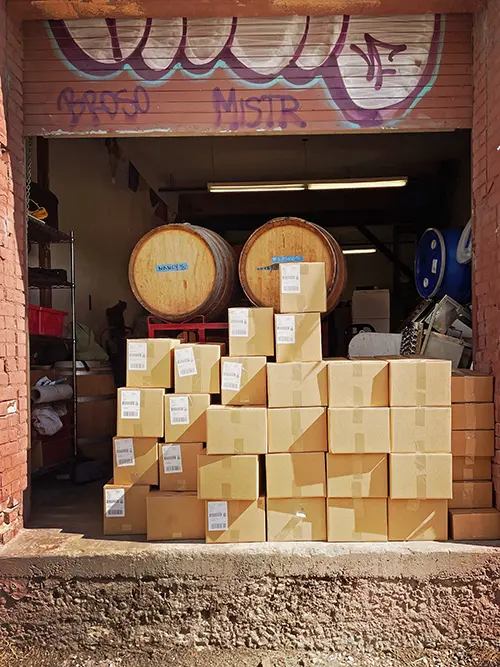
A reflection on Classicism, occasioned by the bottling of two Autumnal red wines
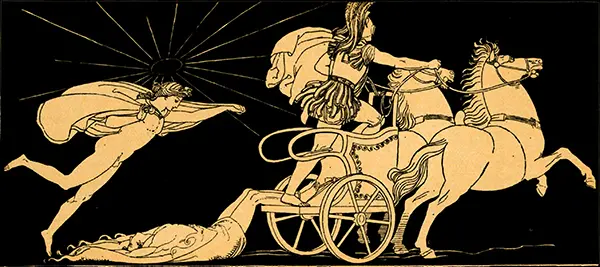
Hector Tamer of Horses and Pergamos
CLASSICISM
And two Autumnal red wines that exemplify it.
The first of two missives.
I have been thinking about this topic for a long time, and I have a diptych of reflections in mind. This is just something of a preview. The diptych is on two related topics: 1) Classicism in Wine, and 2) What it means to talk about Energy in Natural Wines. The second is a much more difficult topic, both to ponder and to articulate. Let me say a word on the second subject, and then turn to Classicism. And at the end of the reflections, you will hear about the two very Classical Autumnal wines.

You could say that I have been engaged in an interesting battle with so-called Natural Wines for a few years. As a drinker, a consumer, I became very impatient with them around the beginning of the pandemic, as the term became associated with what looked like the future of the wine industry. It turned out that I enjoyed drinking very few of the wines that earned this rubric, and became especially impatient with the sea of partially fermented wines appearing in clear bottles, sealed with crown caps. "Chilled Reds" also held very little attraction for me, in general.
At the same time, I thought that there were real beacons in this kind of winemaking, people who made wine that shouted "natural," but still made wines that were beautiful, serious, and intriguing. Preeminent in this respect were and are the wines of Gut Oggau.
There was a habit at the time, within the world of Natural Wine, to praise wines for "energy." I found this term annoying for its vagueness and the frequent vapidity of its uses. Yet, there were certain wines that, when you tasted or drank them, undeniably had a sense of energy in the mouth. Sometimes I even thought that you could feel them flowing through your flesh or even in your bones. So some wines far outstripped the vapidity of the term. And when I encountered them, I noticed that they were almost always on the natural side. For instance— some of the wines of Gut Oggau, some of the wines of Ganevat, and Hiyu,
This is where I want these reflections to end today. I will return to this question in a much deeper investigation later this Autumn. Composed perhaps on a long train ride. For today, I want to concentrate on a preliminary investigation of Classicism in wine.
What is Classicism in Wine?
By "Classicism," I mean wines that have a certain shape, taste profile, presentation. I am not defining the term rigorously, and would rather point to certain wines that exemplify it.
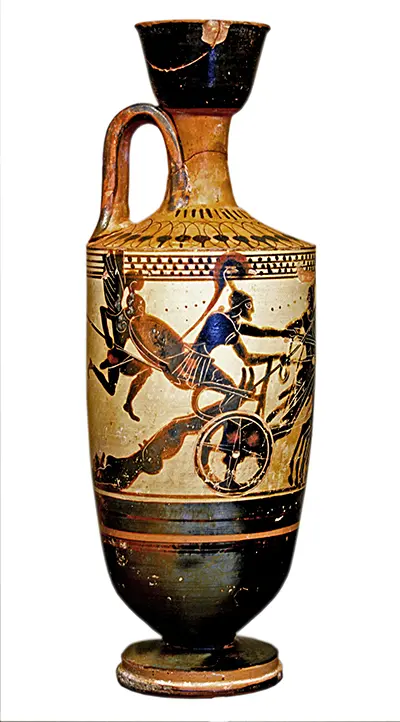
But let's start outside of wine. Pictured is an Ancient Greek olive oil pitcher, a λήκυθος, lekythos, from about 490 BCE. It is not exactly classical. It is too rustic, too primitive. Yet we can see its form pointing toward something: clarity, grace, balance. There are wines like this that I admire and enjoy very much: somewhat rustic, not utterly polished, but still graceful, clear, balanced.
The scene depicted on the pitcher is legible: we can see figures, in armor, a chariot, a horse. It is Achilles, dragging the corpse of Hector, from the end of the Iliad. Legibility is somehow essential to Classicism, or at least, clarity. The classical is somehow always clear, not confusing.
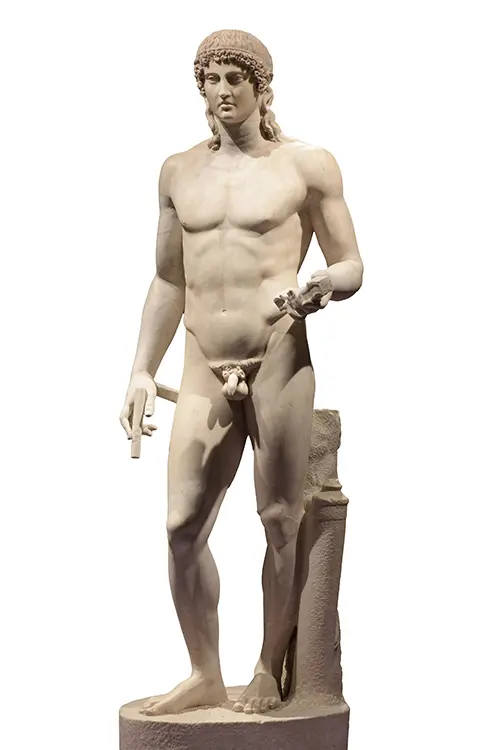
Now look at the statue, a Roman copy of a Greek statue from about 450 BCE. It's a statue of Apollo, based on an original by Phidias; now in the Capitoline museum. It is the epitome of the Classical for me. Clarity, balance, grace. But also: One can see, even without anything nearby to compare it to, that it towers. There is something both in the stance of the figure and the mere proportions of the physical object that give it grandeur. This is an essential element of Classicism: there is not only grace, proportion, balance— but there is always at least a suggestion of grandeur.
It is also no accident that this is a copy of an original: there is something about the clarity, the intelligible regularity, of the Classical that makes it both inviting and easy to knock off.
The red wines of Bordeaux are perfect examples of Classicism in wine, as are the Napa Cabernets that emulate them. These can, in some ways, be like the Roman copies of Greek statues. This is meant as analysis, not criticism: both wines are devoted to similar ideas of balance, proportion, grace, and a degree of grandeur. The form of the Bordeaux bottle that they share is not accident. The bottle-shape states clearly that this wine is in the family of Apollo above. Note that when a winery wants to make a claim for extra grandeur in its wine, it increases the span of the shoulders of the bottle slightly, to make its silhouette even more like that of the Greek god.
It is worth considering from the start that Classicism is no guarantee of quality, neither in statues nor in wine: one can make industrial wines with clarity, balance, regularity— perhaps even grace. It is not hard to make wines that are Classical but uninspired. You can see now that I don't mean "Classicism" as a simple term of praise: it is more like a tool for classification, elucidation. A hermeneutic device.
Classicism is not simply about proportion and the suggestion of grandeur. Aristotle makes an interesting point about beauty: he says that once a statue reaches a certain size, it can no longer be beautiful, no matter what its proportions [Poetics VII 1451a1]. There is a similar principle in wine. If you know anything of the Napa wines of the 1990s and 2000s, you can see how the wines could start within an utterly Classical framework— and then exceed it, break out of it, by losing proportion, moderation, presenting exaggerated features. Or perhaps just by turning up the volume too loud. It stops being chamber music at a certain volume, even if everything else is kept the same. Classicism in wine is the same: size and power, not just balance and proportion, are determining factors.
Three necessary elements in making Classical Wine
We have the beginning of an understanding of the form of Classical Wine. Now I want to spend a moment examining what kind of decisions you might have to make to bring about this form. Or let me put it another way: it is very hard to say how you bring about balance and proportion in wine, to say nothing of grace and inspiration. But it is not so hard to point to three necessities that lay the foundation for the possibility of Classicism.
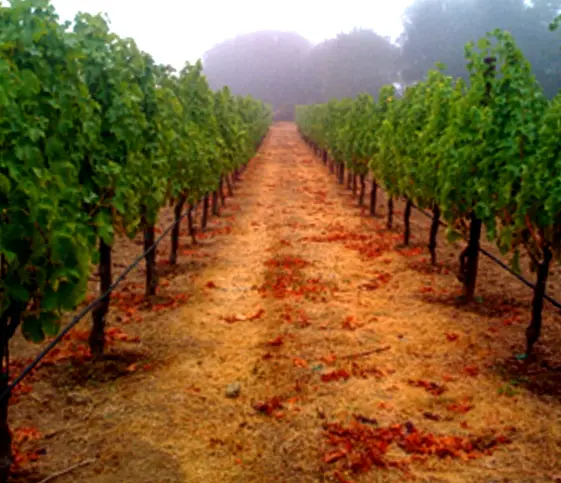
1. The vineyard itself should be Classical
This is perhaps the least obvious condition. What I mean by this is: our deeply beautiful old-vine, own-rooted, head-trained, dry-farmed vines of Southern California can make deeply beautiful wines— but it is difficult for them to make Classical Wines.
In order to make a wine of clarity, balance, and regularity, you must start with a vineyard with the same qualities. The easiest way to achieve this is with a vineyard of conventionally trellised vines, planted in rows and supported, regulated, by posts and wires. In this way, the clusters are similarly, perhaps even equally, exposed to air and sunlight; the crop load and vigor of the vines and the leaf cover can easily be not only regulated, but homogenized. There is less wildness in the fruit, less variation. There will also typically be more uniformity in the microbiology of the vines, the leaves, the fruit. This in turn can lead to less unpredictability in the winery, more regularity, even a kind of docility in the fruit.
The key thing is not the presence of the trellis or the choice of a certain training scheme. The key is the achievement of a regularity that strives for homogeneity, no matter what the specific means.
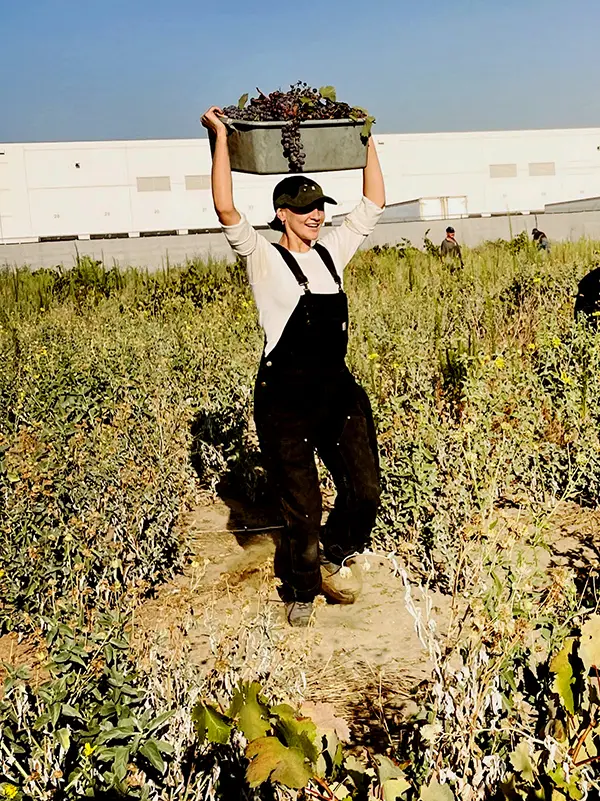
Nate Ready of Hiyu once said to me, pointing to our old vine Palomino vineyard: "you can't make classical wines from those vines. You need a classical grape variety and you need a trellis and rows." He then added with a smile: "It's not all about what happens in the winery." His carefully tended estate vineyard has rows, and traces of a trellis, but the vines are sprawling, with many different varieties planted next to each other in the same blocks. He would be taken aback by the accusation of regularity.
The vineyard photo at the top of this section is of Farina, on Sonoma Mountain, the source of the Prince and La Severità until 2020, taken near dawn in 2018. The second photo is of Maglite, a 17-acre nearly abandoned vineyard 35 miles east of Los Angeles, harvest 2023.
Let me look ahead to a very important counter-example: Lone Wolf. Raj regularly makes wines of magical beauty from this most wild of vineyards, and this year, following Raj's example, we might have accomplished the same thing. This leads to the next two considerations.
2. The use of stems in the fermentations must be carefully considered.
Note that when we turn to winemaking, the first question is not about the role of cultured vs. wild yeasts, or about the use of SO2. I am living and working with a fantastic exemplar of why these heated questions are not in fact crucial: my colleague Kaeley's Widow Black wines, made from Merlot from the Black vineyard in Coombsville in Napa.
These wines are made pretty much without SO2, and, more importantly, are fermented spontaneously by the same motley crew of feral microbes that ferment everything else in the winery— and yet the wines are not just clean and precise but beautifully classical. In the modest confines of our winery, they tower like some paradigmatic statue of Diana in the Louvre.
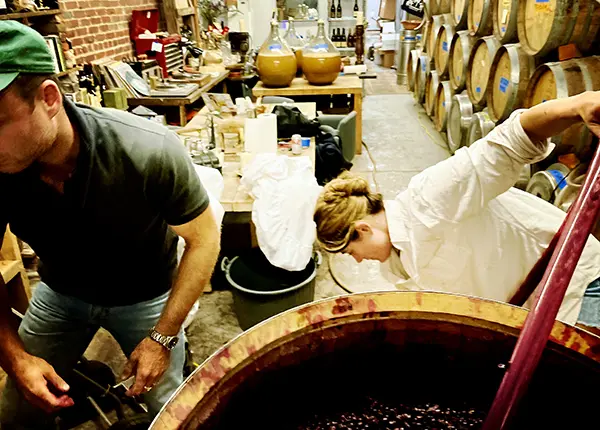
If you look in the puncheon in the photo, you will see dark purple berries, slightly collapsed by the activity of fermentation. This is the 2024 Widow Black, carefully tended by Kaeley and Matthew. The fruit in the puncheon was destemmed gently at Raj's winery, with little or no breakage, and then trucked down to LA.
What I have learned, 27 or so years into my career as a winemaker, is that there is no decision more crucial to the formation of skin-fermented wines than the decision about the stems. For several years in LA, I reveled in the notion that we de-stemmed nothing, that we did not even own a destemmer. In my last few years at Tenbrink, I was proud of the fact that some years, we never even took the destemmer out of the shed. I felt a kind of philosophical commitment to not separating the fruit from the stems— as if it were unnatural, or at least, wasteful— that destemming was somehow a rejection of the whole product of the plant.
The decision was not about "stemminess", not about woodiness or sappiness or any other flavor element; it was not even about tannin or structure or texture. It was an aesthetic decision about how I wanted to work— not about the result of the work.

And, once we started work in Los Angeles, we made wild wines in this way. It felt perfect. And in a certain sense, we were absolutely right— in a certain sense, the truest presentation of these crazy vineyards must include the stems. The wildness the stems produce is true to the vineyards themselves; destemming is not a simple discarding, but some kind of excision or dissection or disruption. And it is not just about the woody material of the stem itself: we are just beginning to learn that stems have their own microbiomes, distinct from the microbial populations of the berries and the leaves. Destemming is thus not just about the wood in the fermentation, it is about changing the microbial makeup of the system. The wildness of our Los Angeles wines flows directly from the vineyard, riding in on not just on the fruit but on the stems.
Destemming is thus a a kind of editing, but not necessarily a pure loss. I have seen that it is essential to the character of Kaeley's Merlot. And perhaps to Lone Wolf too: we see this in Raj's beautiful versions of Lone Wolf— always 100% destemmed. For this reason, we got our own little destemmer last year, a gift from a friend. But we did not use it. I was not quite ready.
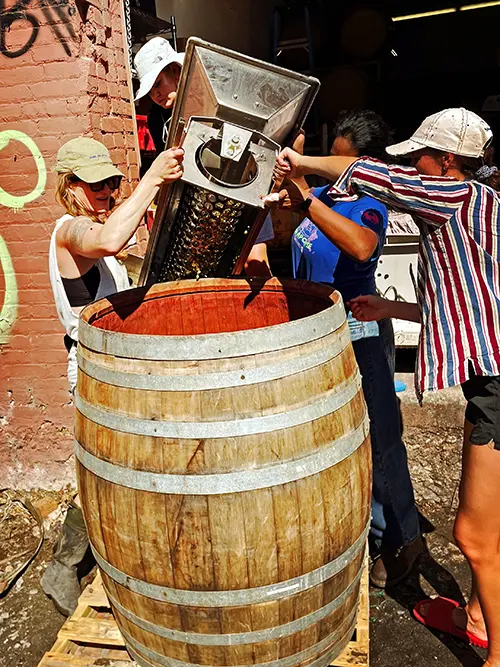
This year, overwhelmed by the beauty of Raj's and Kaeley's wines, we got it out for Lone Wolf.
We destemmed about 90% of the Lone Wolf clusters. In the next photo, you can see how crazy the clusters are: long, stringy, with tiny berries of many different colors at once. You can imagine how different the resulting wine would be without all of this fibrous, woody, material in the fermentation.
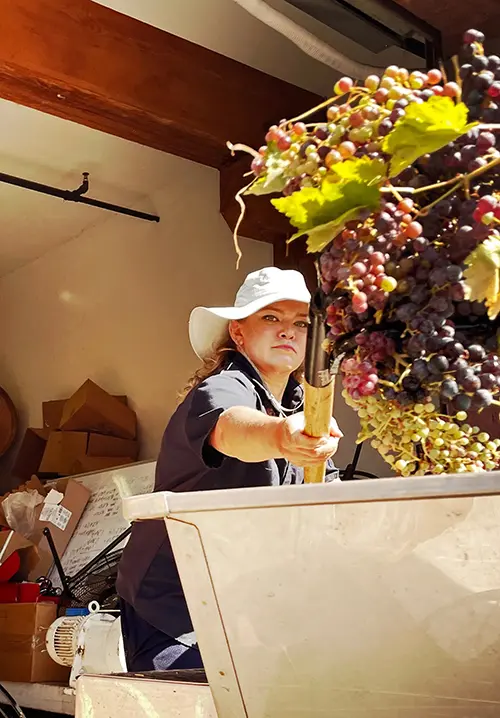
And indeed, the wine this year is clean and clear and beautiful; limpid, legible, calm. Nothing else is changed. It seems that in this case, the stems of Lone Wolf make the wine too wild— they obscure the wine, not support it. You could not say that the destemmed 2026 wine is Classical— more like the oil pitcher above, beautiful but still somewhat rough and primitive.
3. You must keep the barrels full.
This is perhaps the most obvious condition for Classicism, but it is still worth making explicit, and then investigating at least a little.
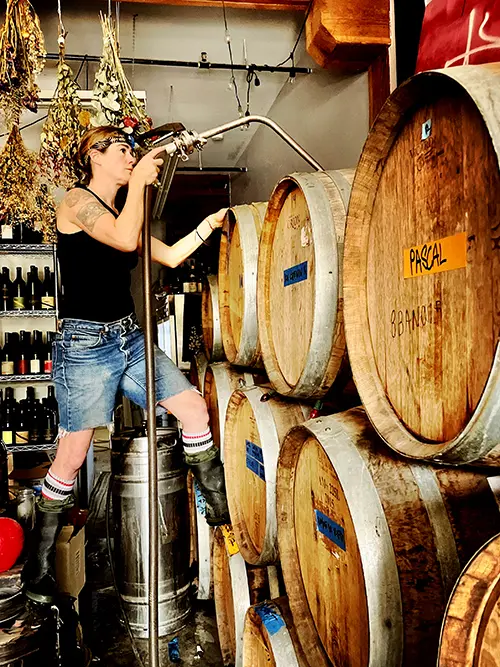
Very early on in my winemaking, I decided that I did not have to top regularly. Instead, over the course of a few years of experimentation, I decided that, in almost every case, I would use wooden barrels to mature the wine, and allow the gradual evaporation of wine in barrel to proceed unhindered. The result of this would be the replacement of wine in the barrel with air, with oxygen gradually penetrating the wine, and, in some cases, suffusing it.
This nearly universal strategy had very different effects depending on the wine. Babylon— made from high-tannin, high-acid, Petite Sirah, was hardly affected, and, except for its rather loud volume, was always a classical wine. The oxygen, in fact, toned it down. Wines made from Chardonnay, on the other hand, soaked up the oxygen and reflected its penetration, developing all kinds of beautiful, often unexpected, secondary and tertiary characteristics. I knew early on that if I wanted to make a classical Chardonnay, I would have to suppress the oxygen: limit the amount of time spent in barrel, replace evaporated wine, perhaps use SO2.
It was an easy aesthetic decision to do none of this: to allow Babylon to achieve its classical form without any effort; to allow the Chardonnays to go in a completely different direction through exactly the same process. I considered not-topping and evaporation to be the default mode; topping was an act of interference to be avoided.
The penetration of oxygen has two effects: it feeds the microbes in the wine and allows them to reproduce and metabolize; and it combines with molecules in the wine to make new substances, with new flavors, feelings, and aromas. Both can have very strong effects on the wine. It is easy to see that suppressing the penetration of oxygen is thus a way of limiting change. The wine that comes out of fermentation goes into bottle with only subtle and gradual development, due to molecules already in the wine interacting with each other— without the introduction of new components. No new flavors and aromas are produced, no existing molecules are degraded or consumed by the microbes. This double suppression preserves a kind of linearity in the wine, a sharpness, and so is crucial for clarity and legibility. Oxygen can introduce a kind of fog or mist, can blur lines. We can see how, even long before spoilage, it can still be the enemy of Classicism. More Hieronymus Bosch, less Apollo or Diana on a pedestal.
Two Classical Wines from Napa Valley
Now I want to tell you about two wines whose winemaking has been deeply affected by these considerations. The first is a new wine.
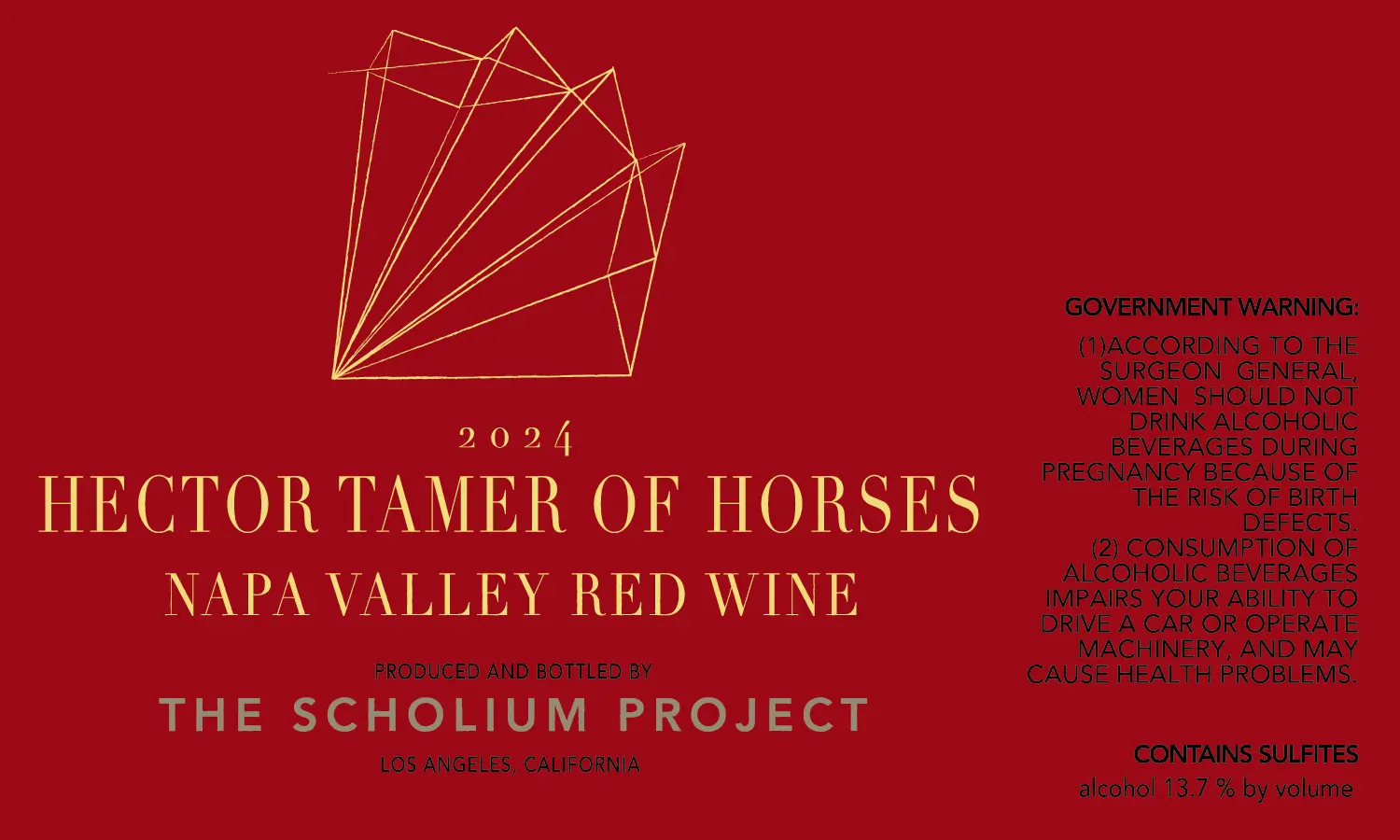
HECTOR TAMER OF HORSES The Olive Oil flask pictured above was on my mind for two reasons: Tenbrink Olio Nuovo, which we just finished bottling (and shipping! all but 5 orders have gone out), and because of the image of Achilles and Hector that the flask presents. I have been thinking about this wine for months, and, from the beginning, I associated it with Hector. I knew that it was part of what you might call a cycle of Classical Wines that I was making, and I wanted to give it a Classical name.
The wine was made from a vineyard in the Northwest corner of Napa Valley, on the benchland of the Mayacamas Mountains. It is composed of Cabernet Franc, Cabernet Sauvignon, and Merlot, in nearly equal quantities; Classical varieties, all planted in rows, on vines constrained by trellises. The fruit was all destemmed before fermentation; the barrels that it aged in were mostly new, and all kept filled.
Except: I did not want to make a Greek statue with this wine. I wanted to make something more like the lekythos, the somewhat primitive olive oil flask. More Bosch than Apollo. And so I included 14% Lopez Zinfandel, grown without trellis, fermented without destemming, aged without topping. And, at the last moment, 2% crazy 2024 Lone Wolf. I wanted a beautiful vase, but perhaps one that had been handled roughly and had a chip out of it.
Hector always seemed to me wounded from the beginning of the Iliad. He is surely the more human of the pair on the flask. And so this wine got its name, from the scene on the flask, and the more human hero depicted in it.
This human wine is the most recent installment in the project of classical recovery and return that we began last year with the three wines of the Mt. Veeder Fantasia.
Since you have read this far, I will tell you that I have set what I hope you will find is an interesting price for this wine. If you click here, you will see what it is. Reading this far gives you the first shot at it.
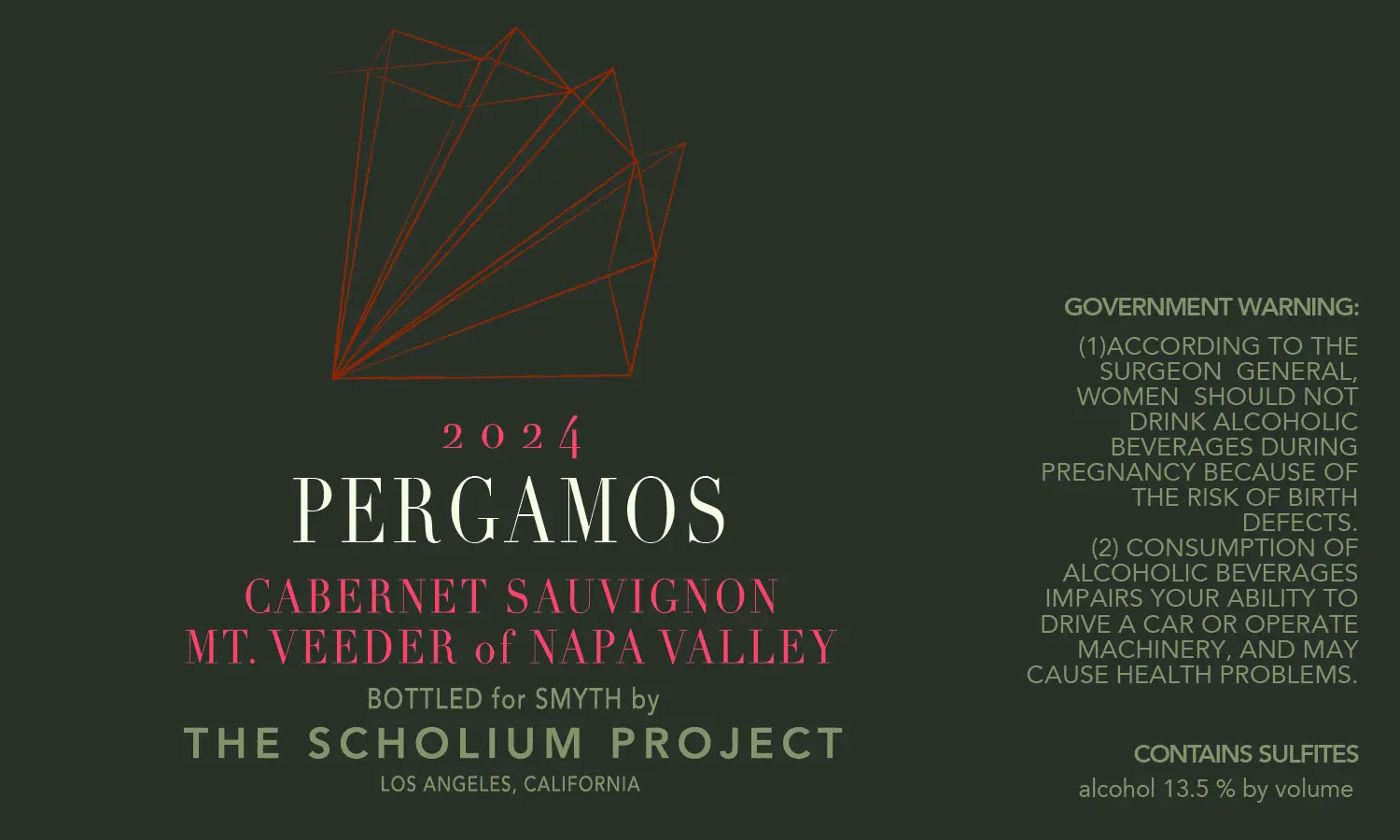
PERGAMOS Here is the statue of Apollo. Towering, grand, imposing. Classical, for sure, but so much more. This wine too is part of the recovery project, but it aims even higher: it aims at the very heights of Napa.
It is 100% Cabernet from a very carefully farmed vineyard high on Mt. Veeder, east-facing. 100% destemmed, of course. Barrels, some of them new, all of them topped assiduously. A shining example of the excellence that is possible in Napa, without conventionality or predictability. It is very exciting.
This wine is a pair with Hector, but more severe, more serious, more intense. I have decided to offer it now on the same pricing scheme as the Hector. You may go here to see what that price is.
I will write you again— perhaps tomorrow, perhaps early next week, with a quick explanation of the pricing scheme, and some other commercial considerations. You who have read this far get first crack at the wines, and the prices. I will only keep them in effect until the end of the day when I next write.
I learned yesterday that we have already sold most of the Pergamos to Smyth in Chicago. It is our great honor that it will be part of their Michelin 3-star tasting menu. We even made subtlely special labels for them.
Till soon—
Abe
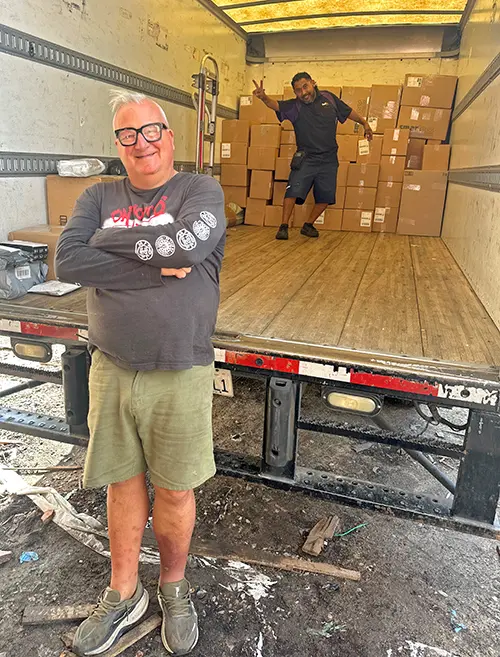
PS: It is finally Fall here. We are now digging out from harvest. Some wines we need to ship are still buried, but we will get them out soon. This what I shipped yesterday, with my colleague, Rodrigo. Step by step.