Mt. Veeder Fantasia: The Culmination
in which we announce our Mt. Veeder wines
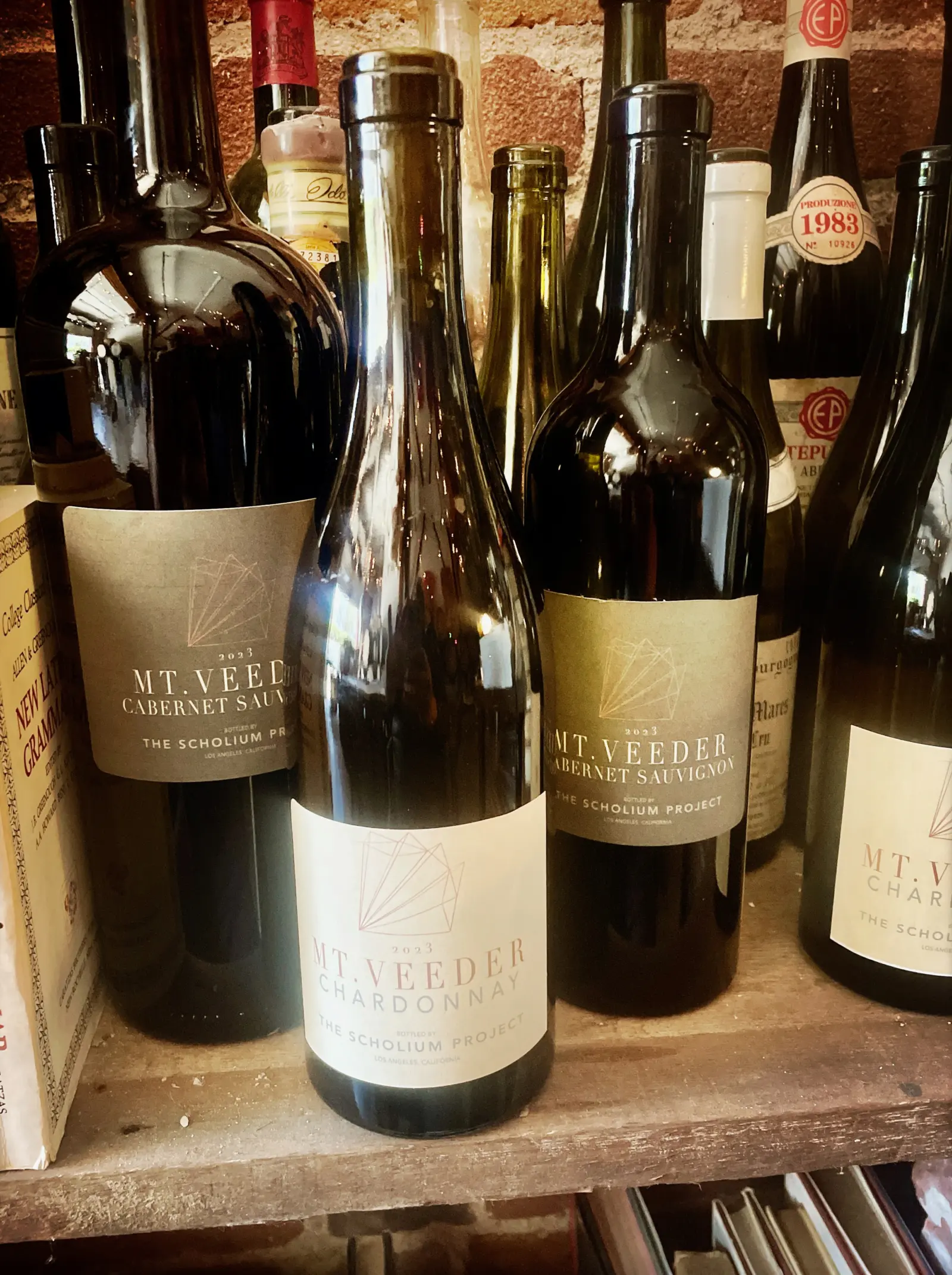
THE MT. VEEDER FANTASIA— THE CULMINATION
The WINES
I am so glad to get this to you. I hope you have enjoyed the progression thus far.
I had finished editing this and would have hit send last Wednesday afternoon, but I was afraid that the inevitable force of the maelstrom might not leave enough air in your room to consider these idiosyncratic reflections on winemaking in California. At this moment, Tuesday morning, I feel like this could be a good time to take a breath.
This is the culmination of the variations: to announce the release of our first ever wines from Mt. Veeder.
This is a great moment in the rebirth of Scholium but it is also a release, you now understand, with invisible roots stretching back decades: to my first trip ever to Napa in 1997— and long before then, before I ever dreamt of making wine— to a Christian Brother who taught me at St. John's College in 1982 and helped move his order's winery to Mt. Veeder 50 years earlier.
The two wines are both from 2023 and both are single-vineyard wines: a Mt. Veeder Chardonnay and a Mt. Veeder Cabernet. More on the wines, and on the particular role of Chardonnay, especially, on Mt. Veeder, below.
1. The Eternal Return of the Same
In this fourth and final variation, I want to explore a little further a theme that I alluded to in the third variation: the Eternal Recurrence of the Same. The phrase is is borrowed from Nietzsche; in the original German it runs:
Die Ewige Wiederkunft des Gleichen
Let’s look at what it means:
"Ewige" means "eternal;" "Wiederkunft" is sometimes translated as "recurrence." I often repeat the phrase to myself as "The eternal recurrence of the same." But "Wiederkunft" is more of a RETURN, or a COMING AGAIN, not simply a recurrence. The reason that I am insisting on this now is because of the manifold ways that these Mt. Veeder wines mark a return for me— not a mere cyclical return in time, inevitable like the setting of the sun… Instead, they mark a retracing, or a certain kind of coming home. Let me enumerate the ways:
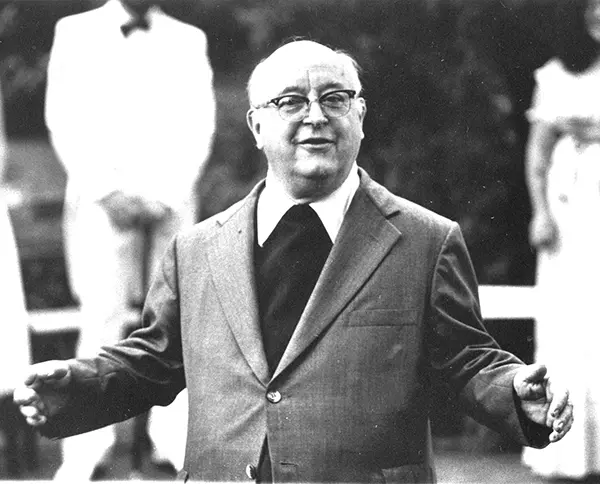
First, from Variation I: Long before I ever thought of making wine or living in Napa, I had a teacher and then a colleague who helped to establish the Christian Brothers winery on Mt. Veeder, and then lost several fingers to the crusher-destemmer as a winemaker there, before he moved on to the relative safety of college teaching: Brother Robert Smith.
I never ever thought of Brother Robert’s time at Christian Brothers making wine when I took all the steps that made me a winemaker, and this is all the more remarkable. But Brother Robert shaped my thinking in many ways— perhaps in my relation to hospitality and conviviality more than in any other way. His imprint on my life now is unmistakable, even if I had carelessly forgotten his Veeder connection until recently. It is interesting to think that I had a foundational Veeder winemaker as a teacher at St. John’s, and did not even know it.
Second, in 1997, while I was still pondering the destination for my sabbatical from St. John’s, I made the first trip in my life to Napa. It convinced me to come North and to pursue an internship in the wine industry. That trip was to one of the old vineyards on Mt. Veeder. The release of Veeder wines now seems to be a kind of inevitable return to that founding moment— an Eternal Return to the Same.
But the German phrase does not mean a return TO the same— to the same place for instance. My return to Veeder, as outlined above, is merely coincidental, or at best, sentimental. And this is not what the phrase means: It is the return, the coming home, OF the same, not to the same. And this is much more interesting.
2. The Flight from Rome
In the Variation II, I told you about my move from the vineyards of Napa to the hinterlands. I reflected on the early years of the Scholium Project, and my exploration of Suisun and the Sacramento River Delta, and cast this exploration as a flight from Rome, and, through wines like Babylon and Naucratis, as an explicit embrace of the Barbarian.
As one reviews the recent history of California winemaking, one can see this as a kind of seminal and founding moment, the beginning of a wide movement away from the conventional wines modeled on Napa, and toward novel and experimental wines made in outlying areas. This movement has now achieved a sclerotic maturity, so that now California winemaking is as much associated with with fucked-up skin-fermented wines from regions you’ve never heard of as it is with a predictable bottle of Napa Chardonnay.
One could ask, in this moment of sclerotic maturity, when the fucked-up has become conventional— what is the path of exploration? Experimentation? Where does one go to continue a path of overturning?
One goes to Napa and one makes Cabernet and Chardonnay. From Mt. Veeder.
The return to Napa is thus a return of the same: of the same unconventional, inquiring, striving, spirit that inspired The Scholium Project from the beginning.
3. The Unforeseen Tie between Veeder and Champagne
I am going to be brief here, as I speed to get you to the new wines.
After Stalham Wing planted the first grapes on Veeder, he was followed by a slew of German immigrants, who came up the Sonoma side of the mountain, on roads that they dug themselves: Hudeman, Streich, Jordan, Metz, Bauer, Barth, Hein, Benkheiser, Fisher, Gier. And they planted Riesling. The Wing Canyon ranch was known simply as Johannisberg (sic) for years. Sometimes they planted Zinfandel too, and eventually Cabernet. But the first plantings on Veeder were mostly Riesling. Veeder was understood from the beginning as a White Wine growing region.
When the behemoth Champagne house of Moët-Hennessy decided that it must make a “Napa Champagne,” it bought vineyard land on Mt. Veeder, some planted, some virgin. When they eventually established a winery on the benchland just off the valley floor in Yountville, they planted some of the surrounding land— but at the beginning, most of their fruit came from mountain vineyards. One of their best blocks was and still is a Chardonnay vineyard planted in the 1970s in Pickle Canyon, not far from Wing Canyon. Chandon still makes a single vineyard sparkling wine from this site.
I am not sure if I am more excited about the prospect of making Mt. Veeder Chardonnay or Cabernet. But I want to point out how particularly Californian it is to be able to do both.
3. The Unforeseen Tie between Veeder and Cultured Yeast
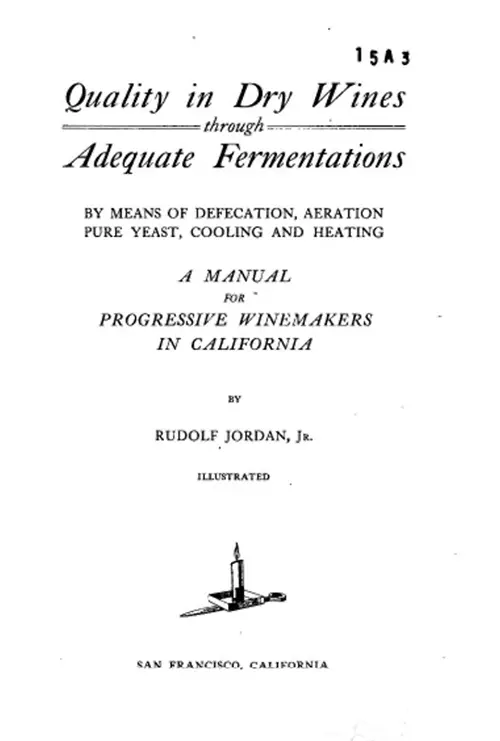
Just one more note about the history and especially culture of winemaking on Mt. Veeder. One of the very first places in the world to keep a record of experimentation with cultured yeasts is not a university in Europe, but a small winery on top of Mt. Veeder. There, Rudolf Jordan, working with the Streich family at their Castle Rock property, began publishing the results of inoculated fermentations in 1912. He also detailed their use of cold running stream water in the winery to cool fermentations! Why, one might ask, should this have happened on Mt. Veeder, in an enclave of German winemakers?
Because they were engaged in making Riesling, the best Riesling they could. The hill invites, perhaps enforces, a certain kind of winemaking… of clarity and precision.
You don't come here to make skin-fermented Orange Muscat.
3. One last Note: On Economy and Secrecy
Working on Mt. Veeder has a very high bar to entry. It certainly always has: recall the horses shot in the mud by the old-timers; the German immigrants digging their own roads so that they could plant Riesling. A winemaker on Veeder quoted me a Cabernet price of $19,000 per ton yesterday. One ton of Veeder Cabernet would cost as much as we spent on all of our grapes in Southern California last year. I am happy to say that it is not inconceivable that we will be able to pull this off next year, and probably not at this price.
One of the things that has made this vintage of Veeder wine possible (and future vintages dreamable) is the current difficult state of the wine market. You know, perhaps, that thousands of tons of California grapes went unharvested in 2023, and thousands more in 2024 (one broker listed 46,000 tons of premium California wine grapes still available on October 1 2024).
This crisis has affected every level of the wine market, even the highest levels. This, in turn, has made it possible for me, for the first time, to purchase Mt. Veeder fruit and to make Mt. Veeder wine. One condition of my 2023 purchases was not to reveal the precise sources of the fruit. This is in part so that our wine, at our price, cannot undercut the price that the owners of the vineyards want to maintain for the first wines of their vineyards.
But this is a temporary condition: I am so happy to say that there are really good consequences of the current difficulties too. Many rules are being rewritten, many new relationships forged. Beginning with 2025, we will have relationships born not out of crisis and desperation but collegiality and excitement, and our Veeder wines will bear the names of their vineyards. More soon on this. But for now, let me say that the 2023 Chardonnay is from the southern ridge of Wing Canyon. The origin of the Cabernet must remain even more mysterious.
And they are both really good.
You may purchase them here.
Thanks so much for reading so much.
Abe
The previous three variations:
- Variation I
- Variation II
- Variation III— especially don't miss this one, on the nature of Mt. Veeder
And tickets to Julia's 12 Seats on The Dream of Mt. Veeder