Mt. Veeder Fantasia: Variation 3
The past and present of the mountain
THE MT. VEEDER FANTASIA
Variation 3:
The Eternal Return of the Same
This variation is a meditation on the past and present. In fact, all four of the variations are. The subtitle of the whole Fantasia is the Eternal Return of the Same. You will see in what way this a return by time you get to the end of this missive.
1. Mt. Veeder— a rough place
I remember driving up the Silverado Trail with John Kongsgaard in 1999, on the way to a vineyard that Luna was getting Sangiovese from in Rutherford. John looked left at the unending carpet of vineyards covering the valley floor, flowing west to the hills separating Napa from Sonoma, and running very slightly uphill to the north, as far as the eye could see. He said, “This is what makes Napa special. The one place in the world that you can grow Cabernet at 7 tons to the acre and make $50 bottles of wine.” (Lopez Zin, by comparison, comes in at about a ton per acre.)
It took me a minute to digest. On some other occasion, we would return to other excellences, tucked into canyons, up on the hills. But what makes Napa Napa is the valley floor. The valley floor: the Aristotelian essence of Napa.
Mt. Veeder is the opposite of the valley floor. In a certain sense, it is not even part of Napa. It forms the western border of the valley, and of Napa county, but it is its own world. You will see why.
Let's start with geology: the valley floor is all alluvium and the alluvial deposits are complex and heterogenous. But all of them depend on the upland soils and rocks that border the valley floor, on the east and west and north. In the words of Eugene L. Begg, writing in the remarkable petition to create the Mt. Veeder AVA:
The nature and composition of each alluvial fan, terrace, or floodplain, and its associated soils, is thus a function of the geology and soils of the watershed of each stream.1
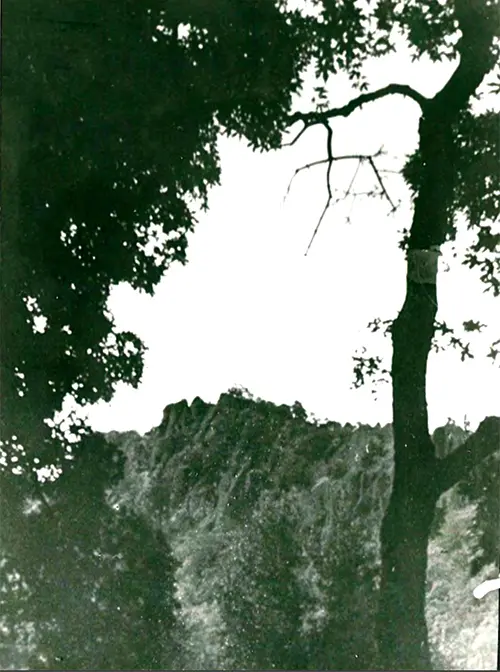
The floodplain of the valley floor depends on the surrounding hillsides, but the hillsides rise up independently of the valley floor. The hills are cause and the valley floor is their effect.
Mt. Veeder itself is the result of a combination of sedimentation and volcanic activity: sedimentary shale and sandstone were laid down, and then volcanic eruptions burst through and capped the sedimentary rocks with younger volcanic ones. Veeder itself is a volcanic caldera, with its peak at the edge of the caldera.
And then this amalgam was faulted and uplifted, resulting in sudden shifts in the landscape and even a rearranging of the sedimentary and volcanic rocks.. And because of this great diversity in soil and geology from mile to mile and meter to meter, the erosive power of rainfall caused even more differences to multiply as the rainwater flowed down the slopes, toward the valley floor, eroding one kind of soil more here and simply flowing without effect over some other impermeable rock there. The result of this, in the words of Begg, is:
… sculpturing the mountainous terrain to its present day prominent ridges and deeply incised streams. In the process of erosion and downcutting through the volcanic capping, the underlying sedimentary rocks were exhumed and subsequently weathered to form many of the upland soils of the appellation area.2
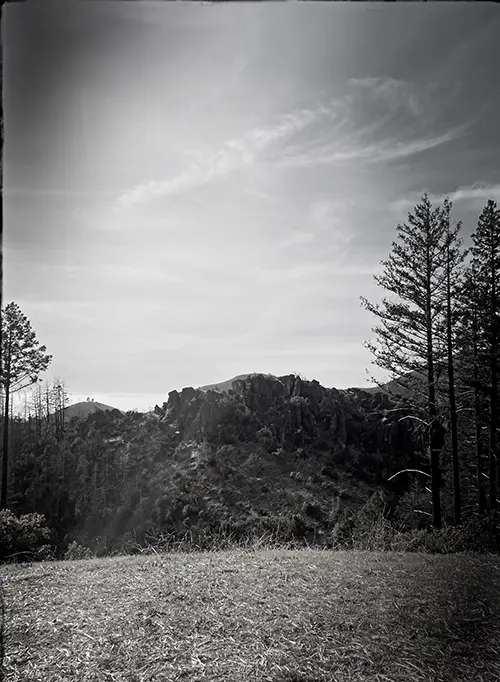
Veeder is a land of steep slopes, gorges, defiles, jagged outcroppings. There is something terrifying about it. But then are also alpine meadows and softly sloping hillsides, covered with the exhumed and weathered sedimentary rocks as soil. These are the vineyards. There is something very cinematic about all of this in spite of the fact that it is utterly natural.
Let me quote one anecdote at the intersection of geology and the lives of humans. This is from an amazing history of Mt. Veeder written as the independent study project of a Vintage High student in Napa in 1975.
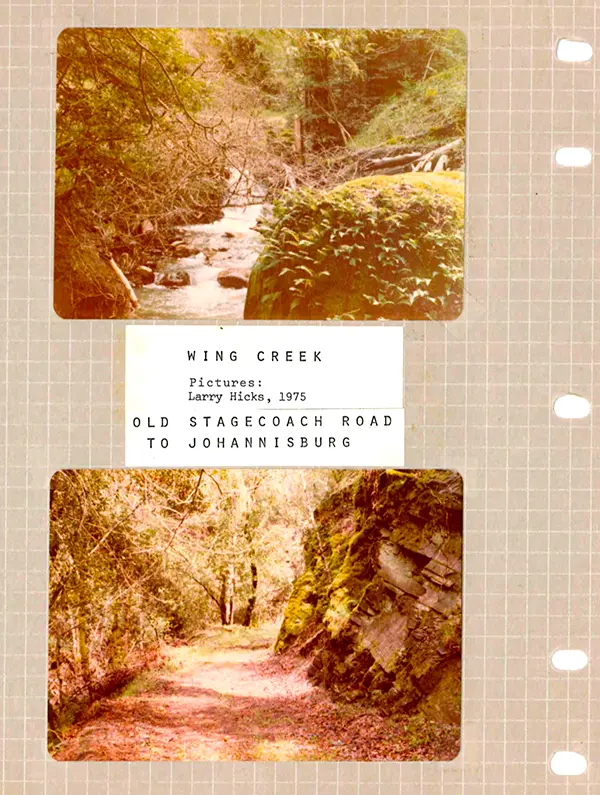
(The image at top left is a photo of a page in his project, with two photos that he took.)
It is this writer's opinion that the road through Pickle Canyon was not called Mt. Veeder Road until after the 1900’s. Evidence available had led me to believe this road was called Red-Wood Road. This old road was hard to travel— very dusty when dry and very muddy when wet. Many "old-timers" related to me that horses got stuck in the mud during the winters. Some stuck so deep that they had to be shot.3
The valley floor has Cabernet, effortlessly making $50 bottles of wine. Mt. Veeder has dead horses shot by their owners in the winter rain.
3. Aerika Estate— the present of Mt. Veeder
I shared this anecdote with Julia van der Wink, who is establishing a new vineyard on Mt. Veeder, near the edge of the caldera. She said: “Savage. Rhyolite. We have found 2 horseshoes already. They must have lost them in the mud.”
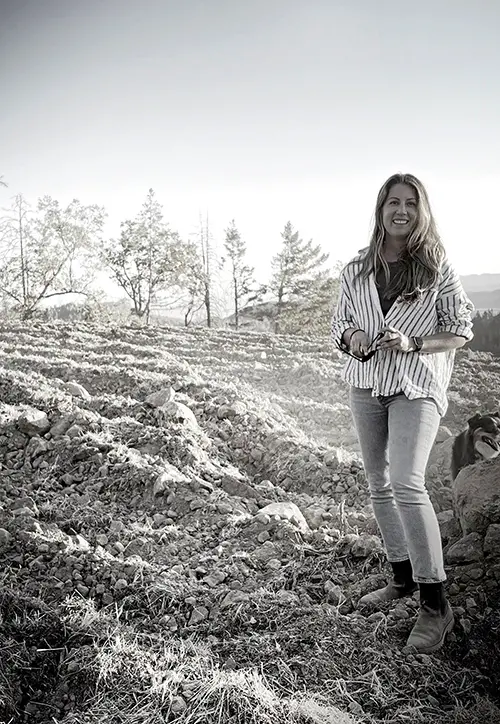
It is Julia who brought Mt. Veeder to my attention. It is because of her that you are reading this now. We have been friends and colleagues since we met in 2012, on the crush pad of Tenbrink in Suisun Valley. I can’t point to anyone in Napa I have learned more from or whose opinions I trust more. She began revealing, about nine years ago, what you could call an obsession with Mt. Veeder.
At first, I was merely charmed, in a way that reflects badly on my judgement. She served blind, night after night, Mt. Veeder wines from the 70s to the early 2000s. They were really good, one after another. After a few years, I paid attention and began realizing that something special was taking place on Veeder. But there is a lot of good wine in Napa, and there are a lot of mountains: Howell, Spring, Diamond, Atlas Peak… “What is so special about Veeder?” is what I thought deep down.
And then Julia and her partner Rob somehow put together a deal to buy land on Veeder. This is another story in itself— how they put together the deal, the business plan— but this is not the subject of this meditation. Julia and Rob bought land. Not a vineyard. The land had been cleared and even planted years before, but when they bought it, the vines had been ripped up and the land was fallow and unmarked. They started utterly fresh, from the beginning, imagining blocks, row directions and spacing, the curves of the rows as they followed the sweeping contours of their alpine meadows. Irrigation, soil preparation, cover crops. How long would the rows be? When to interrupt them to make them human in length, so that one could imagine getting to the end of a row in one’s ceaseless tasks of caring for the vineyard…
"This block is mostly rhyolite on the surface. This has more basalt. These soils are Franciscan. We are going to plant Cabernet here. And Assyrtiko here." Their sensibilities were tightly regimented and focused on excellence, but their imaginations very slightly unbounded also. A kind of Nietzschean discipline of the dance.
In this way, they have created Aerika estate, near the top of Mt. Veeder.
4. There is nothing new on Mt. Veeder
Look. To grasp the importance of what Julia and Rob are doing, you must grasp something more of the history of Mt. Veeder than the peril of horses.
Stalham Wing planted the first vineyard on Mt. Veeder in what is now called Wing Canyon around 1860. Even the mountain itself did not have a name in 1860. The rest of Napa, meaning the valley floor, the flood plain as it gradually emptied into the wetlands of the San Pablo Bay, had already been divided into districts and ranchos and estates by the Californios and the more recently arrived Americans. But the imposing mountain on the west side of the Valley went unnamed. Wing was not just the first vineyardist, he was one of the first people to try to develop the wild land in any way. The mountain district, miles in length and breadth, but accessible only from a narrow defile at its southern apex, was simply referred to as “The Napa Redwoods.” Wing had to petition the county to put in a road. Even in 1975, many roads on the mountain were still dirt. (See the 1975 photo of the road into the orignal Wing property at the top.)
The mountain was eventually named after Peter Veeder, the pastor of the Napa Presbyterian Church, who moved to Napa in 1859 and was “given to long hikes and mountain climbing.” It’s worth thinking this through: how does a whole mountain get named after one lone bachelor who likes to hike it?
It must mean that no one else goes there, that no one else had even a casual claim on it. The mountain was not named for the family that owned it, or built the first saw mill, or who discovered gold in the creek. It was named after a city-fellow who liked to hike it. This means that around the time that Stalham Wing planted the first vineyard, the rest of the nameless mountain must have been uninhabited, unmapped, terra incognita.
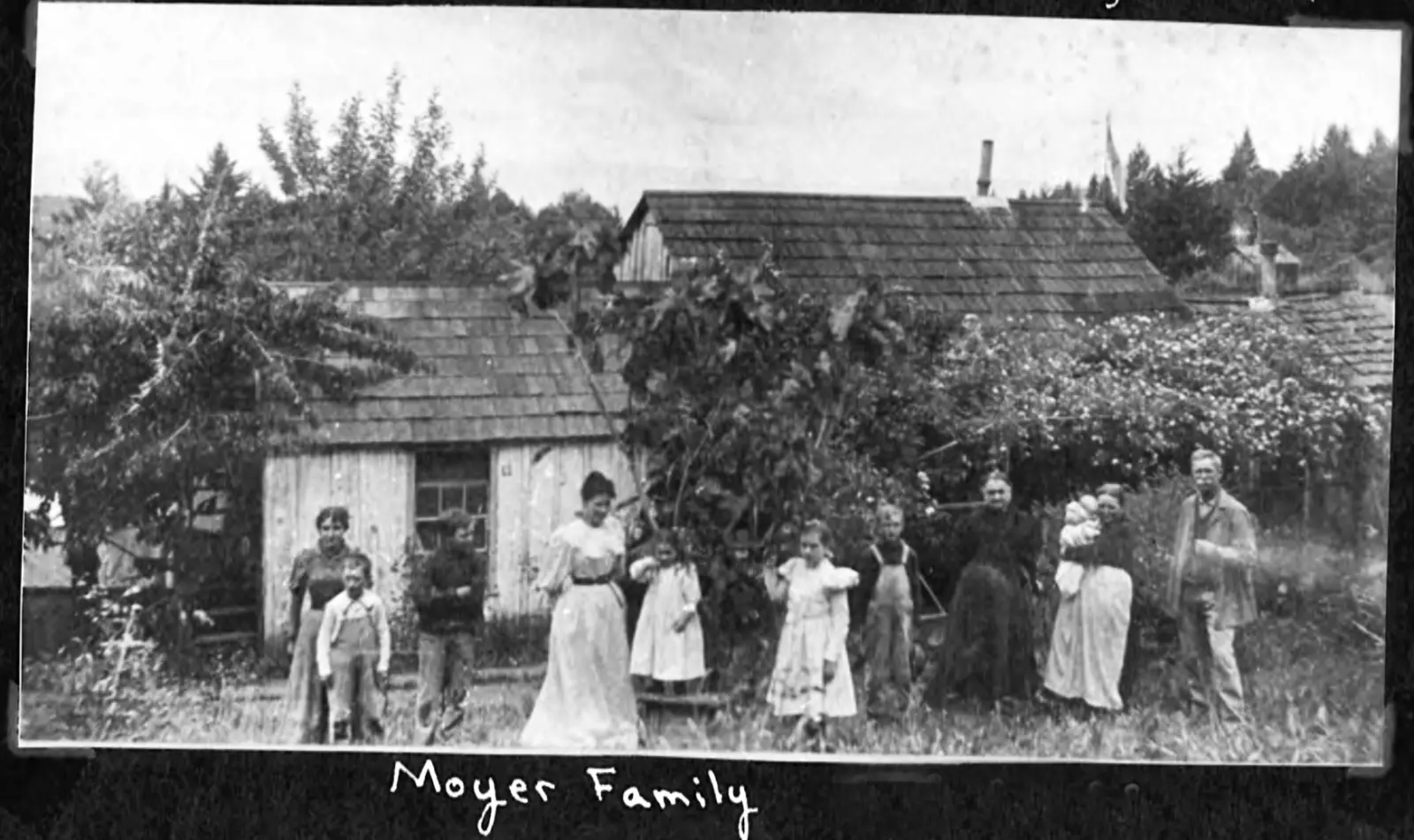
Grapes were planted on the valley floor by 1839. By 1860, there were thousands of acres of vineyards in the alluvial soil. But maybe 10 or 12 acres on Veeder. By 1890, there were 7 wineries on Veeder, a few hundred acres of vineyards, established among the defiles and outcroppings. By 1960, 70 years later, when there were 30,000 acres of grapes in the whole county, there were still only 7 vineyards and 2 wineries on Mt. Veeder, every single vineyard descended from an initial planting of 1895 or before.
In 1965, a couple moved up from San Francisco, purchased an old prune plum orchard, and created the first new winery on Mt. Veeder since the 1890s. Since then, there have only been 5 more vineyards created where previously there were none, and two historical vineyards have been resurrected. By my count, there are only about 11 wineries functioning on Mt. Veeder and nearly every single vineyard is descended from a an initial planting from 1895 or before.
As the valley floor has been planted, subdivided, renamed, crossed with a wine train, Veeder is withdrawn and stands aloof, mostly unchanged since the first German immigrants planted hundreds of acres of vines in the 1890s… and then time essentially stopped.
Julia and Rob’s project, Aerika, is profoundly historical. It is adjacent to the Mayacamas Vineyards, which are themselves descended directly from the J. H. Fisher vineyard, planted in 1895. They are also making a Cabernet from fruit grown at the original Wing Canyon site. Julia says that it is their best wine. As it should be: Stalham Wing won a medal for his in 1864.
5. A visit, in 1997
In 1996, I got tenure at St. John’s College. A sabbatical would follow in 1998. My ex-wife and I decided to spend the sabbatical in California. We were leaning toward Venice; Abbot Kinney reminded us of Soho in the early 90s, there were still studios and surf shops down at Rose and Speedway. My friend Peter, who lived in San Francisco, wanted us to give his city a look before we made final plans, so decided to visit him, right before school started again in 1997. I was interested in wine and loved the idea of making a day trip to Napa. And my friend, and ex-student, Zach, was working at Stag’s Leap. We rented a car and drove up. Somehow I chose Chateau Potelle as our destination. We picked Zach up in downtown Napa and made our way up Mt. Veeder. I was breathless at the scenery; I had never seen anything like it. Redwoods everywhere; the wild crags of rock. Chateau Potelle was having some kind of wine club party. We drank a lot of Chardonnay on a deck in the Redwoods and decided that day that we would move to San Francisco, not Venice, and that I would spend my sabbatical on an internship in Napa, in the wine industry. The address of Chateau Potelle was 3875 Mt. Veeder Road, just below the Veeder Caldera.
Thanks so much. Till next week, with the fourth and final variation.
With very best wishes
Abe
FOOTNOTES:
1. "MT. VEEDER - NAPA VALLEY" VITICULTURAL AREA PROPOSAL, p. 13: Soils report, prepared by Eugene L. Beggs 2. "MT. VEEDER - NAPA VALLEY" VITICULTURAL AREA PROPOSAL, p. 11 3. "HISTORY OF MT. VEEDER by Larry Hicks 1975, p. 37