A report on the Harvest of 2024-- in Two Parts: the Vineyards of the South
We nearly lost everything this year
2024 HARVEST REPORT
Part 1: The Vineyards of the South
I have a story of some depth to tell— in our little, narrow, world, a story of some importance. It's the story of this year's harvest, and I must tell it in two parts. In this part, I will tell you about the wines that we have made from our vineyards in the South, the dear desert vineyards I have been telling you about since 2019. In the next part, which I will send to you on Wednesday, I will tell you about a new set of wines, a new set of vineyards…
New— and not new.
JULY 31
HARVEST IS THREATENED!
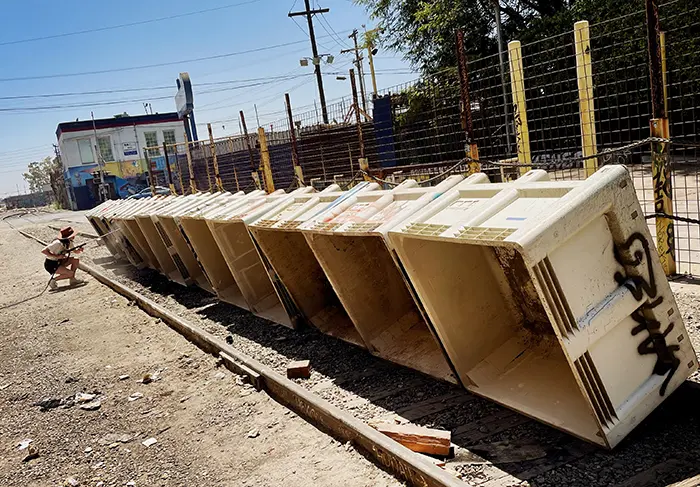
It's the end of July. We have been enveloped, nearly strangled, by a heat wave that began weeks before. We bottled most of our 2023 wines in June, and hoped to begin shipping them right away— but it was impossible. You could not put anything on a truck.1
We began visiting vineyards on Fourth of July weekend. Everything seemed behind last year— only a few days behind, perhaps because of more Spring rain and a cool late Spring, but we were grateful for the respite, the delay before the madness of harvest. We prepared carefully and with gratitude.
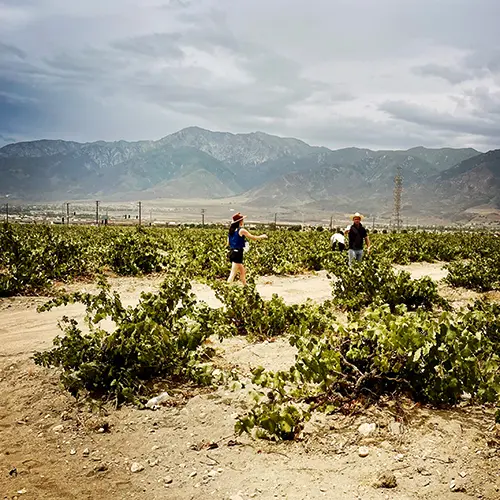
We kept checking the vineyards: the heat was worrisome. There was no damage yet, but how long could the fruit survive these relentless temperatures? The younger and harder the berries are, the more they can resist mere atmospheric heat; but as they begin to ripen, and soften, they become more vulnerable. Now it's August 1, and the Palomino is suddenly ripening, much more quickly than it had been. No surprise.
We don't see any heat damage yet, but the fruit is at risk. We abandon the leisure of a few days before; we must be ready to pick immediately— absolutely as soon as the fruit is ready.
This kind of heat right at harvest can truly be disastrous — in 2020, the Galleanos lost nearly all of the Lopez Zinfandel to an August heat strike. We made no Lopez Zin at all that year. And even if the fruit is not fried, rapid ripening at the end of harvest almost never promises high quality. You want stress on the vines, but not panic.
We begin facing the possibility that we would harvest no fruit this year. If the weather did not break, everything could be lost, even before we began.
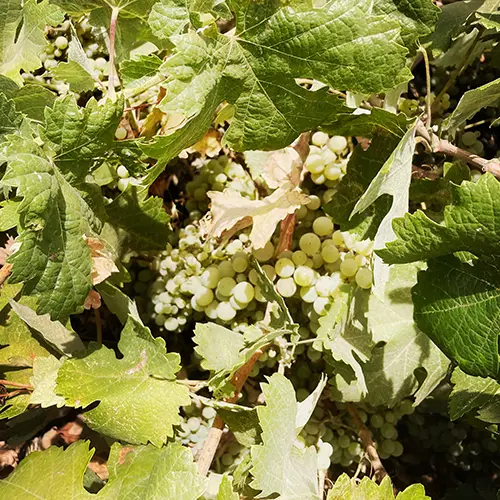
And now it is August 7th. It's 100° once again in Lopez. Something strange is happening. The fruit looks perfect. Bright green, not golden; no sun tan, much less sun burn. And ripening has slowed down again, proceeding at the same rate as if it were 15° cooler… I am mystified, but delighted.
The old vines have seen this heat before; perhaps countless times. We are new to Cucamonga; they have been here a century and more. We plan to begin harvest in 5 days, on the 12th.
AUGUST 12
1. LOPEZ PALOMINO
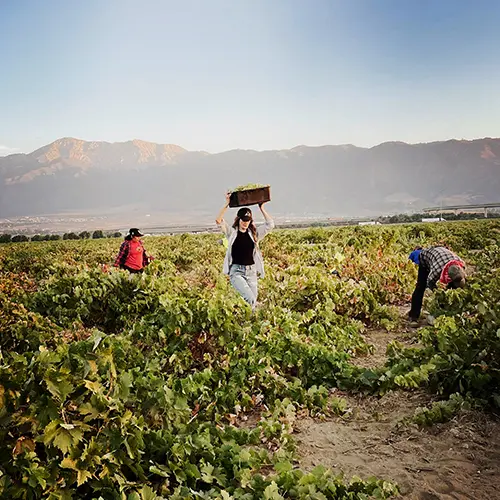
Three other friends are getting fruit from the 112-year old Palomino vines at Lopez: Mikey from Scar of the Sea, the Herrmann-York boys, and our dear friend Tomas, who is making his first wine. We all plan to pick on the 12th. We only want to haul a ton and half at a time in Kaeley's new truck, so we plan to return the next day too. The temperature is 83° by 9 AM when we finish picking, but the fruit is beautiful and we rush it home, full of excitement.
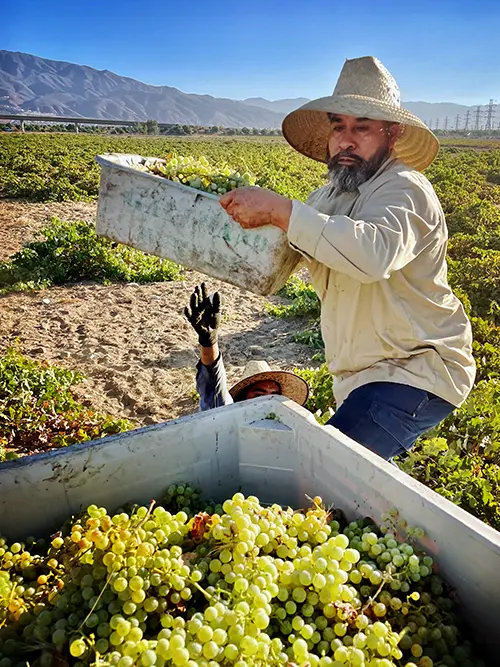
Our excitement is not in vain. We press the fruit, using the protocol that we learned from Chiara Pepe last year. The juice is brilliant, fresh, and high in acid. We have talked a lot about what we want to accomplish this year. We made good Palomino last year; maybe even some that is great. But the bulk of it, fermented in a single, small, stainless tank, was not as good as it could have been. Too rustic. We know we can do better. I intend to use a technique that I had used years ago, to make Naucratis and La Severità di Bruto. We are going to add sulfur at pressing.2
The juice fermented pretty quickly; I remember tasting the tank on my own, and then finding Kaeley and Matthew in the other room. "This is one of the best white wines I have ever made," I told them. I stand by this still; come to the winery and taste it. The doom of the heatwave passed, unrealized.
AUGUST 15
2. LOPEZ ZINFANDEL
We move from the Palomino a few hundred meters east to the neighboring Zinfandel, planted in 1918. We begin harvest on the 15th, with bright, high-acid fruit for Rosé. We harvest and haul two tons this time, and the truck does not struggle at all. We will make somewhat less Rosé than Palomino, but we are delighted with the fruit.
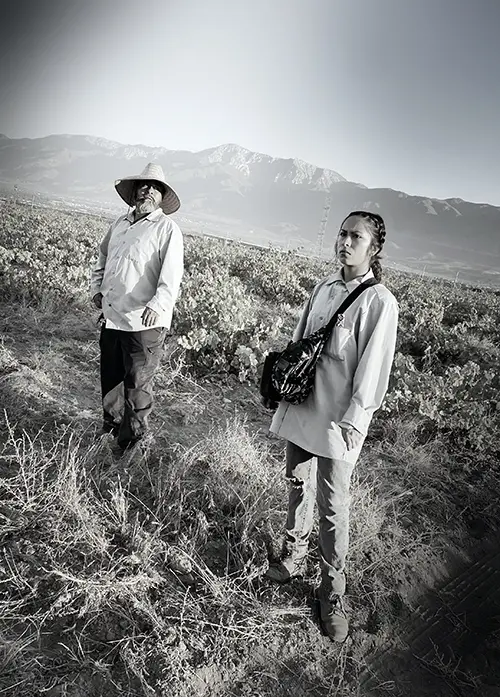
Pictured to the left are our dear colleagues, Agustin and Nancy Olvera. Agustin and his family and loyal crew harvest all of the fruit at Lopez; in the Winter, they prune the vines too. We could accomplish nothing in Cucamonga without them; working with them is one of the great pleasures of the harvest.
The Zinfandel seems really excellent; like the Palomino, it seems completely unharmed by the heat. The berries are round and smooth and plump; nothing has dimpled, nothing beat up. We make Rosé using the Chiara protocol, like the Palomino. I use sulfur on this wine too. The wine ferments slowly, in spite of the heat. The air conditioner in the winery fails— at this point, we are not even surprised; it seems inevitable. Yet the wine is beautiful, light and fresh and dense, all at once. Serious Rosé, from Zin. The old vines are a marvel.
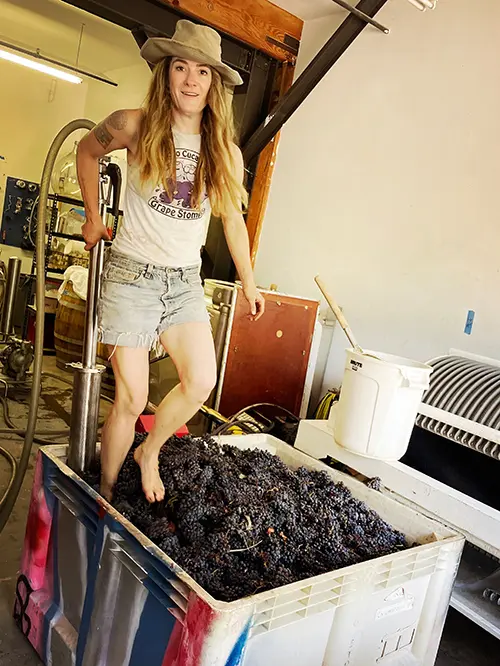
We feel fortunate to have harvested such beautiful fruit for Rosé. Last year, we waited a week after harvesting Zin for Rosé until we went back to harvest fruit for red wine; this year, in this heat, we feel lucky to have such beautiful fruit. We don't want to push it. We return the very next day to gather fruit for red wine.
We make two wines from the red fruit; one is already dry and resting in barrel. We have a light, dry, red; high in acid and intense. We tasted it together yesterday, and it seems hardly like Zinfandel. And this is not surprising: it is Lopez, not simply Zin.
The last of the two Zins is still unfinished. We have saved a barrel of the wine for a Ripasso, as we had done last year. Sometime next week, we will harvest our last fruit— 700 pounds of Jones Ranch Petite Sirah from the Tenbrinks in Suisun Valley. We will bring the fruit home, stomp it, and pour the barrel of finished Zin over the crushed fruit, initiating a second fermentation of the dry wine and the new fruit together: a Ripasso.
AUGUST 31
3. MAGLITE
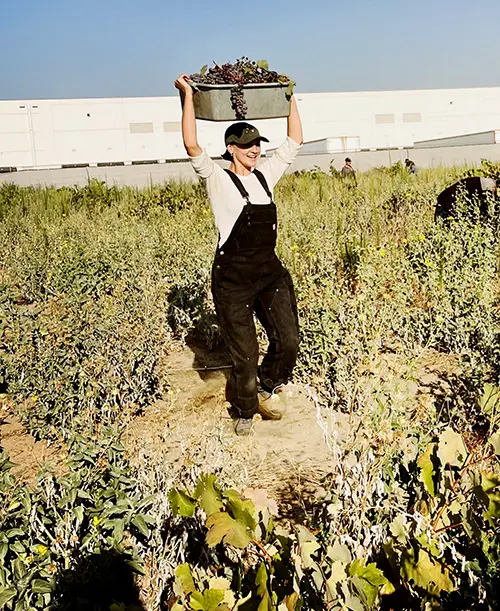
Maglite is the next vineyard in the South, and now it too is ripening slowly, in spite of the heat. I had projected that we would pick it a week after the Zinfandel, on August 24. I wanted to wait for a Saturday so that we could get friends to join us; it's an amazing vineyard, spooky and witchy— and completely overgrown. It was pretty much abandoned this year; we were not even sure we would get permission to harvest it. But I got a text message from the absent landlord a few days before we wanted to go in… and then the vines began relaxing, once again in spite of the heat. Ripening slowed further, and we put the harvest off another week. Last year, we harvested too early and still made a great, beautiful wine— the vineyard is so noble. This year, we have the chance to harvest fully ripe clusters, dark and purple.
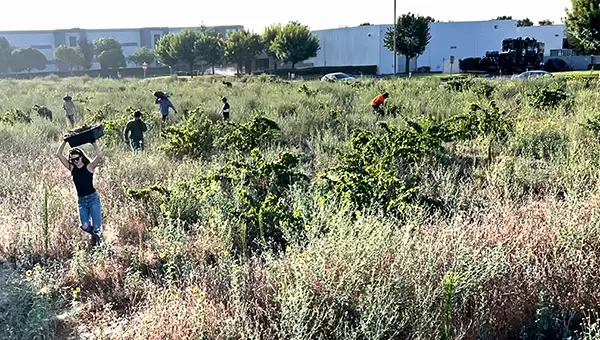
It's August 31. It's going to be 100 again today. The morning light is brilliant, harsh. The field is so overgrown that some of the vines are not even visible. Agustin and his crew are doing most of the picking, we just haul the boxes over the loose sand, through the thorns. One section of the vineyard is full of beautiful dark clusters, a very dark navy blue, some purple. We keep this fruit separate to make red wine. There are only a couple of hundred vines; we harvest 1000 pounds of red grapes. We don't really know what the grape variety is; the locals say it's Grenache, but we are not convinced.
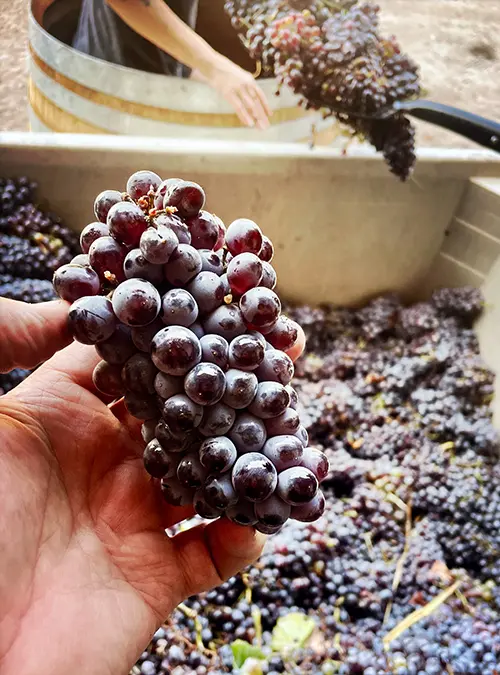
The rest of the vineyard is planted to a wild menagerie of mixed varieties, probably originally intended for an aromatic white wine: there is mostly a new world hybrid, Rose of Peru; and both of its parent vines: Listan Prieto and Moscatel; Palomino; maybe Grenache Blanc. We have made a Blanc from this section since 2021 and it is always magical: some perfume, a little rustic tannin, great depth and length. It is somehow a serious wine in spite of crazy origin. As with all of our white wines this year, we use the Chiara protocol to press and add a little sulfur.
The resulting wine is already dry. It is appropriately witchy, and aromatic— more aromatic than anything else we have made recently. I had an Austrian Grüner last night and was shocked to find that it reminded me of our wild Maglite Blanc.
SEPTEMBER 21
4. LONE WOLF
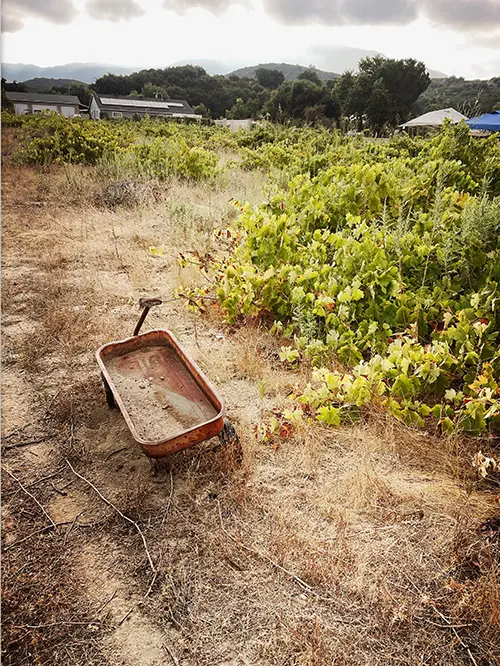
The photo at the beginning of this report is of Lone Wolf, and it catches the spirit of this place well: wild, nearly out of time, but with traces of human civilization. The abandoned child's toy: also a feeling of desolation, of peripherality. I took the photo around 7 am, on the morning of harvest, our last grape harvest of the year. And, in a certain sense, our most important vineyard.
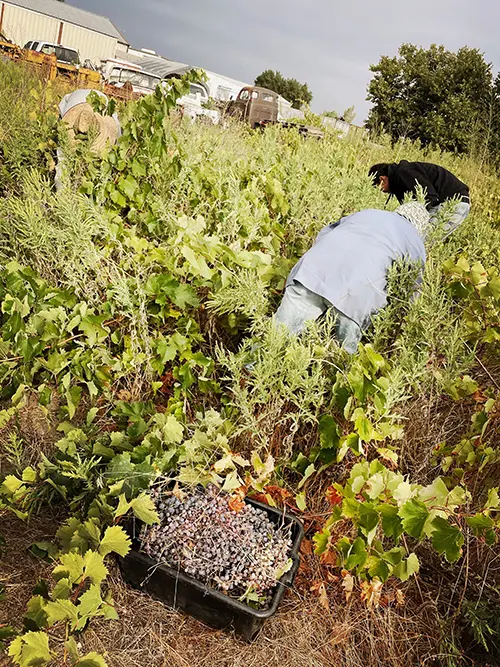
We have worked hard in the vineyard since we discovered it, abandoned, in 2019, and yet the vineyard is still nearly wild.
No rows are apparent; as much as we have pruned and pruned and pruned again, many vines are vast sprawling webs, interlocking, with nary a central trunk in sight.
When we began pruning this vineyard in February of 2020, most of the vines had been left untended for 70 years; some of them showed no traces at all of ever having been pruned. Yet the vineyard was still alive; some of it very strong. It was its own place, growing, surviving, by its own rules, following its own inscrutable path. We were unsure how much we ought to try to tame it— how much we ought to try to recast it in the form of a more familiar, conventionally managed, vineyard.
Now we have a somewhat more certain sense, and we have taken a kind of middle road. We prune, we try to concentrate vigor, but there are no rows, no wires. Most vines still have an animal's burrow at their base; we don't interfere with this aspect of the life of the vineyard.
All of the vines are now bigger and stronger than we when we found them; many that were scrawny and moribund have now been rescued.
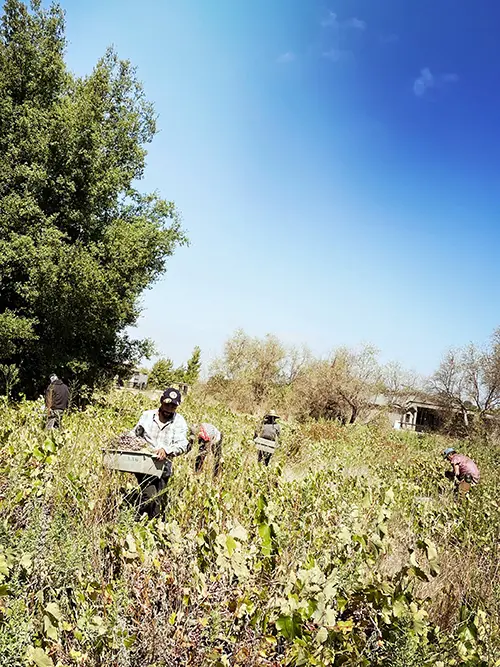
Yet one section, "The Wildlands," is thriving only vegetatively: it produces hundreds of long shoots, thousands of leaves— but almost no fruit. We know that we must create trunks here: a kind of vertical, axial, structure to get the leaves and the fruit up in the air and distributed in space. As much work as we still have to do, we have made progress here and throughout the vineyard: we harvested more fruit this year than we ever have— nearly five tons from less than two acres.
Some of the vines are original, from 1896. We think that most of these are Listan Prieto, called "Mission" in old California.3
Some, that produce only or mostly red fruit, might be Grenache. These big vines sometimes bear 100 pounds or more of beautiful, ripe, purple, fruit.
Some, much less big, more scattered, are seedlings, the daughters of 70 years of unpruned, unharvested, vines. These are the results of sexual reprodcution in the vineyard, and so they are all crosses of various plants; some of them are hybrids, no doubt offspring of the European vines originally planted and the native wild vines in the surrounding woods.
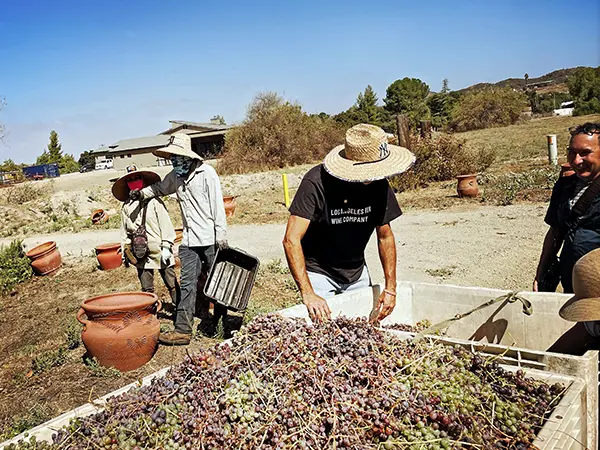
The fruit that this complex population produces is wildly variegated: some clusters look just like Grenache, and some don't even look like the fruit of cultured grapevines. We sort casually in the vineyard as we pick: two bins this year get mostly red fruit, mostly tight clusters; one bin gets the mottled, loose, clusters— yellow berries, gold, pink, purple.
We made a skin-fermented red wine from the dark fruit, our first since 2020. And and a Blanc from the rest— a wine that has been one of our treasures every year, equal to the magic of the vineyard.
IN THE NEXT REPORT…
Thank you so much for reading this far.
There is a message I have been whispering, since the beginning. I want to say it out loud now:
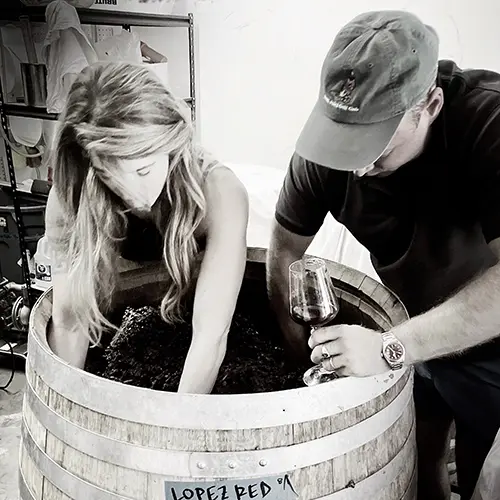
This has been our best harvest in Los Angeles ever; one of the very best harvests of my winemaking career— Napa, Suisun, Redhook. There are many reasons for this, some of them knowable. The most important, by far, is the coalescing and maturation of a team: Kaeley Weinberger, now Assistant Winemaker; and Matthew Jordan Beck, now Cellar Master. Titles, ranks— they seem nearly meaningless in the org chart at our little winery of three— but they mark legitimate and strenuously earned honors, meaningful both for the outside world and our own inside understanding. And, after five years of making wine in Los Angeles, from these wonderful, overlooked, vineyards, all of us now know better what we are doing: we understand our vineyards better, and have the confidence to try new (and old) techniques to bring our wines to an excellent fruition.
There is another reason that it has been such an excellent and joyous harvest. And to reveal and discuss this, I will send you a second missive, on Wednesday.
Thank you, as always, for your attention and loyal support.
Abe
FOOTNOTES
1. I feel terribly about shipping. We had more than a week sequestered to ship valuable, wonderful, orders in July— but it was too hot. Not unpredictably so, but we still had hope. There never were two or three cool days in a row to pack boxes and ship them out— and then, before the heatwave ever broke, it was harvest. It is beginning to cool now; and soon harvest will be over. There is still another week of brutal weather to come—not just in Los Angeles but over most of the country. Once this passes, in about a week, we will begin shipping again. I am so grateful for the patience of so many of you. Next year, we will know better.
2. "Sulfur": what we want is the sulfite ion; there are many ways of introducing it. We use a powder: potassium metabisulfite. For years in Los Angeles, we used either none or nearly none. We had a ceremony every year, right before bottling, where we might sprinkle a little sulfur in every barrel… That was about it. We were not careless; we really thought that this was for the best.
This year, we are doing something that I did frequently at Scholium: we are adding sulfur as soon as we begin winemaking, as soon as the fruit arrives, rather than waiting for the wine to form, develop, mature. We are doing this chiefly to influence the microbiology, and to favor yeast over bacteria. We have conferred with friends all over the world as we take this step; it is not just prudence but care that demands it.
We hope that the result will be wines that are more classical and more beautiful. We know that these vineyards are destined to make wines that are at least somewhat wild, yet we feel that we can still produce more harmony and grace while still remaining true to their unconventional nature.
3. The Lone Wolf vineyard is on the Pechanga Reservation; we work it and harvest it with the permission of the vineyard's owner, Bob Munoa, an elder of the Pechanga Band. He inherited the vineyard and the land that surrounds it from his great-grandfather, who planted the vineyard with cuttings straight from Spain. The only vines that we have so far identified by chromosomal analysis are pure Listan Prieto. This variety has had an amazing history in the New World, and though it is widely propagated, this has rarely happened without hybridizing. The variety and its pure or not-pure offspring are widely referred to in California as "Mission," as has been the case for about 200 years. The variety is also known as "Païs" in much of South and Central America. When we asked Bob what he preferred that we call it, he said that "I am good with using Païs and educating people about the name. I am not in favor of changing history to keep from hurting someone’s feelings. The tribe took 'Mission' out of our official Federally recognized name."