A nearly final report on the harvest of 2023-- with an invitation
13 wines harvested, fermenting, beginning to age…
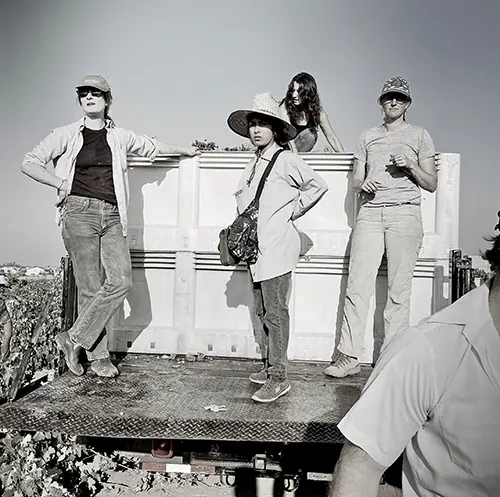
HARVEST 2023:
A NEARLY FINAL UPDATE
I begin writing this on a warm, sunny Sunday in the middle of October. It's already been a long, beautiful Autumn in Southern California, the three-quarter point in a meteorological year like no other. And every meteorological moment of the year has had implications for our vines and so for our winemaking. Heavy Winter rains and late Spring showers have ruled our natural realm like pagan gods: a gesture from the skies months ago continues to echo through our world every day; it's like that water falling from the skies laid out a plan whose conclusion has been as ineluctable as if Zeus himself had proclaimed it.
We never forget for a second how absolutely dependent we are on a natural world that we cannot control, that we barely even succeed in influencing— from the rain to heat spikes, to the subtle difference that a morning breeze can make to the onslaught of mildew… Yet the far-reaching magnitude of the effect of these rains somehow still surprises— or at least keeps us thinking of the power of the skies.
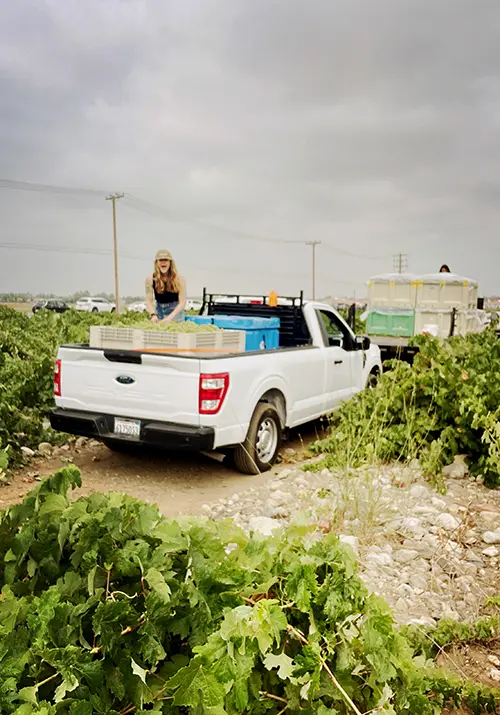
August 11. The beginning of Harvest. We are reunited with Agustin Olvera and his team, including his son and daughter. He has pruned the almost abandoned Lopez Palomino vineyard this year, and farmed it carefully in the lead-up to harvest. It's 3 weeks later than we began last year, a dog's age in the viticultural cycle. The water in the soil has slowed down ripening and made the vines fat and happy. I measure the vineyard carefully, make many visits and many calculations: we think that there are 90 tons of fruit out here— from a vineyard that in 2020 went un-harvested. Agustin points out that a section of the vineyard has not been pruned or otherwise cared for since 2012. More than 20 years. We will take our fruit from here.
I want to give you one more note about this photo: we made a decision this year to bring in all of our fruit one ton at a time. Thus the pickup truck. We are going to make twice as much wine this year as last year, but we are still tiny. Seven hundred and eighty cases from our old vines on the edge of the desert; nearly 14 tons of fruit. But one ton at a time. You can see one half-ton bin in the back of this truck. This was for our first pick; the half-ton explained below.
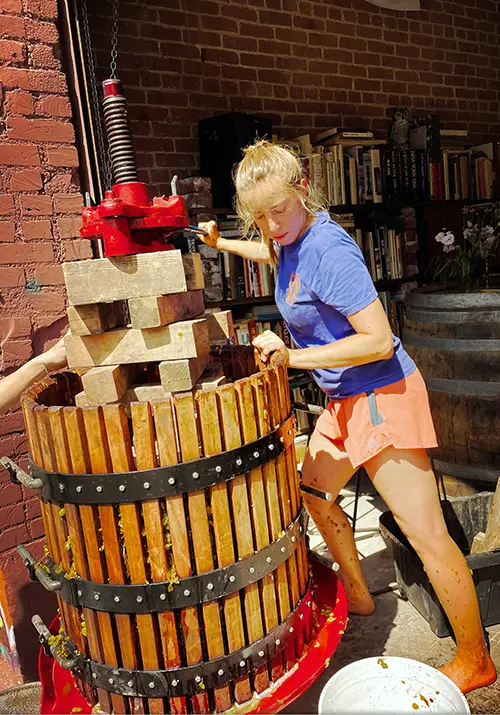
We had kind of blinding insight early this Spring: to host guests not just in the same building that we make wine, but in the same room. We limit the number of guests to 12— for the sake of intimacy, but also because the guests must share the space with the wine. We have had truly wonderful guest speakers in the winery; one of the most magical was our friend Chiara Pepe, who visited right on the edge of harvest. When she learned that we were planning to pick fruit (for Raj and other friends), but not yet bringing in any for ourselves— she was astonished: "What? I am here and we are not making wine?"
PURCHASE THE WINES OF 2023 So Kaeley and I quickly rented a pickup truck, put a bin in back, and brought home half a ton of Palomino from the first pick, so that we could make wine with the Olympian Chiara Pepe herself. The wine stands alone and will be bottled simply as "2023 Chiara."
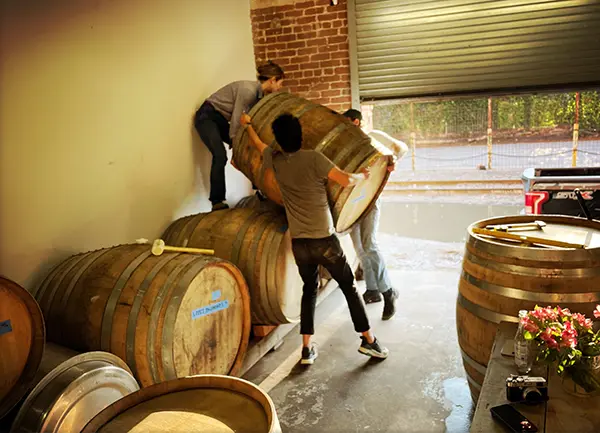
This was the first wine that we made this year, and we were barely ready to make it. The winery was a Potemkin village. We had most of the barrels that we needed for the year, all nicely stacked— but they all needed to be cleaned again and refreshed before harvest. And we were awaiting the delivery, from Burgundy and Jerez, of several large format barrels (1.5 and 2 times the volume of our regular barrels). Their purchase was part of a general program of innovation and improvement that we put into effect this year: in the Spring, in the lead-up to bottling, Kaeley and I looked at each other and said: "We can make even better wine next year." We loved the wines that we had made in 2022, our first year in this new home, a home with a roof, and air conditioning… And we thought: this home, this small rock of stability after years of quasi-tragic turmoil, this gives us the opportunity for calm, placid, improvement and innovation.
And to be precise and nearly technical: we knew that the greatest ground for improvements that we could make was in the vessels we used for fermenation and aging, and their management. So we bought two stainless steel tanks and the large format barrels. And for the first time in our Southern California winemaking, we determined to control the interaction of our wines with atmospheric air and especially oxygen. The aim: to make wines that are more crystalline and pure, less raucous and errant… I will return to this theme in a later email, to be written in the reflective leisure of the early Winter.
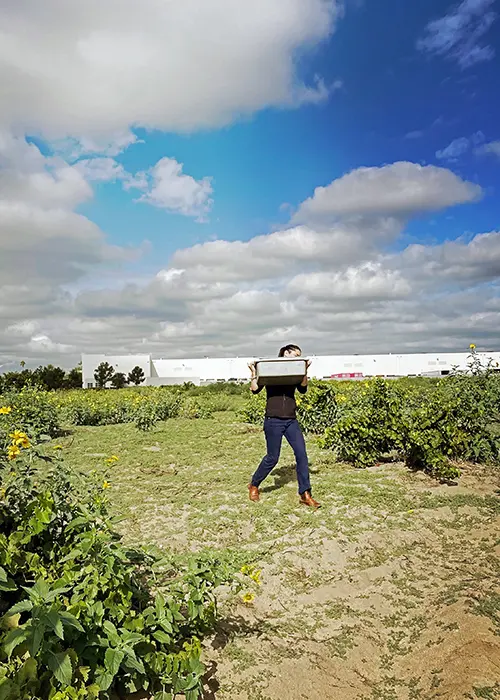
Once it started, harvest proceeded quickly and relentlessly. Every morning, we drove to Cucamonga to meet Agustin and his team, first in Lopez Palomino, and then in the Galleanos' Lopez Zinfandel. We harvested fruit from hundred year-old vines for our wines, for Raj's, and for other friends. We worked day after day until the tropical storm forced us to stay out of the vineyards for two days. And here again, we glimpsed the plan of Zeus, and for us in 2023, it held no doom at all, in spite of the opening of the skies: the vines were unscathed by the storm, and the fruit: beautiful, taut, unaffected by downpouring rain and furious winds.
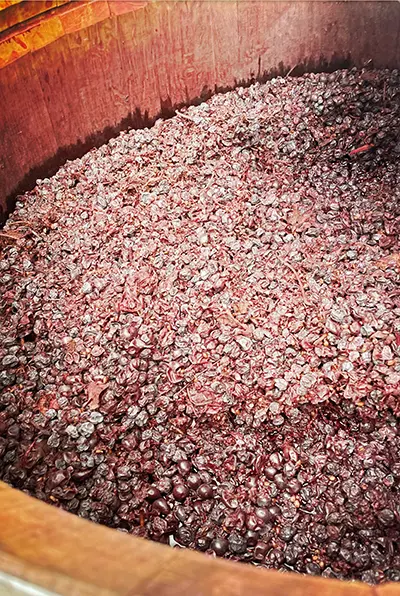
The water in the ground slowed things down; the heat never became intense. We never had to rush to pick; we never felt that terror that ripeness was escaping us. The calm and comfort let us think more about what we could do, not just what we had to do. I had time to reflect on a wine that was very dear to me— in fact, the single wine that bewitched me to want to make wine: Guiseppe Quintarelli's Valpolicellas, made with a second fermentation of the wine over partially desiccated grapes. I knew that we could do something like this with our Lopez Zinfandel.
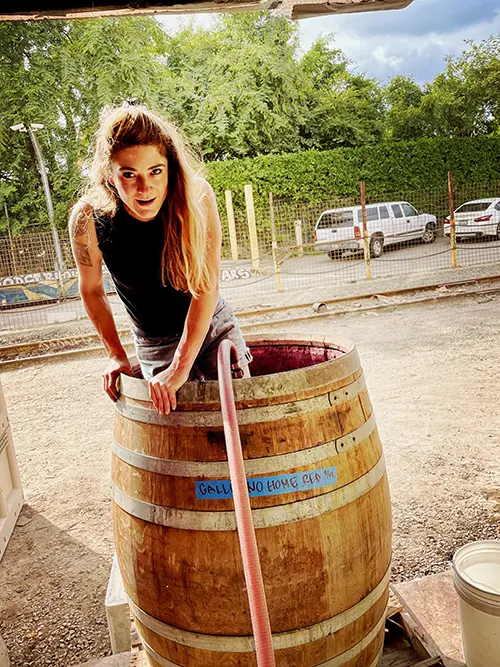
And so we put aside a barrel of fully fermented, beautiful, fresh, high-acid, Zinfandel wine from our first pick, and then harvested another quarter ton of more ripe Zinfandel, three weeks later. We brought the new fruit back to the winery and laid it out on slotted racks, and let it air dry for two days in front of our industrial fan. Then we put the frut in a puncheon, Kaeley stomped it lightly, and then we poured the barrel of dry, first-pick, zinfandel over it. The second fermentation took about 3 weeks, as the yeast struggled to consume the new supply of sugar in an already alcoholic environment. We allowed the cap of dried grapes to float above the fermentation, gracefully infusing it with its power. After about two weeks, we separated the new wine from the skins and seeds and stems, and, still sweet, put it into an old barrel of John Kongsgaard's, given to me by Lisa Tenbrink Howard, a wine unlike we have ever made in North or South… 2022 Lopez Ripasso.
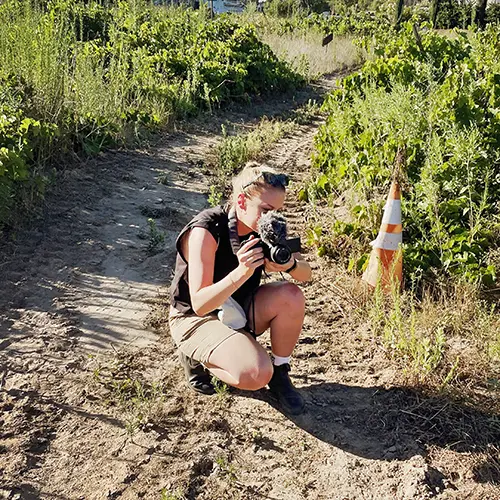
We had two truly wonderful visits in the middle of harvest, very important to us for both spiritual support, but also for an opportunity to learn from fresh eyes, new minds.
First, at the end of August, Christina Rasmussen and Honey Spencer visited us from London. They are both luminaries in the wine world there, but even more: Christina helped found our Southern California project in 2019 and is chiefly responsible for the rediscovery of Lone Wolf. We visited all of our vineyards together, including Lone Wolf. It was wonderful to show Christina Lone Wolf thriving, after years of our care in pruning and shoot-thinning— and for her to witness the power of the rains and see the ancient vines luxuriating.
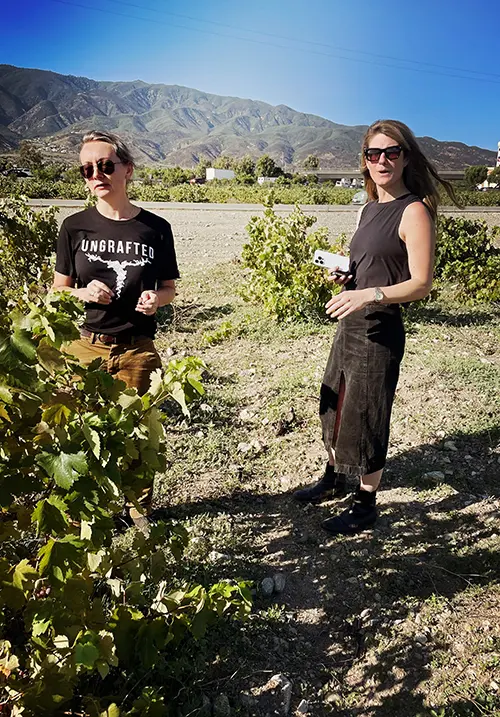
Next, at the beginning of September, Pascaline Lepeltier visited us from New York. She is a woman of amazing power and accomplishment— one of the great sommeliers of the world, but so, so much more. She was out here on a teaching tour, and Kaeley and I got to sit in on her session in Los Angeles. She posed philosophical and historical questions about how we taste and how we are taught to taste, and helped to make the schemes that shape our thinking about wine visible— and you might even say palpable. You could see that it was foundational event for the people in her audience. She came to the winery the same night and led a seminar with me, at 12 seats, on the virtue of disappearance in wines and sakés. I will have to tell you more about it another time.
But for sure, the highlight for me and for Kaeley, was her visit with us— in between her morning class and our evening seminar!— to Lopez Palomino to see the 1912 vines in their post-harvest glory. She stood speechless for minutes and finally said: "This is one of the most important vineyards in the world." We then were speechless ourselves, and now my heart sings with the recollection of her words.
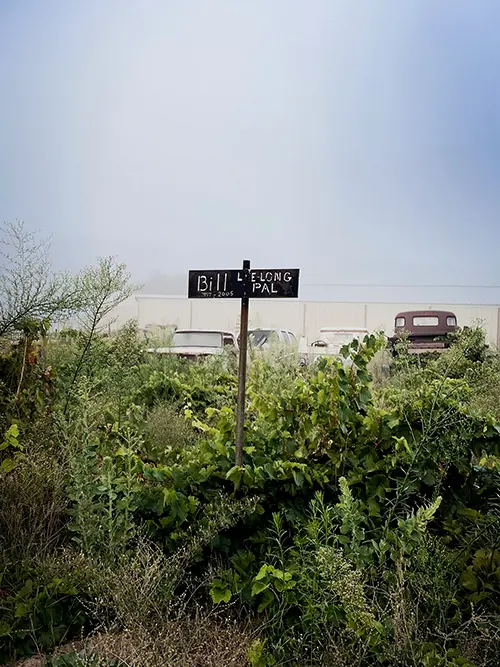
Now it is the middle of September. We are nearly finished in the South. Our main concern is the harvest at Lone Wolf, a once abandoned vineyard planted in 1896. We harvested less than two tons of fruit from it in 2022, and lost about 500 pounds to coyotes. We could see 140 year-old vines perishing in the drought. The rains this year brought not just health to the vines but a visible exuberance. We are delighted and deeply grateful. But now we are determined to best the coyotes. I don't want to lose a cluster. And yet we are unwilling to fence in this vineyard. It seems deeply contrary to its somewhat wild and witchy nature to fence it in, to create a clos out of Lone Wolf. I determine to begin camping out in the vineyard as harvest approaches.
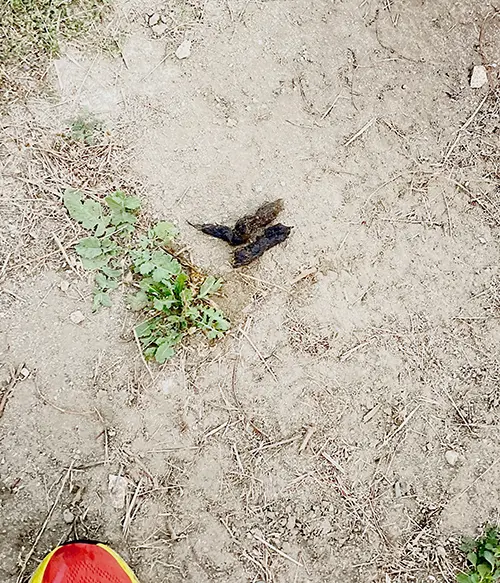
We are so fortunate: we have a friend, Anna, who lives nearby. She knows the vineyard and helped to prune it this Winter. She visits every night about 10 PM with a flashlight and walks the vineyard. She returns in the morning to check the fruit. Every morning, she is greeted by a single, neat pile of fresh coyote scat in the middle of our path through the vineyard— but no fruit is missing. (The photo at left is the marker on harvest morning.) The gods are protecting our harvest, but the coyotes remind us who really lives here. We harvest at the end of the month and bring hone nearly four tons. Agustin and his crew take the lead; nearly 20 other friends show up to help. Steve and Misuk serve lunch to all. It was wonderful day; a gift to all of us.
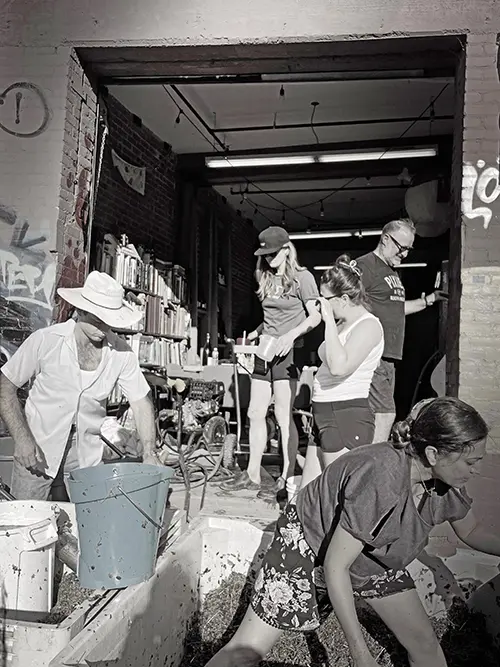
A note on the wines that we made from Lone Wolf: even though we harvested the fruit a month later than we did last year, and even though all of it tasted completely ripe— the fruit never colored this year. The predominant grape of the vineyard is Listan Prieto, known together with its hybrid cousins as "Mission" in California; for two hundred years, it has had the reputation for coloring unreliably. And so it did this year: we harvested almost only yellow fruit. We brought it home, stomped on it, and made 170 gallons of beautiful, high acid, white wine. We kept out a few hundred pounds of pink and red fruit and skin-fermented it. The wine is not red, but it is distinctive: tannic and smells more like some odd potion than normal wine.
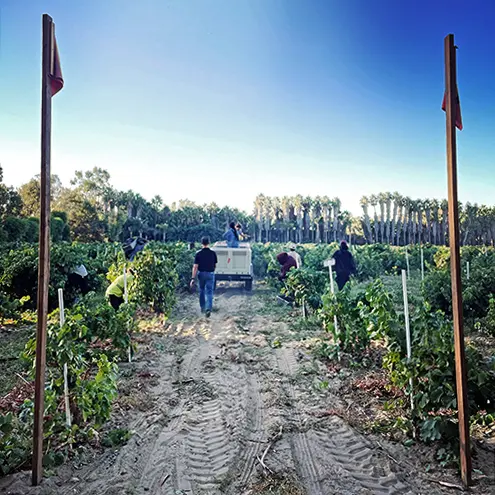
A couple of days after we harvested Lone Wolf, we got a call from Red Wentworth, who helps run vineyard operations for Domenic Galleano. He said, "Hey, do you guys want some Grenache?" We knew there was a little very old Grenache at Lopez, and yes, Raj and Kaeley and I were very interested. Grenache ripens much later than Zinfandel in Cucamonga, so we felt confident that the fruit would be ripe, not too ripe. We agreed to harvest Thursday. When I asked Red where to meet them, he said: "Hofer. You know."
Indeed I did. And I was very surprised that we were not talking about Lopez. Hofer was one of the first vineyards that I visited in Southern California, in 2015, with Jon Bonné. It was absolutely magical; and I have been trying to get back into it, with no success, ever since then. It is owned by Paul Hofer III, and was planted by his grandfather in the 1930s, at the end of Prohibition. The vineyard at its greatest extent was 640 acres, but from the 1960s on, it has been gradually pared down. Most of the present Ontario airport was built on Hofer farm land; at some point Paul III cut a deal with UPS to turn over almost all of the remaining land for a freight hub. (The word on the back of the tractor is that he gets $0.05 per package that moves across his land.) He saved about 6 acres that contains two vineyard plots, several stands of majestic palms, and about a half-dozen ranch buildings dating back to 1875. The whole is fenced in, with high walls on most of the perimeter. There is no sign at the entrance, and the locked gate has no call box.
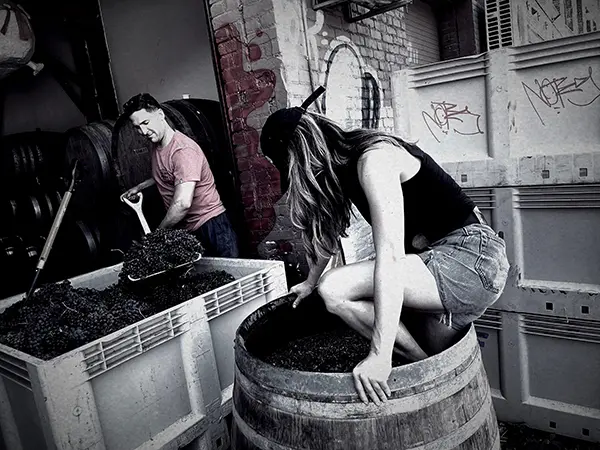
Together with Agustin and the Galleano team, we harvested a ton of fruit. We made a puncheon of skin-fermented red wine, and a barrel of Blanc de Noir. I am so excited about this wine, partly because it is so new to us, and partly because of the esoteric magic of Hofer— but mostly because the first wine that gave me confidence about the possibility of making excellent wine from the fruit of Cucamonga was a Hofer Grenache. In 2019, I learned that Angela Osborne had been making a Hofer Grenache for a couple of years and passionately beseeched her to send me a bottle. It was sold out, but she sent me a magnum. I opened it for friends, and we were all transported. The wine was ethereally light, but profound and complex. It's been a beacon for us in all we do, and it feels like a slightly scary honor to have the opportunity finally to make our own Hofer.
The many surprises that await us every day in Cucamonga…
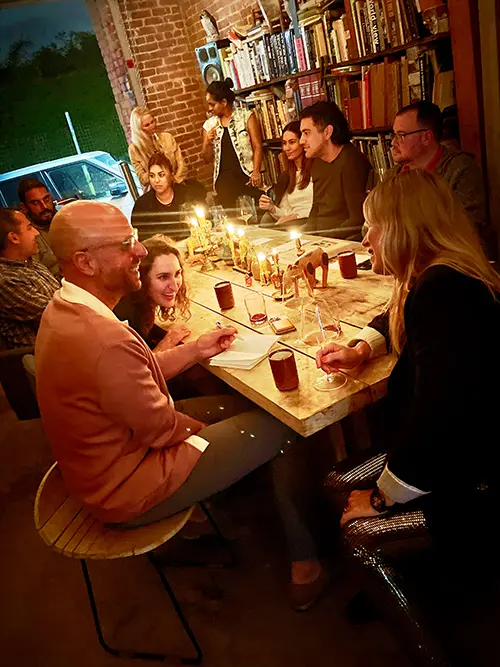
This report has not mentioned every wine, not even every vineyard. We have made 13 wines this year, from 6 different Southern California vineyards; all of them but Hofer more than 100 years old. It's so much an adventure; in some ways a historical project of recovery and preservation; in other ways, a project of absolute discovery and exploration. You may become a part of it by purchasing a selection of the 12 best of the 13 wines right now. PURCHASE THE WINES OF 2023 We will begin to bottle them in the Spring and will begin shipping them then.
But there is much more that you can and should do. You should plan to visit us at the winery and taste the wines.
- First: we will hold a barrel tasting of these wines this Saturday, the 21st— in the winery itself, for 12 guests. Seated. With some light snacks. We held one of these a couple of weeks ago, for a longtime member of the mailing list and some new acolytes. It was wonderful. Noone had ever been to such a thing: to taste the new wines of the vintage, only weeks or days old; as they are ust beginning their journey to an eventual excellence that will be caught in bottle. We would love to host you, and you may reserve your seats here.
- Second: just let me know when you want to come and we will build an event around your visit. We must coordinate schedules of course but I promise you we will make it happen. Go here to initiate a request.
- Third: we will offer a few more barrel tastings this Winter. I will alert you in a separate email in a week or so.
Thanks so much for reading so far, and thanks so much, as always, for your support and attention. It has been a strange but still welcome activity to conjure up memories and confect reflections on the recent harvest during these days of terror and affliction in the wider world. I send you best wishes from our little winery, and the peaceful sands of Cucamonga.
Abe
PS: We still have a few bottles of olio nuovo from the first pick available. I will send out one more offering around 10/30 when we have completed the first pick and I have a better sense of how much oil we will get this year.