A report on the Maglite vineyard-- and an excursus on the effect of pruning on grapevine morphology
The wonders of these vineyards....
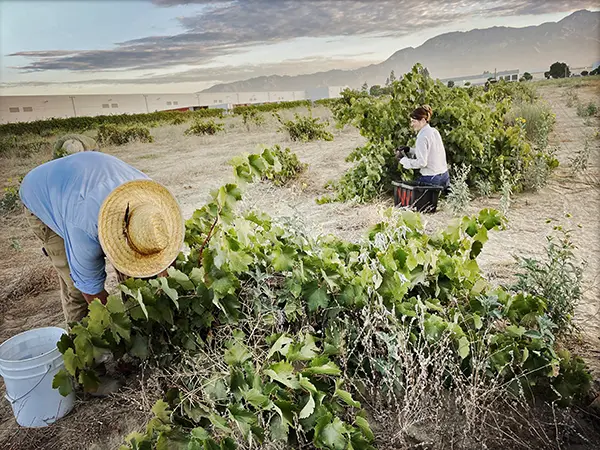
MAGLITE VINEYARD:
THE HEART OF SAND
We picked our last vineyard for two weeks on Sunday. We have a sweet respite now, after a month of picks, day after day, that demanded a thrilling athleticism from of all of us.
The next pick is Lone Wolf, the acme of our work. We will harvest the vineyard over two successive weekends, beginning Saturday, September 3d. Let me know if you want to be part of this beautiful adventure.
But for now, I have the wonderful leisure to compose another report for you, this time on the Maglite vineyard. I have spoken at such length about Lone Wolf, and I don't regret a word I have uttered. But I have not told you enough about Maglite— the source of for sure the most beautiful wine we have made down here.
MAGLITE: our history with the vineyard
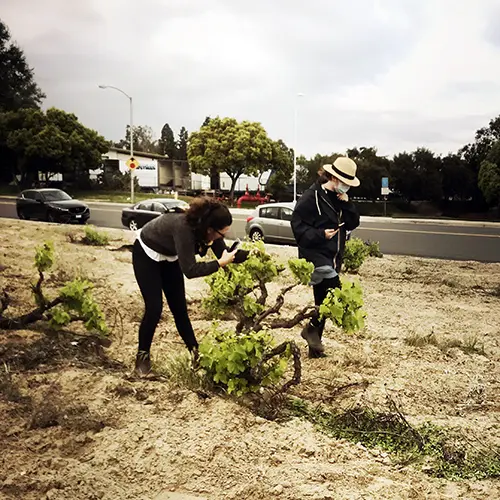
We first learned about the vineyard in the winter of 2020, after our first harvest in Los Angeles. I got a DM on Instagram out of the blue, with a photo: "Is this an old vine vineyard? I drive by it every day on my way to work. It's in Cucamonga."
There it was. Old vines, on their own roots. Not abandoned. Well-pruned. When we first saw it, on a misty day in April of 2020, the buds had just burst and the vernal shoots were unfurling. You could tell that, like the Lopez Vineyard, and the Galleano Home vineyard, not far away, these vines had been well-cared for for years. I was surprised that I had not heard a word about it. I called Domenic Galleano, the key to everything in this sandy realm. "Yeah," he said. "We used to work with that vineyard. I will connect you to the owner."
I don't ask Domenic any more questions than I have to. So I never asked why they used to work with the vineyard, what it was planted to.... Nothing. But I did gain a meeting with the owner. Let's call him "Mario." Not his real name. It took till summer to get a meeting; he was in no rush. He met us in the vineyard in flip-flops and slacks and a Hawaiian shirt. I also remember a kind of festive flowing mane, but I might be embroidering.
He said that the vineyard was planted to Grenache, that it was owned by the grandson of the man who planted it, in 1905, and that he, Mario, only leased it— because he loved to farm it. There was a section of white fruit, also pruned, but Mario said that that they often did not harvest it. He didn't know what the white fruit was.
Katia, Jaime, Matthew and I returned in August and harvested almost 5 tons of red fruit. It was 100 degrees every day by 10 am. It was one of the hardest weeks of my life. We made very good wine, in the parking lot of 1650 Naud Street.
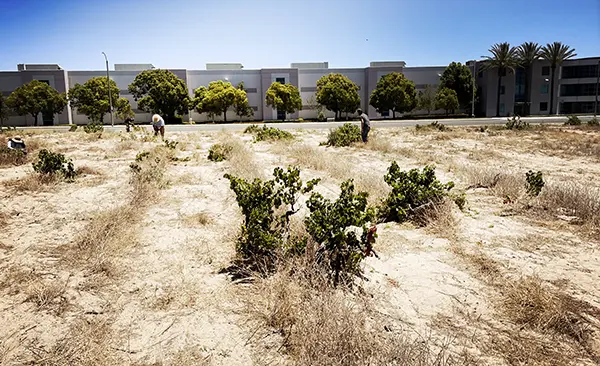
We called the vineyard "Maglite" because it is ringed, almost imprisoned, by newly built corporate headquarters, and the Maglite headquarters face the east side of the vineyard. The whole block is 17 acres; it is one of three remaining vineyards nearby, out of thousands of contiguous acres planted around 1905 for the Italian Vineyard Company. In the photo above and to the right, you can see the corporate headquarters— you can also see how sparse the remaining vines are. Out an original 3800 vines, I estimate that only about 820 survive.
The Heart Of Sand Wines Of The 2020 And 2021 Vintages
We loved the red wine that we made in 2020 and had, for the first time, the sense that this might be not only an old vineyard, but a really good one. "Maglite" was our name for the vineyard; we felt like we could not use the corporate name for wine, and also thought that there might be something more poetic we could call the wine. I thought of "Heart of Sand" in a kind of blinding flash: there is something deep about the vineyard— its wildness surviving in spite of being hemmed in by cheap steel boxes. And the vineyard's geological essence is a pure, fine, deep, sand— unlike our other vineyards, there are almost no rocks.
In 2021, I realized that any vineyard that could produce such beautiful red wine could surely make good white wine. I paid attention, for the first time, to the white wine vines, and saw Rose of Peru (more on this below), Mission, Muscat of Alexandria, and both red and white Grenache. Most of these vines do not, in fact, produce white fruit. All of it is pink to light purple at optimum ripeness; but it is also true that the pigment does not stick. We went from uninterested to eager, and then, in January 2022, it was one of the most beautiful, charming, wines in the cellar is the lightly colored white wine made from these pink grapes. "Heart of Sand Blanc."
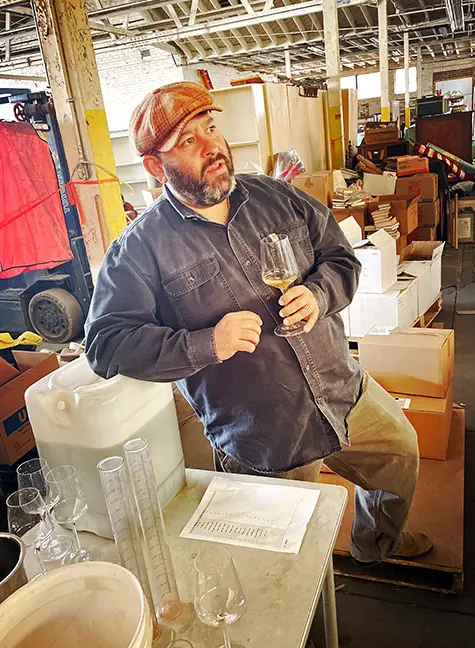
There is one more thing to know about what we did in 2020. We made of one the best red wines of my life, and the most beautiful wine we have yet made here, in Los Angeles. In preparation for bottling, Raj had come down to taste with us. We had four barrels of red wine from Maglite, each one representing a different fermentation of the Grenache Noir. When we got to the third barrel, Raj stopped, looked at me, and said, "What the fuck is this?" We bottled two barrels separately, a Heart of Sand Reserve. Light in color, but deep, and powerfully insistent— both in the nose and in the mouth. Not a heavy or rich Grenache, but powerful and ethereal at the same time. Maglite showed its capacity for a kind of international excellence. I have a few bottles saved to offer you on this occasion.
The Farming of Maglite in 2022
Early this Spring, we had a great meeting with Domenic— 10 or 12 of us filled his living room; we drank fun wine, and talked about making Cucamonga wine. He pulled me aside as we were leaving and said, "I am taking over Maglite next year. It's too important." This made us so happy. After the meeting, we kept driving south, to Lone Wolf, to see how our pruning had gone. The vineyard looked great— but more on that in a few weeks.
We did not visit Maglite for weeks, until after bloom, fertilization, fruit set. The southern half looked great. Perfect. The northern half had not been pruned. The vineyard has a fair amount of weeds; on the whole, we consider this a good thing. Biodiversity, more organic material returning to the sandy soil. But the weeds are hard on the old vines; a tilling consisting of cross-cultivation late in the Spring is a good thing. The northern section was unpruned and untilled.
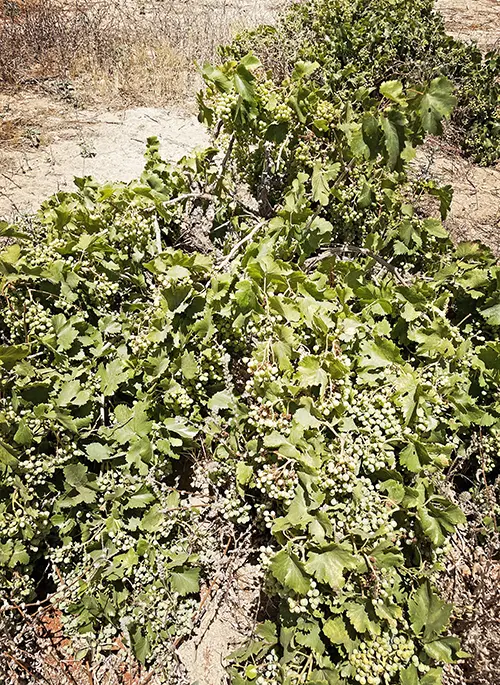
No one could get hold of Mario. We were alarmed for the vines. Look at the photo above and to the left. This is an unpruned vine in June, weighed down with way too much fruit. The ripening of the fruit would sap the vines of strength needed for mere survival; the weight of fruit could break the old arms supporting it.
I called Dom. "Can I come by?" This needed to be dealt with face to face.
"Sure."
I get to the Galleano winery. It is only a few minutes away.
"Dom. I can get my people in there next weekend. We can cluster-thin the unpruned vines. We have done this before."
He looked at me blankly. "I can't give you permission to do that."
I have seen that movie, so I knew what to do.
We returned as soon as I could get the gang together, and dropped more than half the fruit from the unpruned vines. It felt so good— with each cut, we knew we were benefiting these survivors from another era. It felt so good not just to be harvesting from them, but to be aiding the plants directly.
Maglite Harvest 2022: the Knife's Edge
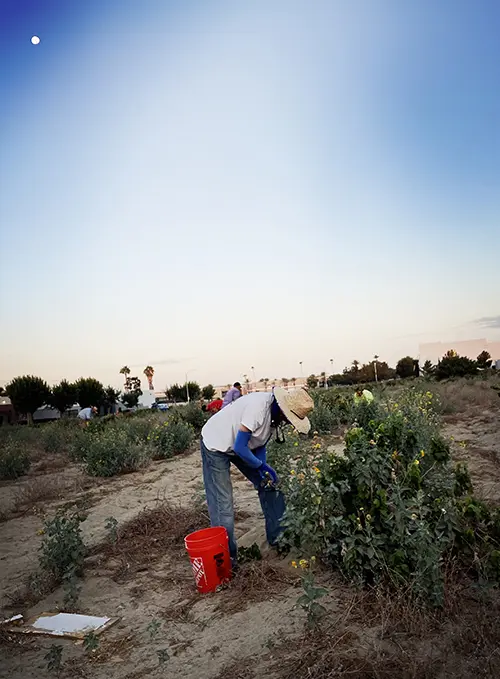
We monitored the ripening of the fruit carefully. Tim, Patrick, Jaime, all returned at tight intervals and took careful measurements. We felt that the red fruit was about a week ahead of the white fruit in ripening and so began harvesting Grenache Noir for Raj's new Scythian Wine Company on August 7, in the pruned Southern section. Herrmann-York took from fruit that day too, and Harvey Walsh. The full moon was still high in the sky at 6 am when we began harvesting; the fruit was fragrant and delicious.
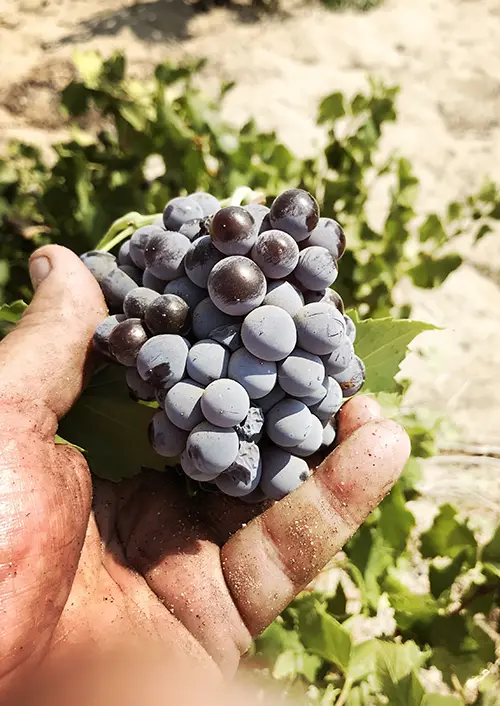
But we all noticed something very interesting: the fruit was not coloring. We harvested clusters that had yellow berries, pink berries, light purple berries— but almost nothing was a dark blue-purple (like the 2021 cluster in my hand above left).
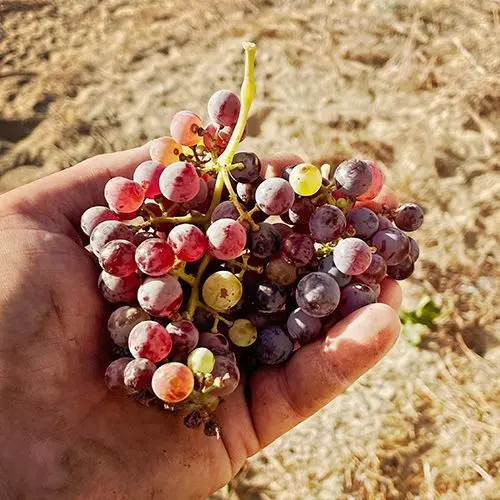
Yet the fruit was ripe: it tasted ripe, and with full flavors, and no sense of green or bitterness. The seeds within were brown— mature. And if you bit into them, they were crunchy. We knew that we were in the midst of something‐ but to be honest, we still don't know quite in the midst of what.
Whatever it was was, it affected not just a few vines, or even a majority of them, but the whole vineyard. And we had not rushed the pick: we began harvesting on August 7— but the photo above is from Sunday, August 21. During the intervening two weeks, the temperature in Cucamonga reached 100 more than once, yet the fruit was not coloring (or adding sugar) on the one hand, nor was it roasting, or collapsing, on the other.
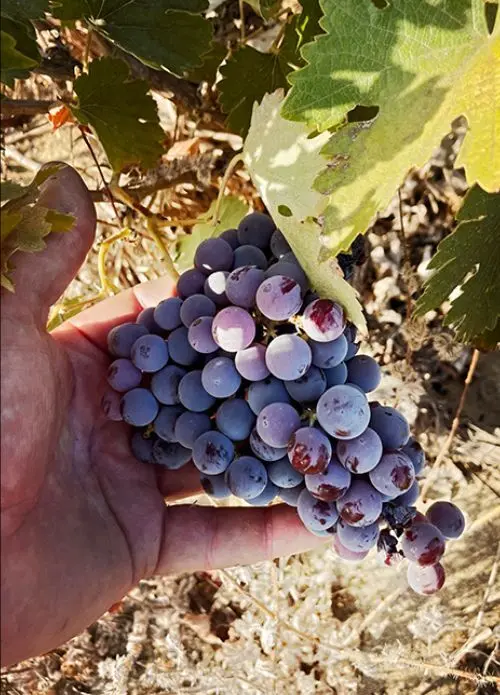
What we harvested on Sunday was truly beautiful: every berry taut, color still vivid, not bleached out. Yet this fruit harvested two weeks later was not sweeter than we what we had harvested before. Instead, it seemed to get tougher, more tannic, almost woody; and not a bit sweeter. As if the vineyard were telling us: "This year, we are not about delight, pleasure. We are about toughness, survival. Taste our fruit and understand." Understand what it is like to be a 117 year-old vine, nearly abandoned on this sandy island, surrounded by busy humans who look right past you every day.
The harvest of 2021 afforded us beautiful wines, wines of pure delight. The harvest of 2022 in Maglite reminds us: these vines are poised on the knife's edge; their vigor, their ability to produce and ripen fruit, is not a given, but a kind of gift, a gift that depends not just on our care, but on this inch of rainfall in December, those cool mornings in May . . . .
A Disquisition On the Effect Of Pruning On Grapevine Morphology
We learn so much in these crazy vineyards. On Sunday, there were six of us finishing the pick in Maglite. One was a recent viticulture graduate of a local college; it is an honor and a pleasure to have her with us. On Sunday, we were working exclusively with the unpruned vines. Recall that we did not discover their condition until after fruit set. As I was plucking the clusters off the vines, I gradually began to notice something strange, unexpected. The clusters were not always attached to the shoots in the way one would expect. In general, what we are used to, and consider pretty much universal, is a shoot that starts with a couple of leaves, always alternating sides, a leaf here and then a leaf on the opposite side. Each leaf is said to arise from a "node." And then a couple of clusters on the next nodes, alternating their points of origin just like the leaves. And then more leaves, continuing in alternation. Here are a couple of photos I have posted previously showing the expected arrangement:
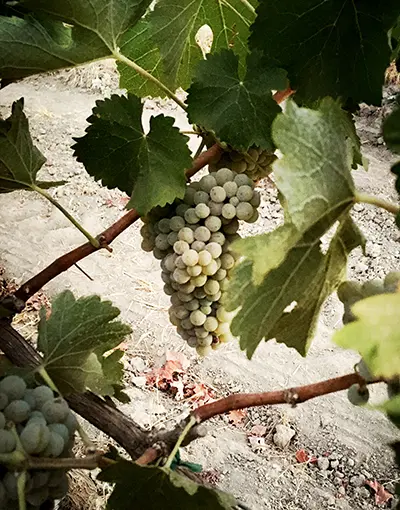
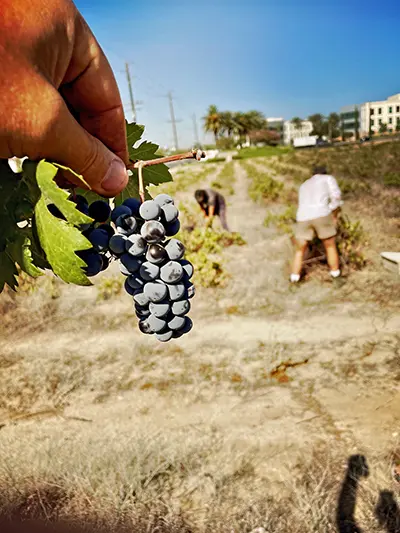
This leads us to think about the morphology of the grapevine in the following way: the vine produces shoots that bear leaves and clusters; the leaves and clusters are kinds of appendages that are somehow attached to the shoots. If we try to create an abstract diagram of the structure of the vine, we get the shoots emanating like straight-line rays from arms of the vines, emerging at roughly right angles from the wood, and then the leaves and clusters emerging in turn from the shoots, also at right angles. This is really clear in the photo of the tiny Zinfandel cluster from Gateway on the right.
But this is what we saw a thousand times on the unpruned vines at Maglite on Sunday (if you hover over the photos, you should see expanded versions, or maybe click on them to see in new windows).
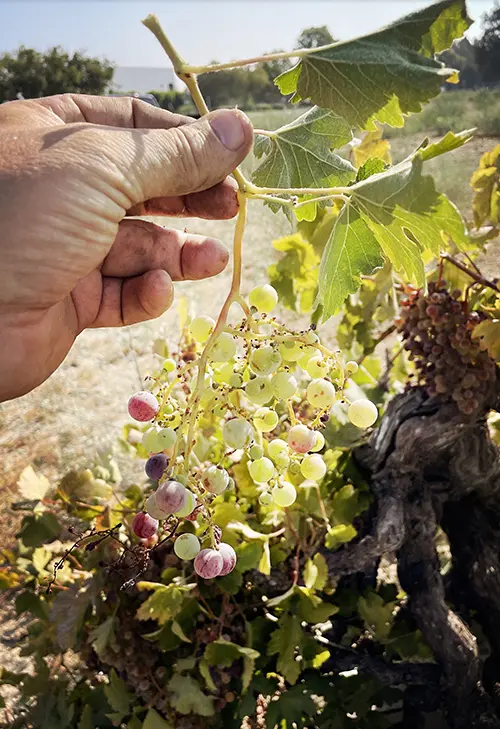
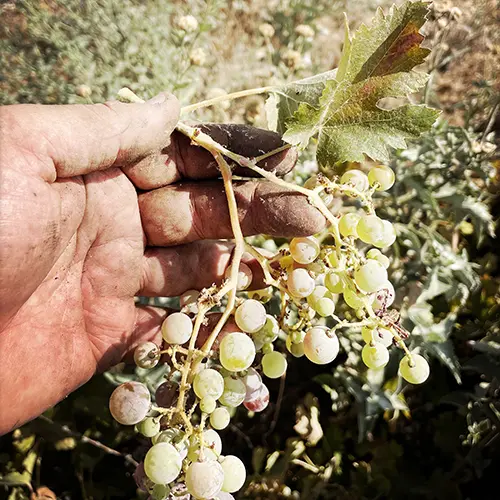
In each of these photos, we see a whole shoot, plucked away from the wood of the year before. The shoot produces a leaf or two, and then a cluster. And then stops. The rachis of the cluster, the technical term for its stem, and the normal organ of attachment to a shoot, is the terminus of the shoot itself. There is not a clear distinction between shoot and rachis, no clear node as a point of attachment. In a certain sense, the cluster of the unpruned vine is an undifferentiated, or much less differentiated, structure compared to the normal arrangement on the pruned vine.
But this observation raises the following question: to what degree is the "normal" structure of the grapevine, and its attendant morphology and physiology, an artefact of pruning?
I do not mean to suggest that the normal structure, with two clusters pendant from the third and fourth nodes of a straight shoot, is somehow artificial, less "natural," than the strange terminal rachis of an unpruned vine— I only mean to point out to what degree the expected structure of the grapevine is its physiological reaction to our viticulture. The pendant cluster is an expression of our intertwining ourselves with the vine, of our dance together.
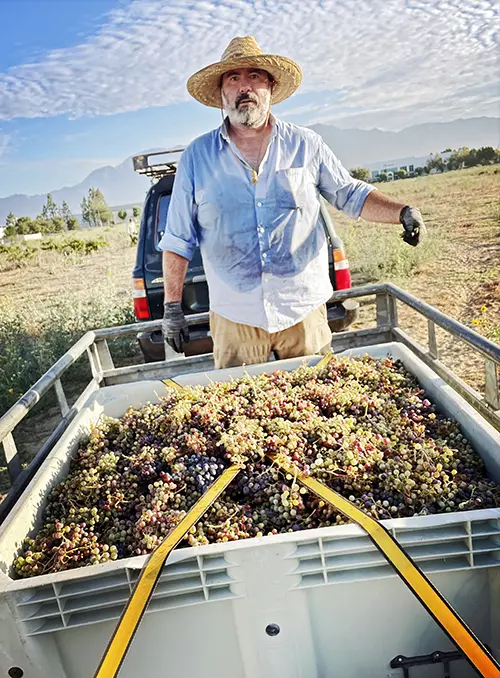
Let me close with an image of Tim and his Maglite fruit from the first pick. What a beautiful dance this is.
And don't forget about the futures. There are about 12 packs left.
Abe