The Lone Wolf Vine Count-- a quick update!
We have compiled the data
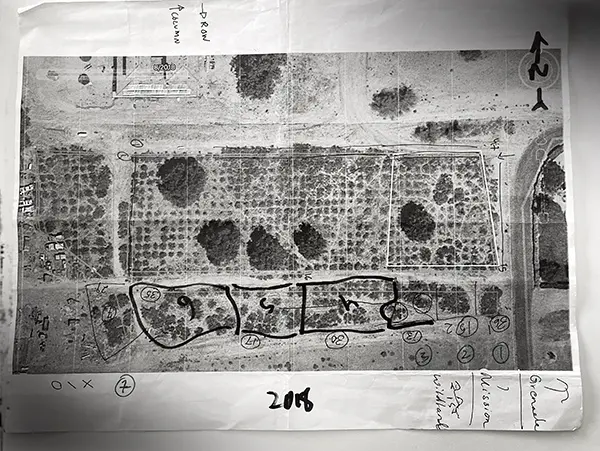
LONE WOLF VINE COUNT
Wildlands on the bottom, Pet Cemetery on the left
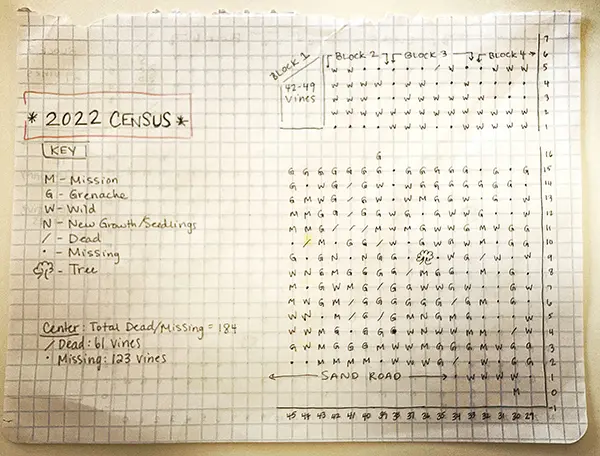
I wrote you Wednesday about our most recent adventures in Lone Wolf, and told you that we still had to compile the data from our vine count. The compilation of the row by row vine reports would allow us to see how many vines we had lost in the drought last year.
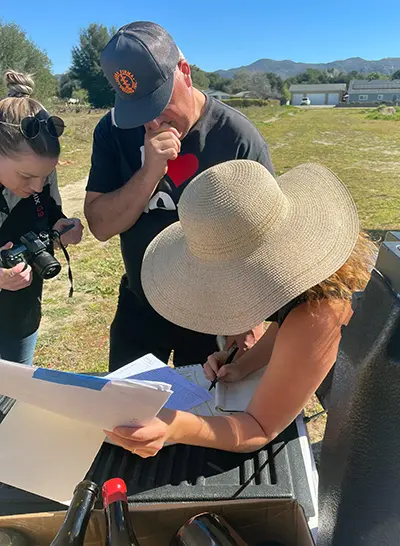
Nina completed the work yesterday, and I am very, very happy to report that we lost only 20 vines last year. This is a bitter loss in itself, but it is way less than I had supposed from mere guesswork— and a much smaller proportion than many of our colleagues have reported in similar, old-vine, dry farmed, vineyards. The drought is punishing on such vineyards, but Lone Wolf is a very tough survivor.
The detailed results are even better. Let me share them in tabular form. But first you need to know two things about how we counted and how I am reporting.
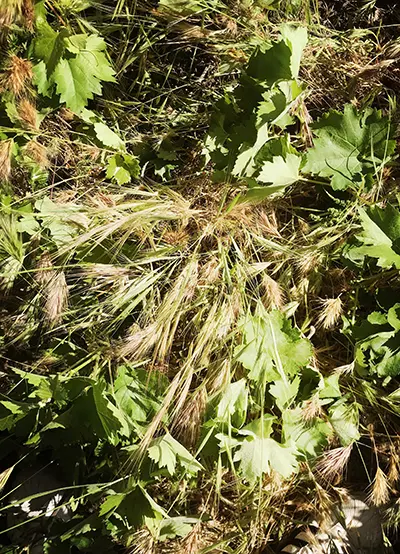
First, we simply found more vines this year. Christina made sure that we counted young single shoots, especially when they were springing up around older, now dead, vines, and emphasized that we not limit our healthy vine count to healthy vines with established trunks. We often see a ring of shoots surrounding a dead trunk, or even an empty spot, that probably represent shoots growing directly out of the roots of the old trunk, or perhaps from old canes that have buried themselves. (There is an overhead photo of a cluster of shoots without a head or a trunk or a cane below; taken May 2021.)
This raised our healthy vine count by about 90. This also made the total dead count go down, in spite of losing some vines to the drought. This is a numerical reflection of the spontaneous resurrection of the vineyard, as young shoots replace dead trunks. We also found many new groups of shoots in Wildlands in places that we had ignored before; this made us bring up brought up the total number of positions. Most of these positions do not even have the trace of a trunk or an old vine‐ that is why we ignored them completely last year. Moreover, this year, for the first time, we recognized the traces of an original grid in Wildlands, and this made us attentive to empty positions on the grid (which we now counted), and seedlings growing up in these "empty" spaces (which we now counted as healthy). Thus, most of the new positions ended up being counted as healthy.
Second, in order to be quite precise about how many vines we lost, I compared the reports vine by vine, position by position. Twenty vines that were reported as living in 2021 were now reported as dead in 2022; 10 each in the Center and Wildlands, none in Pet Cemetery. I will come back to this.
Here is the data, with total pounds harvested divided by total number of heathy vines:
| YEAR | TOTAL POSITIONS | TOTAL HEALTHY | FRACTION HEALTHY | LBS/VINE |
|---|---|---|---|---|
| 2021 | 1109 | 766 | 69% | 11.4 |
| 2022 | 1157 | 854 | 74% | 5.9 |
This makes precise something that was absolutely painfully obvious while we were harvesting: the drought had a punishing effect on the ability of each vine to carry and ripen fruit. It is cheering to learn that there was so little permanent damage; we have every hope that the production per vine will creep back up this year. It rained nearly an inch on Lone Wolf on Tuesday and Wednesday of this week; total rainfall for this season is already twice as much as it was for all of the 2021 growing season.
One more note on mortality in the vineyard: there were no vines lost in Pet Cemetery in 2022. But there were in 2020: I am sorry to report that about 10 of the big, moderately healthy, vines that we pruned in 2020 died during the following growing season. My guess is that the radical pruning that I urged was too hard on them. To be a little more precise: many of these vines had distal growth points, not central or proximal: all of the shoots and leaves were growing very far from the center or the heart of the plant, at the end of long, gnarled, arms. If we cut all of these arms off at once, we would have left no growth points for the vine. So these vines produced few or no leaves in 2020 and then died.
The only good thing about this is that it made for an inadvertent cull of this section of the vineyard, and so, all of the vines that were left have been strong enough to make it through 2021.
I think that we suffered some of the same consequences in the Wildlands in 2021. This time, I was much more careful, but still, I knew that pruning these vines for the first time in 60 years would have to be hard on them. We did a very good job making absolutely sure that we left enough viable buds on every plant, but we still lost 10 of about 175 plants. I don't think that you can ascribe all of this loss (nearly 6%) to the drought.
In the center of the vineyard, we also lost about 10 plants— but 10 out of 501. 2%— less than half the proportion that we lost in Wildlands. This suggests to me that absent the pruning, we would still have lost three or four of the vines— and this is comforting. It is terrible to look at one of these old vines and think that you might have hastened its downfall. I was absolutely full of trepidation, and even felt moments of dread, after pruning Wildlands, but these numbers suggest that we did no overwhelming harm. It will be so interesting to see what happens as we strive to reconstruct centers of the vines over the next few years.
Thanks so much for your attention. Once again, in the midst of very hard times, thinking about this vineyard provides a welcome solace.
We bottle our 2021 wines next week. I will keep you posted.
Abe