Lone Wolf-- a meditative pruning report. And I have scheduled TASTINGS.
A reflection on the special importance of hybrid grapes in this unique vineyard
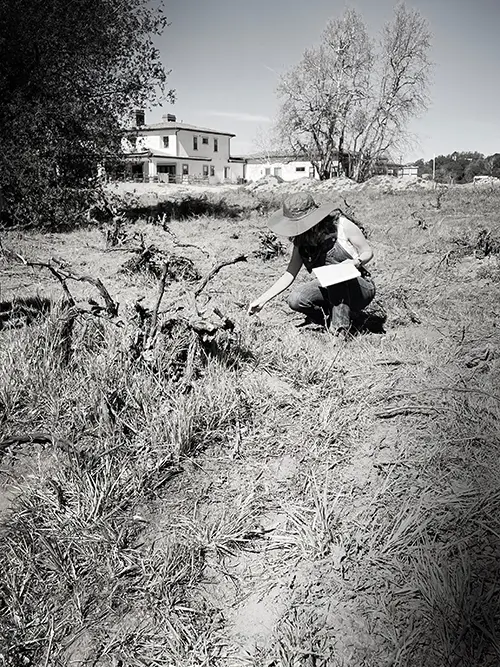
LONE WOLF
Hybrid grapes:
At the heart of it all
You drive down to Temecula. It is not close; and Temecula is irretrievably foreign. In a certain sense, you feel like you are nowhere.
There is only one route to the vineyard, one way in. You turn off the Pechanga Road, past the casino, past a high-school on the left, "Home of the Wolfpack." In a few hundred feet, you are at a security gate. There is a severe guard with a sidearm. This is very serious business; not the fatuous and annoying security of a gated community. There was a massacre of the residents here in 1846, perpetrated by outsiders. The gate has a meaning that no one is about to doubt. Or forget.
You identify yourself: "We are here to see Bob Munoa. To work on the vineyard." The guard nods, looks away, at the next car, and raises the gate. You are now in the land of the Pechanga Band of the Luiseño Indians. There is no sign, except a sign to stop. You are only here if you know where you are, where you are going.
The guard recognizes me and some of the rest of us in the truck, but he still asks. We are so clearly crossing a threshold; there is something absolutely and metaphysically correct about not being able simply to drive in. We are here with permission.
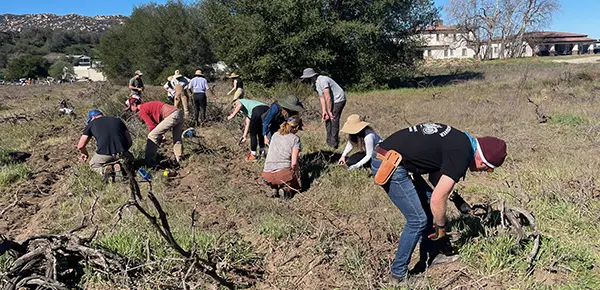
There are 44 of us. Christina flew in from London. Kristyn and Saibhang drove in from Santa Fe. Sharon is a viticulture and enology student from nearby, Lake Elsinore. We met through Instagram. Blake's family has orchards in New York State. He is in California to learn about viticulture, and to investigate the application of regenerative agriculture to grape growing. Two masters students from UC Davis, whom we met through Darrel Corti, drove down even though they are in the midst of mid-terms. There are many newcomers, but Jaime, Eric, Sarah, Nina, Laura, Darcy, Kaeley, Raj, Christina, and I were here the first time we pruned the vineyard, in February 2020. A few weeks before the ground shifted beneath us.
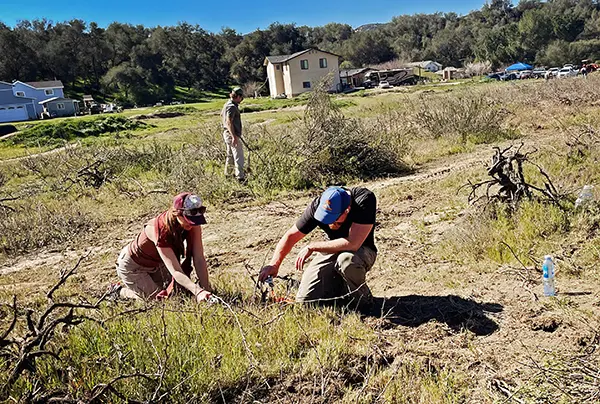
We are a unit now, something even stronger than a team or a crew. Our work is in and on behalf of the vineyard, and this work binds us together— but the bond is not just shared devotion. The tightest fastening come from our shared experiences, a history that we now share not only with each other, but with the vineyard itself.
Ben is the captain of what we call "Team Wildlands." He was there the first time that we touched these crazy old vines, the first time in 70 years that anyone made a cut, removed a shoot. He now knows the vines, one by one. Let me put it another way: as a team, we have made a few hundred cuts in the Wildlands. One human being has made the plurality of them. We are not only caring for this vineyard; for good or ill, we are shaping it. The shape of the Wildlands, visible, palpable, is the shape that Ben and Darcy and Kaeley and the rest of us have given it.
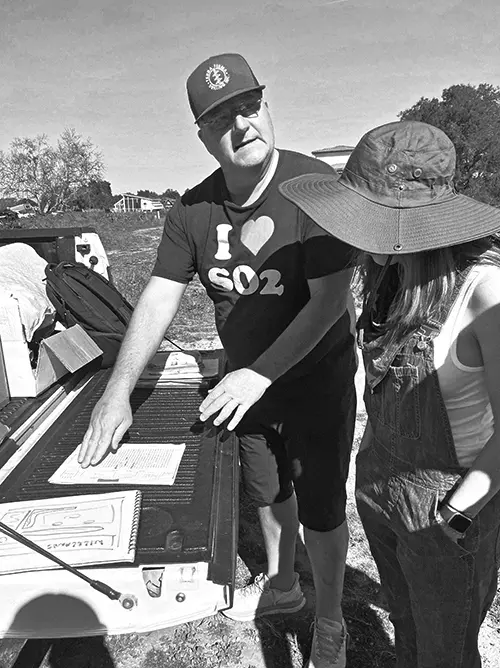
Let me tell you a little bit more about what we did this weekend.
We gathered at 9 am on Saturday morning. I explained the layout of the vineyard to the newcomers, and told everyone how we were going to proceed. The vineyard is a rough rectangle of about 1.9 acres. It is surely the remaining fragment of a much larger original vineyard; how much larger we don't know for sure. It was planted about 1910 by the present owner's, Bob Munoa's, great-great-grandfather. Bob says that he was Spanish, and he thinks that he brought the cuttings over from Spain.
There is an avenue that divides the central rectangle from a kind of spur on the south. The central rectangle has vines that still show signs of having had trunks at some point; they are medium to weak in vigor, and, in 2021, only bore an average of two clusters per vine. (The section inside the white rectangle was so weak in February 2020 that we did not even bother pruning it, but later that year, we noticed shoot growth, thinned the shoots, and pruned the section in 2021.)
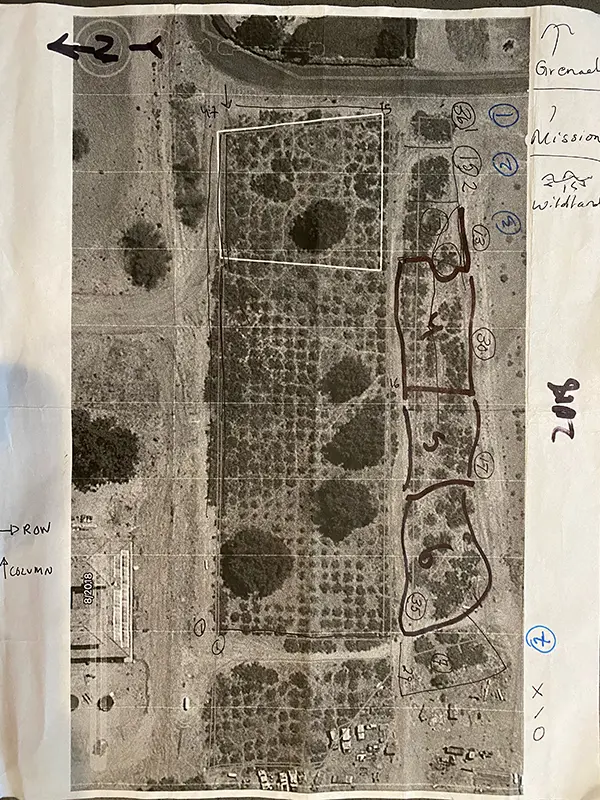
The spur on the south we call "The Wildlands."
When we first saw the vineyard, we had no idea what to make of it; when we first harvested in 2019, we did not even bother trying to find fruit in this section. It was too overgrown. In the Spring of 2020 we finally began examining it more carefully and were completely stunned to see that it had no pruning cuts. No wounds. No sign of human intervention. It takes more than one human generation for a vine to lose all signs of pruning cuts— no one I know knows for sure, because no one has even seen a vineyard like this. But we guess that it would take 50 years or more for the vines to lose all signs of pruning.
The last section, at the western edge (at the bottom of the photo), we call "Pet Cemetery," because it has one within it. It is roughly rectangular but perpendicular to the long axis of the center. We use the term to designate not just an area, but all of the vines of a certain shape and size. Most of them are in this western section, but a few of them are opposite it, in the center, and a few more run around the perimeter of the center. We think that all of these vines might be Grenache, but we have not done any genetic testing on them yet. We have done testing on some very heterogenous vines in the center section, and they all come back pure Listan Prieto— the oldest kind of vines propagated from the Canary Islands throughout the New World. Pure Listan Prieto. Listan Prieto is called "Mission" in most of what is now the US, and is often not a purebred. I will come back to this.
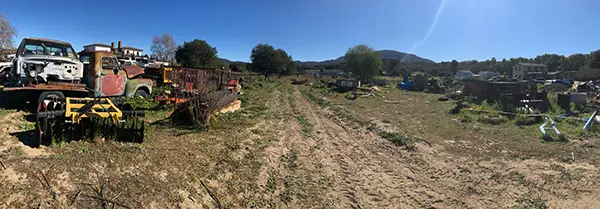
I have divided the 44 of us into four teams: 3 for pruning and one for weed abatement. The first team was devoted to pruning the Pet Cemetery vines; I asked Raj to take charge of this team because I thought that he was particularly in tune with the bigger, stronger vines.
The next team was devoted to the chaotic carpet of vines in the Wildlands, under Ben. Their aim was to bring somewhat more shape and order to the vines, but not to create trunks, or to try to bring the vines into rows and columns.
The last pruning team was under me. Our mission was to go through all of the weak vines in the center and carefully limit the number of buds on each plant, with the aim of limiting growth and allowing the plants to catch their breath, as it were, and focus their energy on one or two growth points. You could say that our aim here was not so much creating architecture as imposing limits.
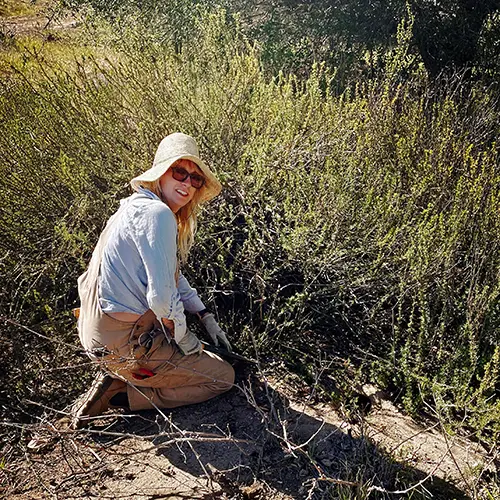
Amanda was in charge of weed abatement, and this was surprisingly important. There are big stands of California Buckwheat in the vineyard, mostly in the weak eastern section. This is a really tough woody weed that spreads through seeds and roots, and it can completely choke out the vines. For the first few years, I just pretended that it was not there. Then, last Summer, I noticed that there were some vine leaves resting on top of one of the clumps of buckwheat. I waded in and found a living vine. Amanda was there for shoot thinning, and the two of us abandoned that task to try to liberate this vine. It took hours to cut down and dig up the buckwheat, but we found a long, straggly vine holding on. Over the next few weeks, up till harvest, we kept hacking away at the buckwheat, but I knew there was still a lot of work to do. She attacked the remaining stands with 8 other helpers. By the end of the day, they had recovered and pruned 20 vines.
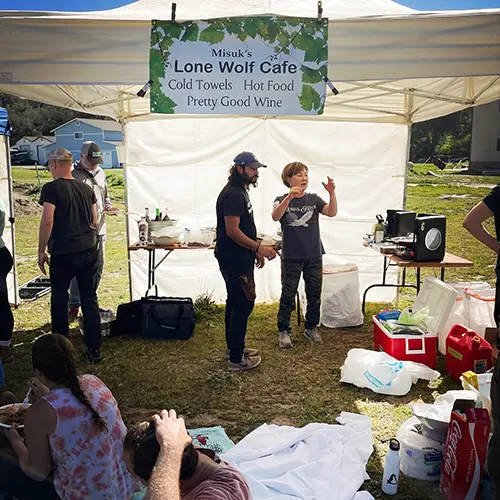
Our first shift was from 9 till 1. You should not believe this, but our vineyard work is catered. The vineyard is about 30 minutes from the nearest lunch place, 15 minutes even from the nearest gas station. So you have to bring lunch. I used to make people work right through lunch, but that is neither kind nor fun. About a year ago, Steve and Misuk recognized our plight and suggested that they would bring lunch. We were shocked when they showed up with tents, tables, chairs, and special wines from their cellar. Misuk always makes Mandoo and Japchae one day, and usually sandwiches on the next. Steve always brings a Hiyu, because their wine and their work is so special to us, and an old Scholium treasure; Ben and others have started bringing Champagne and other treats. Now we break for lunch and also look forward to a little party at the end of the day, with the leftovers.
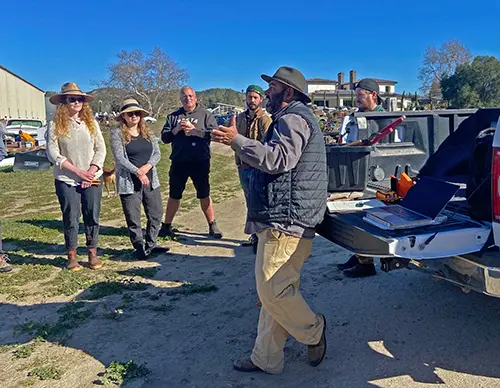
I can't resist the opportunity for a little learning, so we usually have a quick seminar after lunch. This year, on Saturday, Raj rose up, clearly agitated. "The pruning in Wildlands is all wrong. You are leaving all of the buds on the outside, at the end of these long shoots." He picked one up. "There is no structure. No center. The vines have no future."
I think that we all saw it, immediately. Last year was the first year that we had pruned Wildlands. We were only trying to give it some shape, open up some space, limit the buds. We were not trying to give any particular vine structure. Raj was telling us: that mode is past. Now it is time to give the vines structure: give them a center they can flow from, bring the energy back closer to the roots. We knew what our afternoon task was. There was something harsh about this rebuke, but it was still a wonderful moment and we all embraced it. We were not here just to frolic in the sun and drink champagne: If you are going to cut these ancient vines, you had better do it right. Even in our joy, we are reverently focused on what is at stake.
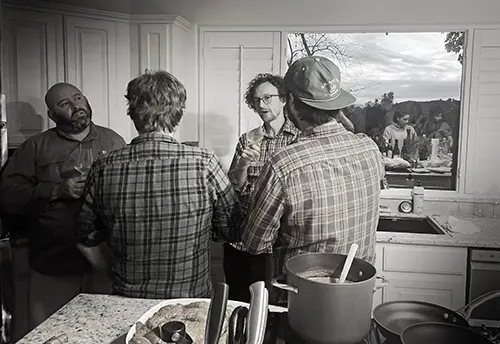
We worked nearly till dusk. By the end of the day, we had pruned every vine in the vineyard. We had liberated 20 vines from the buckwheat. We had gone over every vine in the Wildlands and begun shaping them, picking prospective trunks, cutting back scraggly arms. The work that I had projected for two days, this amazing crew finished in one. We had rented a house for the weekend and made our way there for a festive dinner. There were four of us there who had made wine from Lone Wolf in 2020 and 2021. We all brought samples of our wine. Raj and Christina talked a little bit about the history of Mission and Listan Prieto; Raj and Ben and others brought a wonderful selection of wines that they admired, including two from Listan on the Canary Islands, and several Palominos from all over the world. I brought a magnum of the first wine I ever made, the fabled 1999 Sangiovese from To Kalon.
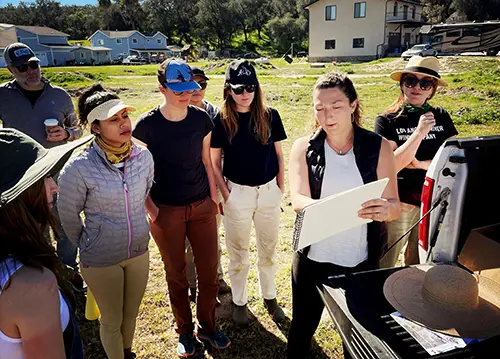
Sunday, the next day, still held wonders. About half of us returned to the vineyard. I had an important task in mind; I just had not expected to get to it this weekend. We did our first vine count last year, somewhat later in the year. We tried to count every vine, distinguish between old vines and new ones that had sprung up, track down the vines growing up the oak trees, distinguish between the vines that looked like Grenache and the ones that looked more like they Mission. I had the very sad feeling after harvest last year that many vines had died during the summer and fall because of the drought, but I never did a count. Now was the time to create a more precise estimate of the health of the vineyard.
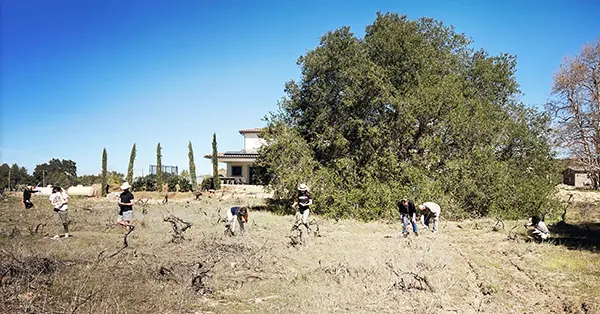
Nina led the vine count last year and was ready to do it again this year. Raj and JJ kept going over the pruning, cleaning up, perfecting; the rest of us lined up on the north side of the vineyard. We found the rows that stretched somewhat haphazardly north-south; each person took a line of vines. Nina called out: "Row 1. Ready?" And then each person made a note of what was in front of them: living vine? dead? Grenache bio-type or Mission? Old vine or seedling, or both?
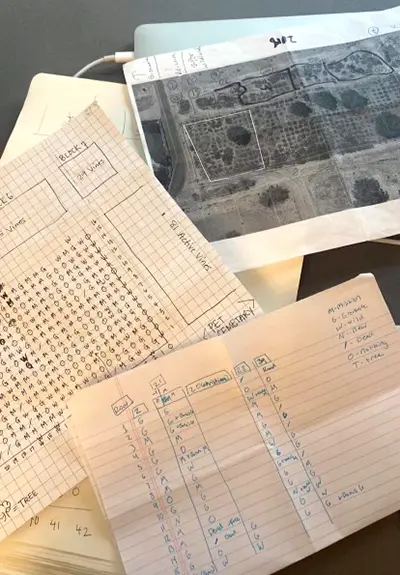
Everyone stepped forward, to the next vine: "Row 2. Ready?" And on we went, one vine at a time. Most rows had 15 vines in them; some had an extra vine at one end or the other. Twenty-eight rows total in the center. We would not know how many had died until Nina compiled each person's data.
But meanwhile, we had learned something really amazing. The day before, a wonderful and crazy winemaker in Sonoma who works only with native American grapevines and native-vinifera hybrids, Matt Niess, messaged me via Instagram and asked me if I would harvest some budwood for him to propagate— but only from hybrid vines, not from straight Mission.
Christina and I had recognized from the beginning that the vineyard must have some hybrids in it‐ since it had not been harvested regularly for years and years, fruit must have fallen to the ground, and seedlings sprouted. These seedlings would be the offspring of sexual reproduction among the grape vines, something that is never allowed to grow to fruition in modern vineyards. We knew that the seedlings would not necessarily be descended only from grapevines within the vineyard: pollen can be brought by bees or wind from far away, and wild grapevines might be nearby. In fact, the cursed buckwheat is an absolute magnet for honey bees because of its pollen, making it even more likely that distant bees might visit. And on top of this, I knew that years ago, a researcher had demonstrated that much of what is called "Mission" in California involves a small amount of hybridizing between Listan Prieto and native American vines. So this is all fine— but how would I know whether I was harvesting only hybrid budwood for Matt?
His answer was plain and simple: the shoots of anything with native germplasm within them would be slightly furry with tomentum. Anything that was pure vinifera would have canes whose wood was smooth. No one had ever told me this. So now, Sunday, we are all straining even more closely to the vines: is the wood smooth? Or is this a little fur I see? I started picking up random canes that we had cut off; about 20% of them had fur. Many young shoots— seedlings— coming straight out of the ground had fur. But this was not really a surprise. We were now merely closing in on a number for what we had expected qualitatively. But there was a surprise: especially in the center, many apparently old vines had tomentum on their canes, and a different, more striated, bark than the pure vinifera vines. We had big, fruit-bearing, old-vine hybrids in the vineyard! We have been making wine not only from Mission and perhaps Grenache, but from spontaneous, natural, native hybrids.
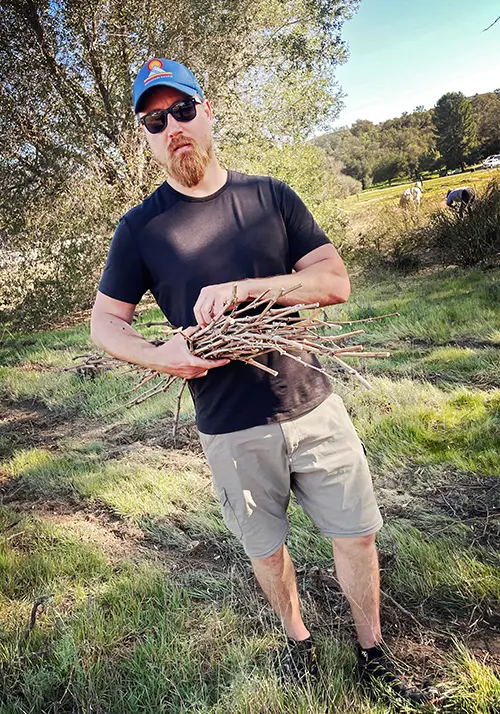
The presence of old vine hybrids should not have been a surprise to me. Bob Munoa says that his family stopped harvesting fruit regularly from the vineyard more than 50 years ago. So, for at least 50 years, fruit pollinated by native American grapevines has been falling to the ground. There is no reason that there should not be some 50 year-old hybrids within the vineyard. I just did not foresee it.
I don't know exactly how to put words to this; it is going to take a while to think it through, and perhaps mine is not the mind to do it: but here, on the Pechanga reservation, how right is it that we are making wine not just from European grapevines, but from the offspring of these grapes and the Native American vines that have always been here. The special opportunities that this vineyard offers still the mind.
Thank you so much for your attention once again.
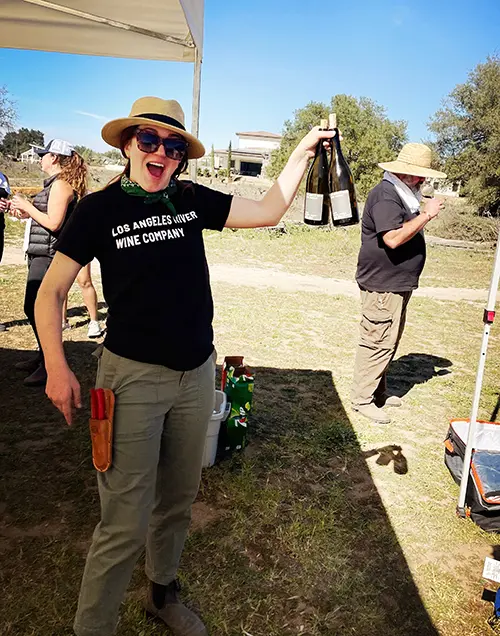
Now, I want to alert you to a couple of developments away from the vineyard. You know that we are going to bottle our 2021 wines next week and many of you have purchased some of them. I wanted to let you know that we are going to bottle more magnums because they sold ot so quickly ("more." Ha. About 30 more.) And there are individual bottles and a few packages still available.
And I wanted to let you know that I have scheduled tastings, at which I will present, and you will be able to taste, all 13 wines that we will bottle next week. All 13, even if some of them have sold out. I am saving enough for the tastings. If there are wines left, you will be able to purchase wine for delivery, and, depending on the venue, purchase some to take home.
These are the tastings:
- NEW YORK CITY:
MONDAY MARCH 14, tentatively 7 pm - LOS ANGELES:
SATURDAY MARCH 19, tentatively 7 pm - CARPINTERIA, CA:
SUNDAY MARCH 20, 3 PM - NAPA:
SATURDAY APRIL 23, 3 PM
I also want to do a tasting in Texas, in Austin or Houston, but I need a venue. Or I would happily do one on Marfa if you want to drive there.
I hope to see you soon.
Thanks again, so much.
Abe