Harvest 2021 is over! An end of harvest report.
The drought is crippling, yet there is brilliance
THE 2021 LONE WOLF HARVEST—
AND A HAPPY OVERVIEW OF THE WHOLE VINTAGE
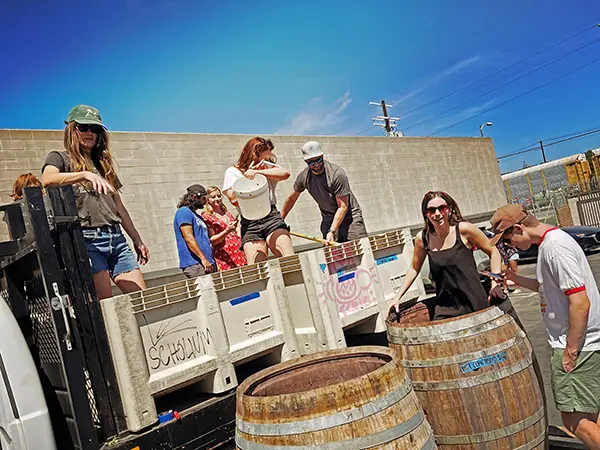
I have so much to tell you. We harvested Lone Wolf 12 days ago, and it feels like another year. Four days later, we returned to the winery and brought out every barrel, every fermentation, and started assembling preliminary blends. Harvest was over (with one happy exception I will detail below), and now, 5 days after this, I am ready to begin reflecting, reviewing, and composing an overview.
1. THE SOURCE OF JOY
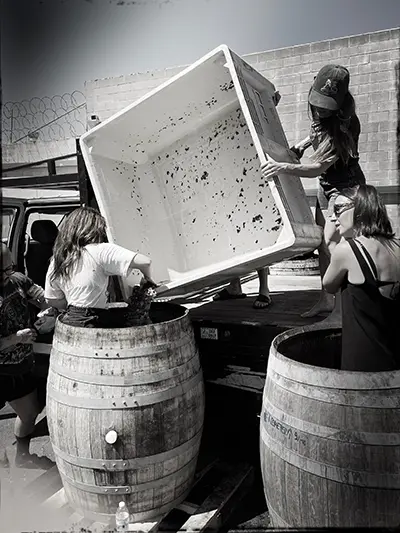
The first thing that I want to tell you, breathlessly, and with some trepidation, is that I think that this has been the best harvest of my life. There might be a hundred reasons for this, but I will concentrate on only one here: the quality of the wines. Last year, we truly struggled in a terrible time, working in masks, always afraid that our proximity might spell doom for each other. We rarely shared a beer after hours of sweaty work; we went home, separately and prudently. There is no way that this did not mark the wines of the 2020 vintage.
I told you this when I released them to you: they were wines of a plague year, and, in some very difficult way, they embodied the quiet terror in our souls. Our work was tremendously joyful too, a true blessing to all of us, especially the work in the open air at Lone Wolf— and the gods of wine responded to this joy, and somehow protected our wines as they fermented in 100 degree heat. I am proud that the wines of 2020 are delicious and still somehow embody the unrepeatable difficulty their origin.
This year, it is not that we are out of the woods, it is not that the plague is over and only exists in our memories— but we walk with so much more lightness in our steps; and we smile at each other not just with our eyes, but with our whole faces, unmasked, and close to each other. We hug and high-five. And there is no way that this lightness, this spirit, these gestures— there is no way that all of these do not find their way into the wines we made this year.
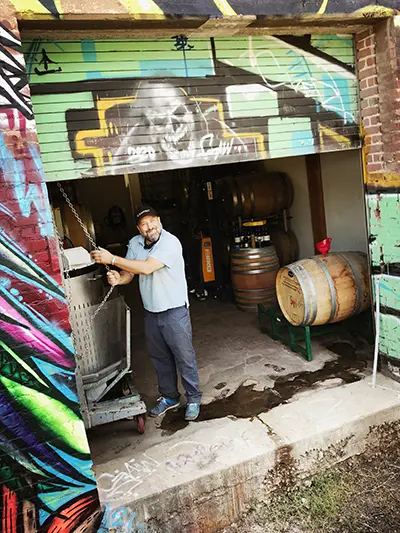
The wines are so beautiful. Never have my wines made me so happy so early in their lives. I am going to single one out, perhaps the most surprising of all of them: Heart of Sand Blanc. It is made from an even mix of Mission, Rose of Peru, and Grenache; pressed by our friend Adam of Sabelli-Frisch at his wonderful little winery, and fermented in a combination of neutral oak barrels, and, for the first time in my life, a terra cotta amphora!! It is made nearly all from fruit that is pink and purple, not gold or green or yellow, yet it has the body and verve of beautiful, light, white wine. I cannot wait to share it with you.
2. LONE WOLF
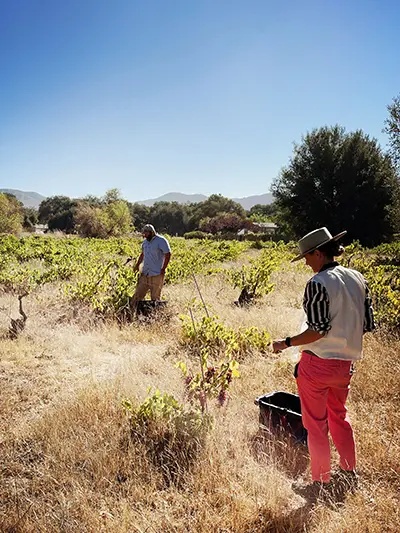
The report is not all good news. Matthew and I went down to Lone Wolf on the Friday before we intended to harvest it. We walked the whole vineyard and tried to estimate how much fruit there was in it. The week before, we had come down and picked all of the yellow clusters off the vines to make a Lone Wolf Blanc. It took the whole day and we got only 600 pounds, but we were excited to come back this weekend and get the rest of the fruit.
When we got back in the truck, I took out my note pad and laptop and calculated. I told Matthew, "I think that there is 2 tons out there." I have been doing this 20 years and I am pretty good at it. This is Matthew's second season in vineyards. He said, "There is not 2 tons out there. Maybe not even one." I knew right away that I was kidding myself, calculating based not on facts, but on hopes and desires. Yet I could not imagine that there was only a ton. We harvested more than 4 tons last year. If Matthew was right, we might be looking at a ton and half this year.
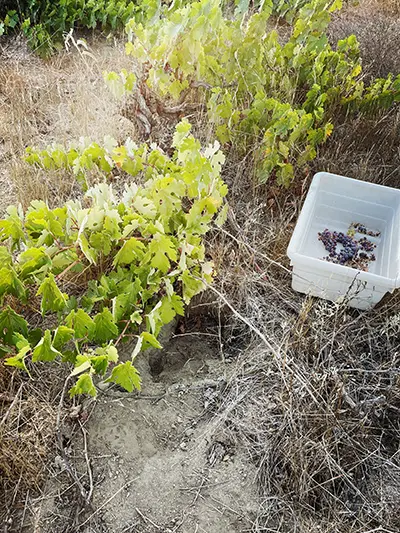
This is the second year of a very severe drought that has affected the whole West of the nation. Tegan and I walked some vineyards in Amador in May and saw right away that there were no baby clusters on the vines. No clusters. There would be no fruit. When I got down to Lone Wolf a few days later, I thought that I saw lots of cluster primordia, as many as last year. But I was already using my imagination more than my mind.
To the right is a photo of a picking bin in between two pretty typical Mission vines in the center of the vineyard. In the bin is all of the fruit from the two vines. Maybe enough for a quarter of a bottle; an eighth of a bottle per vine. Last year, we were averaging more than a bottle per vine. The drought is so severe that if there is not rain soon, we will have get water trucks to drive to the vineyard, and will flood irrigate the vines that are struggling like this. We would do this post-harvest, not to increase production, but to save the vines. There are many that were worse, that had no clusters at all.
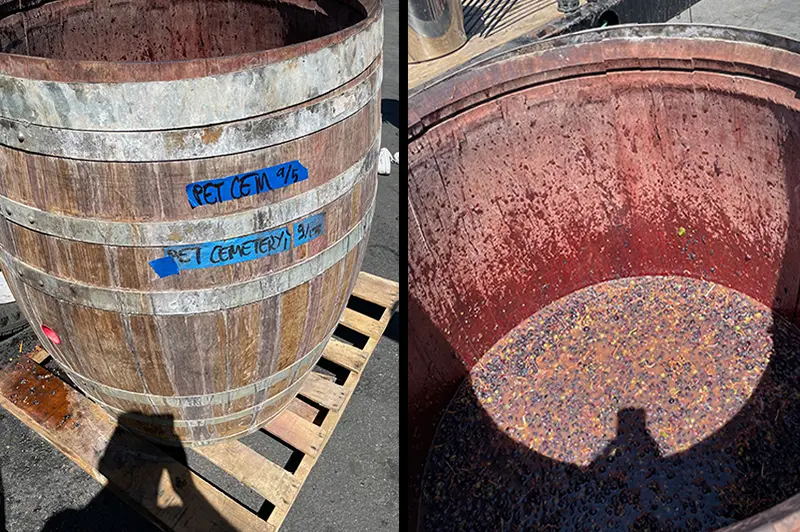
Matthew was right. We harvested about 1500 pounds the next day, for a total of 2100 pounds for the whole vineyard this year. About a quarter of what we harvested last year.
To the left is our typical fermentation vessel for skin-fermented wines. Last year, Pet Cemetery filled two. Look inside this year's fermentation. Maglite, the vineyard that we make Heart of Sand from, is way down this year too— but perhaps by less than half. Last year, we had to walk away from some of the red fruit and did not even make a white wine. This year, we felt so grateful to be able to take the whole vineyard, red and white fruit.
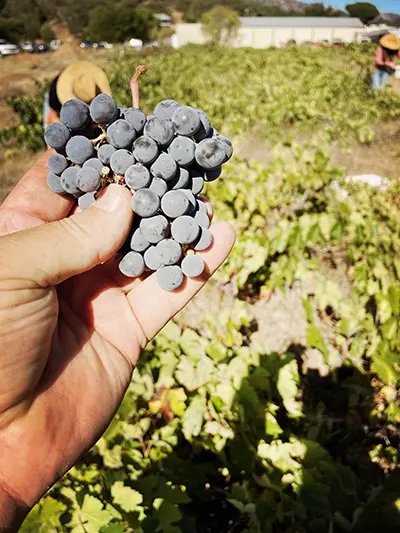
The good news is that the quality of fruit is exceptional. To the right is an especially small and beautiful Mission cluster from Lone Wolf, looking more like Grand Cru Pinot Noir than the usually gargantuan and indelicate Mission. We are going to make 4 wines from Lone Wolf this year, just as we did last year: the Blanc, and three reds. The reds will be from the center, from Pet Cemetery, and from Wildlands.
My projection is that we will make 115 bottles each from Pet Cemetery and the Wildlands, and 168 from the center. This means that we will sell all of this wine through the futures program, and then it will be sold out. More on this below.
I will write back to you in a few weeks, especially to let you know if we will irrigate. Winter pruning will be especially important this year, to allow the vines to recover somewhat and ensure that they do not over-extend themselves next year. It is a daunting and awesome honor to become the guardian of these vines.
3. A QUICK REPORT ON THE OTHER WINES
I have already told you about Heart of Sand Blanc. We have 5 other white wines, beyond the Heart of Sand. I had always thought that it would be possible to make excellent white wine in Southern California, but this is a dream come true! Two of them are also Blanc de Noirs: one from Lopez Zinfandel, an echo of the beautiful wine we made in 2019; and one from Lone Wolf. Both are exceptional already: light but strong, very present, incisive wines.
Two of the other whites are truly remarkable and represent the result of a kind of search for buried treasure. They are both old vine Palomino, the single historic white grape of Southern California. One is from a corner of Lopez, the great Zinfandel vineyard planted in 1918 in the Cucamonga Valley. We have searched for this vineyard since Christina and I heard about it in 2019 and saw it for the first time last year, at the end of harvest. It was in terrible shape, and we could not make wine from it. But this year, our colleague Fidel pruned about two acres of it, and we began monitoring the vineyard early in the year. We have been so impressed with it, and are so excited, that we have shared the vineyard with 5 other colleagues, including our friend Raj Parr, who drove down from Cambria to harvest fruit. Dom Galleano controls this vineyard, as he does the rest of Lopez, and is so pleased with our devotion to it that he has given permission to us to prune it next year— in preparation for harvesting much more fruit.
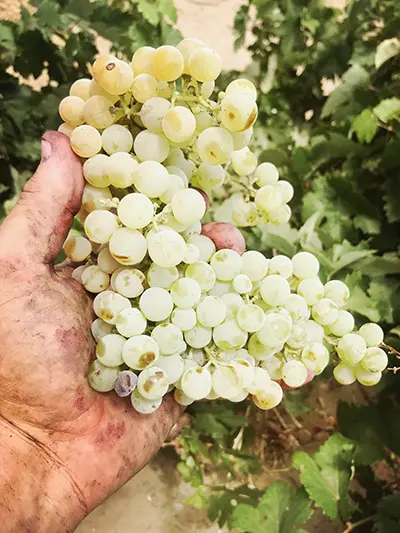
The second of the three other whites is also Palomino, and is also controlled by Dom. It is Palomino from about 1912, planted on the Galleano Home Ranch. The vines have been better cared for than the vines at Lopez, and have access to much more underground water. The clusters at Lopez were small, with very small berries, pressed tightly together. The clusters at Galleano home are large and big-berried. We made a sharp and intense wine from Lopez without any skin-contact; we have made a much more expansive, more charming wine from Galleano, half skin-contact and half juice.
I suspect that we are the only winery in California producing not just one, but two, single vineyard Palominos.
The last white wine is a blend of Galleano Home and Heart of Sand Bland: this year's edition of Disco Essence. Not as funky as last year's, but still, a very fun exploration of what a blended Los Angeles white wine can be.
We have made all of these wines in tiny quantities, measured better in bottles than cases: 115 bottles of the Lone Wolf red wines and our Lopez Red; 280 of Disco Essence; 280 of a red co-fermenation of Maglite Grenache, Lopez Zin, and Galleano Salvador, called "Riverside Red." It is fantastic, and an important lesson: in spite of our devotion to presenting single vineyard wines from these important sites, blending and co-fermentation can produce very moving wines of intensity and precision.
4. FUTURES
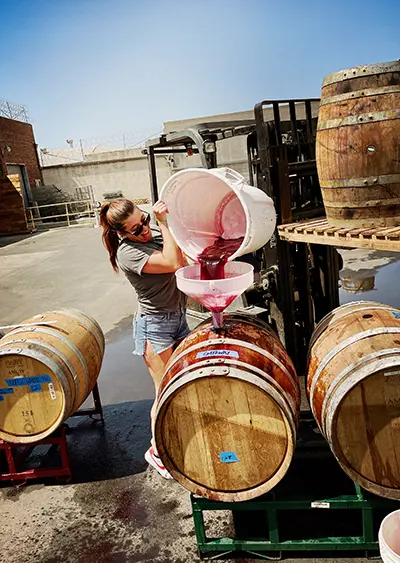
About two weeks ago, right before we had harvested Lone Wolf, I sent a futures offering to you: purchase 12 individual wines of our 2021 harvest now, for delivery in the Spring. I compared it to a Tock purchase, for a special dinner you would enjoy in the Spring. We now know a little more what the nature of that dinner will be.
We have sold nearly all of the 100 cases of futures that we have offered. I am now going to offer another dozen cases to reflect the 115 bottle limit. This means that all of the 115 bottle wines will go into these shipments and will then disappear. The other, "higher production" wines (I laugh), will be available again in March or April. We will ship the futures as soon as the wines are bottled, and before the summer heat. A little before bottling, I will make another offering of the remaining wines to the whole of the mailing list. The retail value of the 12 bottles in the futures offer is about $730, so the futures price of $500 is about a 30% premium.
You may go here to make a futures purchase. You may also use this link to see exactly what wines are in the package, and what their retail prices will be.
Thanks so much for reading so far, and thanks so much, as always, for your support and attention.
Abe
PS: we began shipping again last week, but then had to stop once again because of intense heat. The heat has broken and we will begin shipping again Monday.