Harvest is nearly complete! A report & an offering to our closest supporters
A preview of the 2021 wines
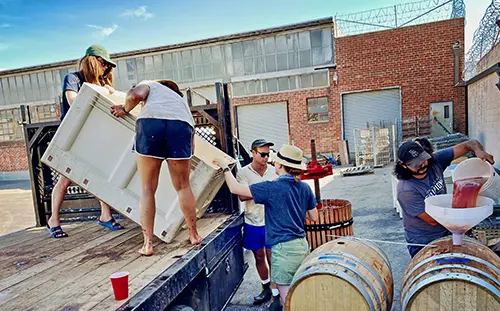
HARVEST 2021— A FIRST REPORT
And an offering!
I am so consumed with excitement that it is hard to write. In a certain sense, I don't even know where to start. The last time I wrote you was on the eve of harvest, and I had just completed an amazing car trip across 4 deserts of the American Southwest, and was reflecting on the way in which what we are now doing is tied to the desert— not just geographically and agriculturally, but somehow metaphysically. Now, only a few weeks later, harvest is nearly over and I am overwhelmed with its success.
I am pausing to write to you because I now have a moment to breathe, and reflect. I am writing to YOU, because you made a gesture a year ago that allowed us to complete the 2020 harvest. You were one of 103 friends (I had meant to limit it to 100!) who had the boldness to purchase a future allocation of the 2020 wines when they were not even all made. For this reason, I want to give you the first report on the nearly completed 2021 harvest, and the first access to the wines from this wonderful vintage.
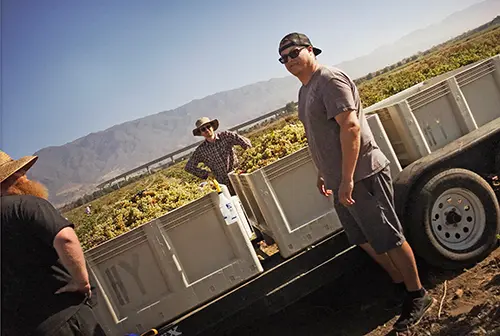
We will make 15 wines this year, from 8 different vineyards, 7 of them in the infinite sands of the Los Angeles basin. I am going to tell you about the harvest of each of these vineyards, one by one, in order, and then give you a link where you can make a futures purchase of these wines, similar to the one that you made last year. Once again, I am going to offer only 103 of these futures purchases. For now, I am making the offer only to last year's purchasers; I will open it up to the rest of the mailing list Thursday evening.
1. LOPEZ GOLDEN CHASSELAS
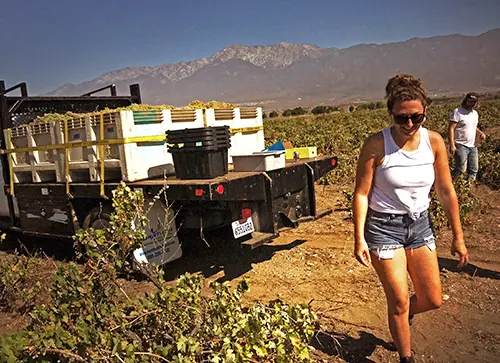
This is the vineyard that I wrote to you about in the desert report. It was planted (we now know) in about 1912, and then a section was replanted in 1960, with cuttings from the original vineyard. It is about 30 acres total, and only about 3 of them have been pruned in the last few years. The new vines (only 61 years old!) fill about 2 of those acres. We harvested all of our fruit from the small amount of pruned 1912 vines, and from a few rows of the unpruned, but still remarkably healthy, 1912 vines. We will make two wines from this harvest: an unblended, single-vineyard, juice-fermented white wine; and we will blend some of this into a new vintage of Disco Essence.
I learned years ago that Palomino in California was often called "Golden Chasselas" by the original farmers who planted the grapes. I had forgotten this until a Cucamonga local helping us to harvest the fruit called it "Golden Charelass," and then it hit me. I find this strange name so charming that we will call the wine that we make from the vineyard "LOPEZ GOLDEN CHASSELAS."
The photo above right is Domenic Galleano, inspecting our harvest with bemusement and a kind of grudging enthusiasm. (Press down on any image to zoom in.) His family holds the lease on the property and I think that it is fair to say that until about 6 of us showed up one morning with trucks and trailers and a lot of friends and picked and hauled away a few tons of fruit— until that happened, he did not think that there was a lot of demand for his Cucamonga Valley Palomino. We now have his pledge to allow us to prune the vineyard next year and to purchase a lot of fruit. We are so happy and grateful for this. A revolution in white wine from the outskirts of Los Angeles awaits all of us.
2. MAGLITE GRENACHE, MISSION, AND ROSE OF PERU
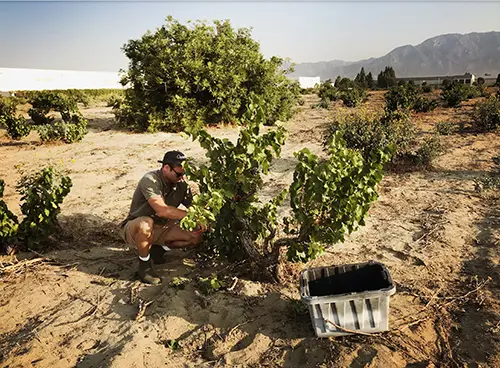
"Maglite" is the name of a carefully farmed vineyard on Francis Road in Cucamonga, opposite the Maglite USA corporate headquarters. The vineyard was also planted around 1912. It has two sections: one is about 90% Grenache Noir, 5% Alicante, and 5% Mission. We will make a red wine from this section, just was we did in 2020, called "Heart of Sand." It is a Grand Cru site for Grenache and makes an ethereally pale red wine.
The "white" section is about 45% each Mission and Rose of Peru, and 10% Grenache. We ignored it last year. This selection of varieties means that none of the fruit is actually white, or yellow, or golden. It is all some version of pink or purple. We will make a small amount of unblended Blanc de Noir from the fruit ("Heart of Sand Blanc"), and the rest will form the foundation of this year's version of Disco Essence.
3. GALLEANO HOME RANCH RED AND WHITE
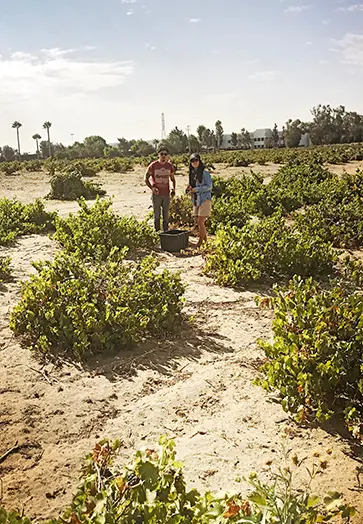
I am speechless with gratitude for the alliance we have formed this year with Domenic Galleano. He made us feel at home in a very special land farmed by his family for 4 generations. He is the quiet leader of a whole culture that preserves not just vineyard land, but the mores of another time and place. It is such an honor to work with him and his family.
He called me early in August and said, "Do you want the Salvador this year?" In 2019, as Christina and I were getting to know him and his family's holdings, he told us about a grape that they no longer bothered harvesting, because there was so little of it, and its growing habit was so annoying. The vines sprawl on the ground; the clusters are small and few, and hide in the vegetation. We made a tremendous wine from the fruit in 2019; so, of course, I said, "Yes!"
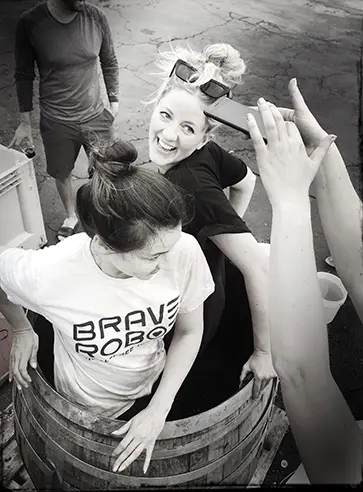
We presented ourselves in the vineyard on August 14, about a dozen of us. We picked all of the Salvador, and there was not much of it. Dom rolled by in his Mad Max 4WD Toyota and said, "There is about 6 tons of Mataro on the far side of the vineyard. Why don't you go pick that?" And then, looking at our truck, "You don't have four wheel drive? Don't worry, I will pull you out."
We are making a deeply colored red wine from the fruit; it hovers between feral and merely witchy. "Galleano Home Red."
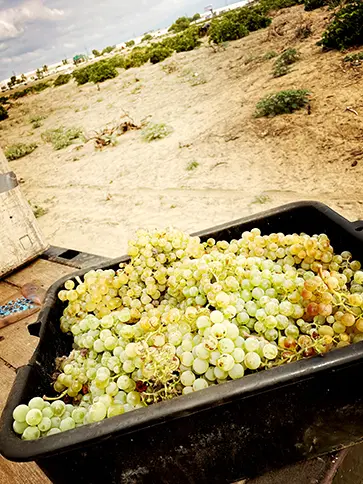
Adjacent to the Mataro was a lot of Palomino. I picked a little to put in with the Salvador and Mataro, and made a mental note to ask Dom for some next year. Six days later, he called me and said, "Why don't you go get some Palomino? We are picking it now." We were in the neighborhood anyway, out there to pick a half ton of Lopez Zinfandel, so we hustled over and got half a ton. We turned half of it into juice and skin-fermented the other half. We have combined them and made one barrel of a single wine. It is superb already. "Galleano Home White."
4. LOPEZ ZINFANDEL
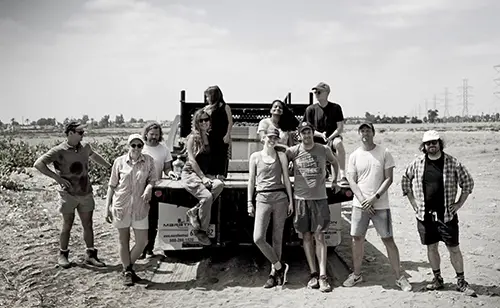
A few days later, I gathered up some friends and returned to the street fronting the Lopez Palomino. I was interested in making a red wine from the same part of Lopez, the same colluvial soil that underlay the Palomino. There was a block of Zin right across the street. Dom gave us permission to pick a ton of it. We worked very hard and scraped up half a ton on a hot morning. The most interesting thing is this: the Zinfandel in this part of Lopez was way less ripe than most of the rest of the vineyard: it was about 19 brix, where Dom was harvesting fruit from another section at about 23. This means that the fruit from our section will be significantly lower in alcohol, and will be lighter and fresher. We brought the fruit back to the city, foot-stomped and pressed it, and have made a barrel rather dark White Zin from this harvest.
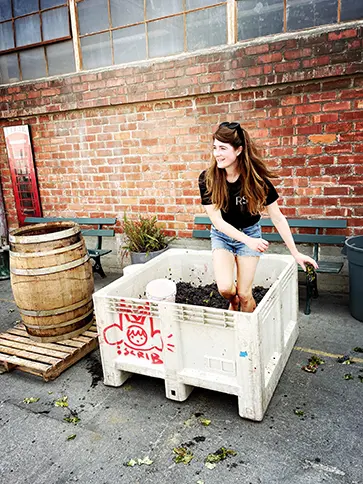
A few days later, Dom summoned us again and we went out and picked up another half ton, from another section of the vineyard. 24 brix. We will make about 18 cases of a robust red wine from this fruit.
5. GUMAN SYLPHS
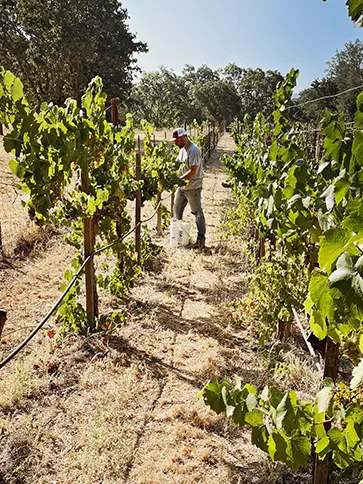
You might remember the story of the Guman vineyard in Napa, and its noble owner, John Guman, who disappeared from me during the first year of the pandemic. We got in touch again in April, after a hiatus of nearly two years, and a few Napa friends and I worked steadily in his untended vineyard to bring it back into a harvestable state. Raj happened to be in Napa about 10 days ago to sample his Merlot vineyard for Colette, and graciously sampled Guman for me. He loved the vineyard and told me to get my butt up to Napa and harvest the fruit.
Matthew, Jaime, and I drove up on the 25th, and on the morning of the 26th, met three more dear Napa friends to harvest the vineyard. We found a scant 800 pounds of fruit and brought the precious cargo back to Los Angeles to stomp and press. The fruit was beautiful; intense in flavor and high in acid. We will return to farming the vineyard this year and expect much more fruit next year. In the meanwhile, this will make a very special wine, marking the return of the vineyard.
6. LONE WOLF— WHITE FRUIT
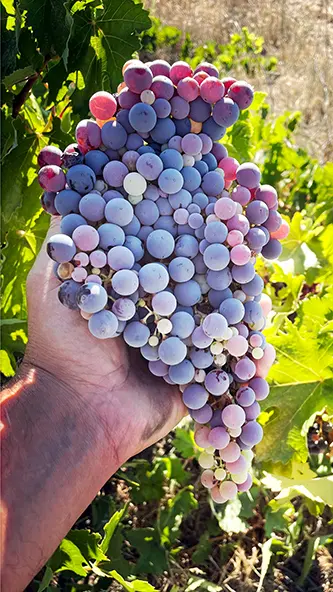
We know and understand so much more about Lone Wolf now that we have worked with the vineyard through two full cycles of growth, and have spent hundreds of dear and beautiful hours among the vines. Last year, we decided to segregate the unforeseen yellow clusters on vines of red fruit, and the more pink clusters from all over the vineyard. We made a single barrel of whole-cluster pressed "white" wine from this, with no skin-contact. It was perhaps the best wine we made last year, and demonstrated why the old California winemakers often regarded Mission as a grape for white wine.
For this reason, I planned from the beginning of the year to make a white wine from Lone Wolf. As we sampled the vineyard throughout the growing season, I tried to determine if there was one section that might be better for white wine than the others, or, conversely, for red wine. I decided that Wildlands seemed to be headed toward more even coloring and ripening, without as much yellow and pink fruit, and so decided to make white from the other two sections, Pet Cemetery and the Center. To maximize the ripeness of the red fruit and the freshness of the white fruit, we would harvest these two sections twice: once, picking only yellow and pick fruit; and then again a week or so later, coming back for the more ripe red fruit. We performed the first of these picks on Saturday.
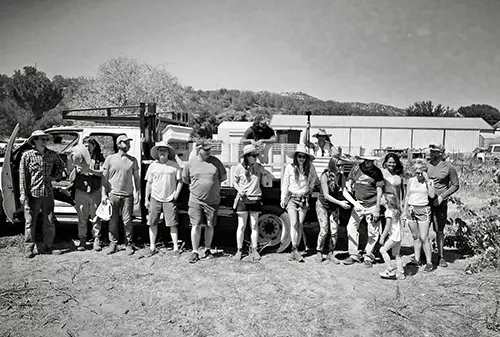
It was nearly 100 degrees in the vineyard, and our work was painstaking. We worked very hard, and harvested about 800 pounds. We drove it back to the city on Sunday— but stopped in Cucamonga on the way back to pick Gateway.
7. GATEWAY
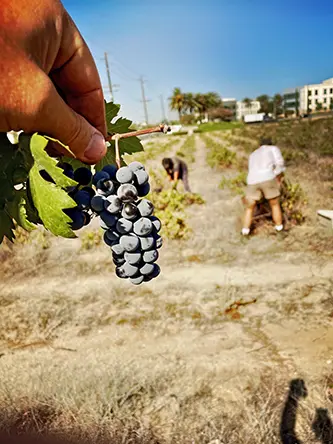
Gateway is one of our abandoned vineyards. I will write much more about all of them in my next missive, in about 10 days. It too is in Rancho Cucamonga, not far from the Galleano Home vineyard. It too was planted in the Cucamonga heyday, in about 1910. It consists of one block of tiny, withering Zinfandel vines; and another that is more mixed Zin and Rose of Peru. The clusters are tiny and few, but their quality on Sunday seemed absolutely extraordinary. I was reminded of Pinot Noir more than Zinfandel. Six of us worked very hard, on the hottest day of the year, and picked about 700 pounds from 200 vines. We brought the fruit back to the city and stomped it, just as we were pressing the Lone Wolf Blanc. We expect to make about 18 cases of a glorious Gateway red this year. As we did last year, we will call the wine "Phulax," Ancient Greek for "guardian."
8. LONE WOLF— RED FRUIT
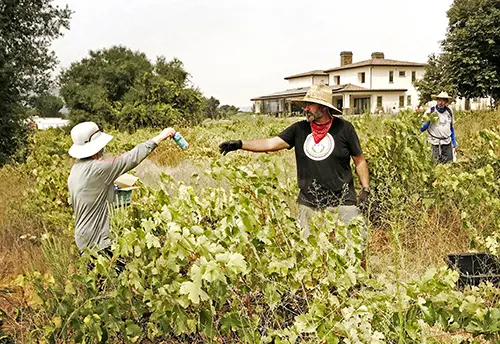
We will return to Lone Wolf on Saturday for our last pick of the year. Raj is coming down from Cambria, and many friends are making their way out from the city. Steve and Misuk will come up from from San Diego and feed us lunch. It will be much more cool and welcoming than last week. The pick will be a celebration in itself, a celebration of discovering Lone Wolf, a celebration of the Munoa family's opening of the vineyard to us, a celebration of all the work we have done in the vineyard since then, escaping from the city during the height of the pandemic, and through all of the nauseating waves since then. During all of this time, Lone Wolf has been our focus and our anchor, and, as glorious as the white wine is, the acme and culmination of our work is to make a wine from Lone Wolf with everything the vineyard offers: skins, and seeds, and stems. This means that the quintessence of Lone Wolf is its red wine, and we will begin to make it next week.
And them, with all of the fruit harvested, we move on: we will monitor fermentations, make decisions about separating the wine from the skins and seeds, and prepare the wines for aging over the winters. And we will begin packing and shipping wine again, after a long hiatus over harvest and the ferocious heat of summer.
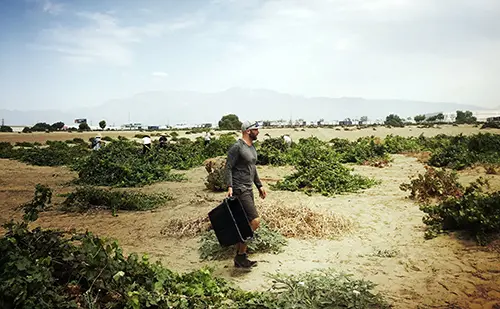
Last year was such a tremendous struggle. Terror lurked in our souls during the whole harvest. Fermentation seemed to be a kind of triumph, and a blessing, in themselves. We were, of course, trying to make the best wines that we could— but really, making any wine at all was our aim. This year, there is still much to do, many difficulties and struggles still before us, but we are making much better wines. We are making wines marked not by terror (undeniably interesting in themselves), but wines that tend toward beauty. We are making wines that speak not merely of trying hard in difficult circumstances, but of accomplishment.
You may go here to buy the wines of the 2021 vintage right now, and, just as you did last year, your purchase will propel us to the end of a triumphant and wonderful harvest.
And just to remind you how this will work: we will bottle the wines sometime in the Spring and ship them immediately afterwards. So this purchase is kind of like a Tock reservation for a dinner that you will not eat till Spring. We bottled quite early last year because we had to move— I am actually working toward a more permanent home for us right now, and this will enable us to bottle somewhat later. (Among other benefits to us, this offering will help get us closer to that home!)
We will ship the wines as soon as they are bottled, and before the summer heat. A little before bottling, I will make another offering of the wines to the whole of the mailing list. Last year, the futures buyers got all of the wine from Pet Cemetery and nearly all of the Pecorino Flor. Something like this could happen again this year. The retail value of the 12 bottles in the futures offer is about $730, so the futures price is about a 30% premium.
When you go here, you will see exactly what wines are in the package, and what their retail prices will be.
Thanks so much for reading so far, and thanks so much, as always, for your support and attention.
Abe