The Desert is not what you expect: a tale of two distant vineyards
THE DESERT— WONDER AND DESOLATION
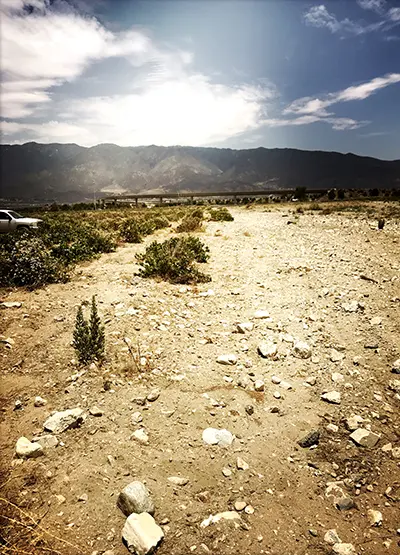
I just completed an amazing trip from Los Angeles to Marfa, Texas. The trip began and ended in the vineyard on the left. This desert vineyard is not in Texas, Arizona, or New Mexico. It is 48 miles east of downtown Los Angeles.
1. MYTHICAL PALOMINO
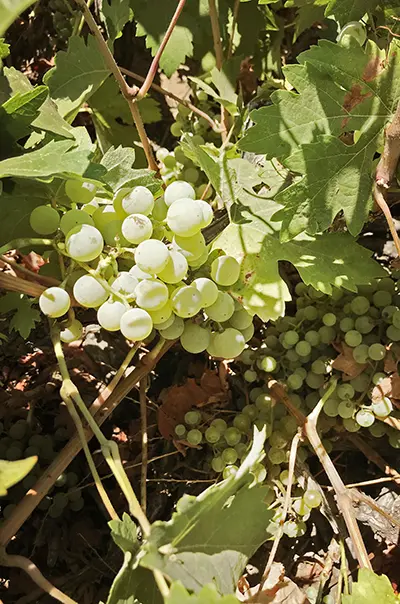
The photo is from the edge of the historic Lopez Vineyard, in Fontana, California. The Galleano family, who have made wine here since before Prohibition, farms most of Lopez; and we got fruit from them in 2019, and will again in 2021 (the 2020 vintage was decimated by a week of 100+ plus weather at the beginning of harvest). They do not farm this section at the moment; only the first twenty rows or so are pruned, the next 80 have not been touched in a few years. The rest of Lopez is meticulous— ancient but somehow perfect. This roughly tended section is the mythical Palomino block.
The rest of the vineyard, a couple of hundreds of acres, is beautiful Zinfandel, planted in 1918. I call this block "mythical" because we heard of it for the first time in 2019, but could never find it, nor get anyone to tell us about it. I drove all over Fontana with Christina in 2019, and then Katia the next year, looking for it. It is tucked in behind some Zin, on a spur stretching west of the main body of the vineyard. As soon as you get near it, you can tell that it is no longer Zin: the vines are much more robust and bushy than the Zin, taller, wider; and the canes are golden, not gray-brown like the rest of the vineyard.
In a certain sense, there should not be Palomino here at all. The vineyard was planted by José Lopez on the eve of Prohibition as a "packing vineyard"— to service East Coast home winemakers determined to make their allowed 200 gallons of wine per year for home use. Zinfandel was the perfect grape to ship east to the Mediterranean immigrants all over the Northeast: dark, rich, flavorful, and robust enough to hold up for the train ride. For simplicity and consistency, José planted all of his vineyard to Zinfandel. During harvest, the train pulled up to the middle of the vineyard.
Yet here is white fruit. There was already a long history of planting Palomino in Southern California to make sherry, and there are a few other plantings left in the area. But there was no market for Palomino for East Coast winemaking. This vineyard is all about pre-Prohibition forethought. Why is this fruit even here? We do not yet know. The place begins as a mystery.
2. THE SHEEN OF THE DESERT
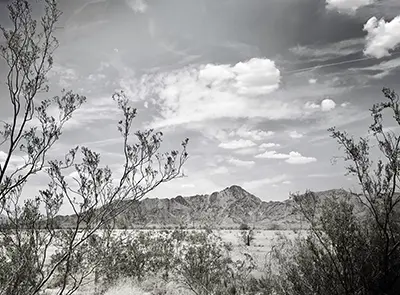
When my friend Brenna, the geologist I mentioned in my last email, first set foot in Lone Wolf, she said, "This is a desert." She meant something very specific and kind of technical. She was referring to the soil, and explained that it reminded her of what is called "desert pavement." This is a very specific geological formation in which somewhat larger particles sit very close to each other, on top of much smaller grains of sand. The larger particles might touch directly, or be somewhat tangent, slightly separated by a border of the fine sand beneath them. The surface is more or less flat, gently sweeping at most, never uneven or broken. The origin of these formations is not well understood, as common as they are: do tiny grains of sand blow away from the larger particles, leaving the larger ones behind? Or, do the tiny grains of sand infill, beneath and around the larger particles? Recent theorizing supports the latter.
For me, perhaps the most interesting things about desert pavement is its microbiological side. An extremely thin and subtle sheen coats the whole surface of the formation, at the interface of rock and atmosphere. The sheen is called "rock varnish." The varnish is caused, remarkably, by a network of bacteria and fungi, that, even in the extraordinarily hot and arid environment of the desert, metabolize clays from the soil in the presence of oxygen, and exude a metallic sheen that coats the surface of sand and little rocks alike. In a certain sense, the varnish is not just the product of the microbes: when we see the varnish, we are seeing the not only what the microbes exude, but we are seeing the otherwise invisible microbial web itself. The microbes produce a kind of fragile glue that holds the pavement's surface together; this glue is invisible aside from the varnish.
The sheen of the desert is the quiet radiance of its nearly hidden microbial life.
3. THE NATURE OF THE DESERT
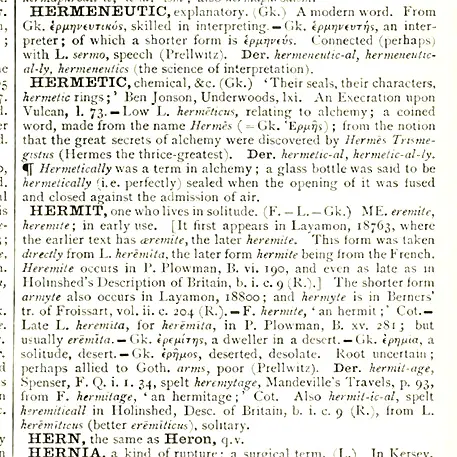
The Ancient Greek and Latin words for "desert" are very different, with no apparent etymology in common. Our "desert" comes directly from the Latin desere, which means "to undo or sever one's connection with another; to leave, forsake, abandon." It is so interesting to me that origin of "desert" is not in solitude or emptiness, but in the cutting of ties. In this sense, our verb "to desert"— to abandon— is immediately close to the root meaning of the place. The desert is somehow that which is without ties, without relations.
The Ancient Greek word for "desert" is ερημια — erēmia. Its closest relative in English is "hermit," the dweller in the desert. Here solitude is primary. But the root meaning of the word does not seem to be tied to the solitude of a human, but the emptiness of a place. That which is ερημος— erēmos— is not solitary; it is bereft or empty. ερημος seems to be different from our word "deserted:" this implies that a place was once full and is now empty. ερημος is more empty by nature than abandoned.
The American desert is full of both kinds of places. One part of the charm of the desert is undeniably its ghost towns. Part of the strange allure of Marfa is that it was once nearly a ghost town: its present life is the life of the revived, not of the always vigorous. New Orleans, for instance, is the opposite: a swampy, riverside, city, always decaying, but always full of a present life, no matter what disaster strikes it. Marfa: full of buildings that had not long ago been abandoned, and that stand now only because no one could be bothered to tear them down. And, by contrast with New Orleans, it is effortless for them to stand because the land and air are so dry. In the desert, abandonment is easy; but decay comes only slowly, at a nearly invisible pace.
4. THE SERIES OF THE DESERTS
Take Lopez as a starting point. Marfa is at the end of a series of connected deserts:
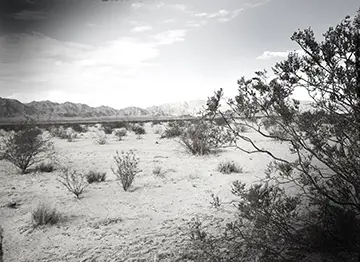
From Lopez, very soon you are in Palm Springs, in the Colorado desert. I watched the soil all the way along my route, and Lopez is as sandy and arid as anything you see all the way to Twenty Nine Palms, in the heart of the Colorado desert. The photo to the right is in the Sheephole Valley Wilderness, somewhat east of Twenty Nine Palms. You could be on the plot next to Lopez.
From here, you drive for miles and hours through nearly uninterrupted desert. There is a beautiful and strange oasis on the banks of the Colorado as it flows toward its sandy disappearance near the Gulf of Mexico, but even this huge river provides only a momentary interruption— like a blue gash in the hard, brown sandstone on either side of it.
You cross the Colorado and do not see another river, not even a dry one, until you reach the Rio Grande, halfway through New Mexico, hours later. You have touched the Mojave desert, crossed the Colorado, the Sonora, and now penetrate the Chihuahua. You have not seen a single forest; any fields seem alien because they have been been irrigated— and suddenly return to desert where the irrigation ends. Once you make it a little further into Texas, there is more scrub growing on the soil, less bare sand; Ocotillo and the evergreen Sotol become your constant companions. But it is still desert. There is very little grazing of cattle, and when you seem them, they are sparse and few.
I have driven 13 hours through four different deserts. My destination is a friend's restaurant. I do not expect that a remarkable vineyard awaits me at the end of my journey.
5. THE THE PROPHET OF BLUE MOUNTAIN TRAIL
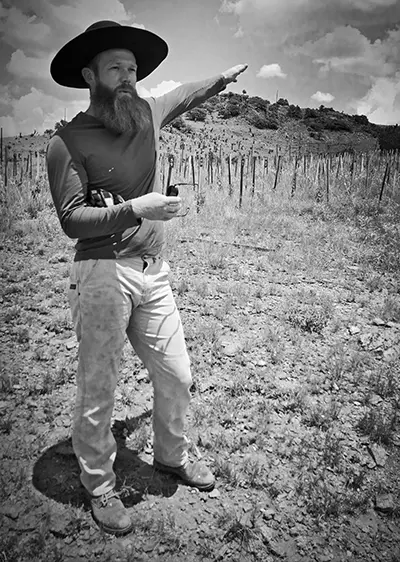
You can learn many things from Instagram, but depth of understanding is difficult to achieve. I knew there was a guy in Marfa making wine, from grapes grown all over Texas, and I knew that he had a bead on an old Chenin vineyard in the hills of Las Cruces, New Mexico. But I did not even come close to grasping what he and his wife were up to on the edge of Marfa. They are Ricky and Katie; their winery is Altamarfa.
Day 1 in Marfa. I had gotten in at 2 am that morning. Long Drive. Ricky: "Can you meet me at the vineyard? It's up Blue Mountain Trail." I drive 15 minutes north of Marfa. Why? I get to a pedestrian, irrigated vineyard. Could be anywhere. You look at the verdant rows of trellised vegetation, it could be Long Island. It is amazing how a certain kind of farming can erase all natural distinctions. I text him. "No,"he says. "Keep driving." Soon, I am on a rolling, rocky, slope, only dotted with scrub vegetation, stretching up to a summit of exposed rock. There is a small, fenced-in enclosure, maybe a couple of acres. A solar panel to power a pump. Wooden stakes arranged in two or three blocks. "See this down here. 5 by 4 spacing. Tight. On grafted rootstock; 110R, 1103P. 5 years old. This is what we first planted. It's not growing. We are ripping it out." He's right. It does not look good. There are lots and lots of misses, and the remaining vines are scrawny, and not in the way we think it is cool when the vines at Lopez are 100 years old and fierce and scrawny. He points to the uphill slope. "10 by 10. All on their own roots. We dug holes with a backhoe and stuck one stick in each hole. Much better. This is what we are going to do down below." There are some misses, but the living vines are strong, with good girth in the wood, and shoots stretching upwards, waving in the breeze.
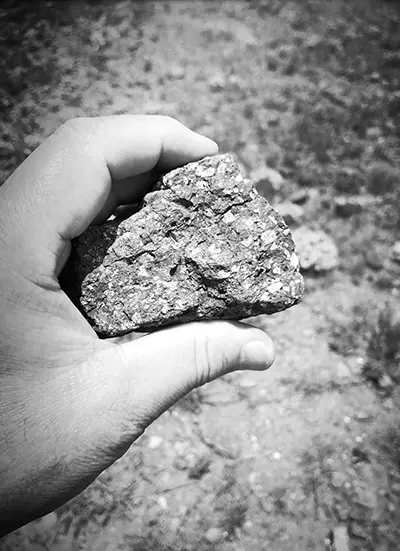
"Why are we up here? Because it's volcanic. The soil down in Marfa is all alluvial. It's OK. Lots clay in with the sand. These hills are all volcanoes. That rock is felsite. It's also the coldest place in Texas. I did a search."
Tegan, you would love this place. And Ricky's brains, and toughness. His willingness to rip out the very safe but unsuccessful planting: it is so promising, for him and Katie, and for all of us. I meet a new voice in our little world, calling to us from the Texas desert.
6. BACK TO LOPEZ
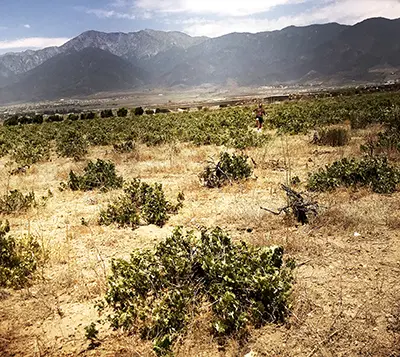
It's Thursday. I meet Garrett from Herrmann-York in the vineyard. There are five of us all together who are going to get fruit from Lopez this year. There is something that feels very, very good about this collaboration, about the diffusion of passion for these once-overlooked treasures. I drove from Phoenix this morning, and the drive was easy because of my excitement. I was struck again by the continuity of this land with the unbroken series of deserts I have traversed, stretching to the Rio Grande. When I reach Lopez, I don't feel like I am in a coastal clime at all; even though it is hours away, I feel much closer to the Picacho Peak than to Santa Monica.
It is hard for me to say what is the source and meaning of my love of the desert, but it is not solitude. It has something to do with severity, and the constant search for the hidden. Not to uncover it, but to revel in its very hiddenness, its distance from the obvious.
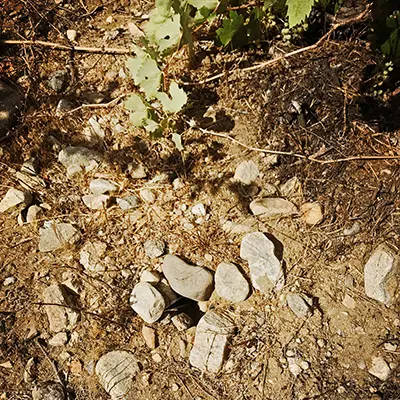
I think of Heraclitus, on whom I wrote a doctoral dissertation, in another life: "Nature loves to hide." The desert loves to hide. The desert is not what you expect. Aridity might be central to this reticence, to this subtlety, but it is not essential. I think also of the Wallace Stevens poem, O Florida, Venereal Soil: "Conceal yourself or disclose/ Fewest things to the lover...."
Yet as a grape-grower, a winemaker, aridity is absolutely essential to what I want to do. I have no interest in making wine in Florida, though I know it is possible. Desert varnish, sand, are what beckon, not loamy luxury. There is something magical and surprising about the ability of these desert vineyards— Lopez, Lone Wolf, Maglite, Gateway— to produce beautiful, round, even lush fruit, without irrigation, even in a drought. This magic is the draw, the final cause.
Jaime and I are going to wash bins today, bang on barrels to make sure they will hold water. Raj is driving his truck down from Cambria. We begin picking Palomino tomorrow.
Thanks, as always, for your support and attention.
Abe
Oh yes— Shipping! We still have not shipped anything for a couple of weeks because of the extreme heat, nearly all over the country. I am trying to be realistic, and next week does not look good either. We will get out what we owe you as soon as it is safe.