Some reflections on the community of winemaking in California
With a reminder about a tasting Sunday!
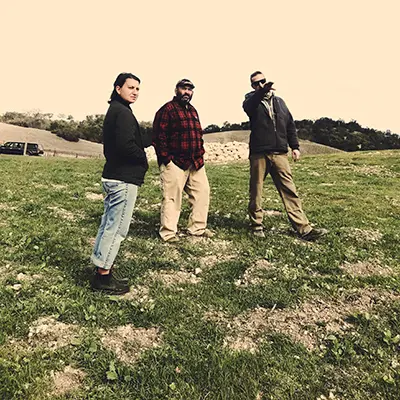
A COMMUNITY OF WINEMAKERS
REFLECTIONS OCCASIONED BY TWO TASTINGS
I am writing to remind you of a very exciting tasting at my friend Alejandro's workshop in Los Angeles. The tasting will be on Sunday at 4 PM, and will include all of the Scholium wines that we bottled last month— and pizza by my friend Lupacotta! The details are here. You may still get tickets, or tell your friends to go.
I am also completely absorbed by another, very different, tasting that I led Tuesday. Let me tell you about it, and share some reflections spurred by Tuesday's tasting.
1. NORTH AND SOUTH
For nearly twenty years of making wine, I had felt no community between winemakers in different California regions. I think, to be honest, that I did not even consider winemakers outside of northern California to be colleagues— as if their working in some other place put them in a different profession.
In a certains sense, this is not so surprising: California is huge, and there are stark differences between everything in the various regions— differences in everything from the growing conditions to the markets for the wines. To make and sell in Napa wine is radically different from the same enterprise in Paso Robles or Temecula. These differences lead in turn to the development of starkly distinct professional cultures. But not only this: what it means to live in Napa is radically different from what it means to live in Temecula. You are part of different communities, different human cultures, even if you are somehow part of the same profession. For these reasons, it is not so shocking if our common profession is not enough to provide a true common community. My friend Kathryn points out that this is not in any way peculiar to California; in a certain sense, it is another consequence of particular importance that place, geographical specificity, has for the whole world of winemaking.
My first colleague who helped me to transcend these gaps was Tegan Passalacqua, who, in a deep way, is devoted to the whole of California winemaking, from North to South, from past to present. He has always made it clear that we have a lot to learn not just from the historic vineyards in Lodi and Amador, but from the farmers and winemakers responsible for their preservation. Tegan has always been devoted to professional community between winemakers not just in all of California but all over the world, and daily makes sure that we are in touch with each other, and learning from each other constantly.
Yet North and South felt profoundly separated for me— until Raj Parr's move to Cambria, on the Central Coast, in San Luis Obispo County. When I first visited here with Raj, I simply thought that he was crazy and could not imagine how anything good could come of this move. I am so grateful that my eyes were not irretrievably closed, and my heart not unbendingly hardened. I have learned so much by being here.
Raj too is devoted to community, and fosters that community nightly at his dinner table. But perhaps even more significant for me has been the incredible spirit of exploration he has demonstrated since moving to Cambria. Let me tell you the one, most important, anecdote to illustrate this.
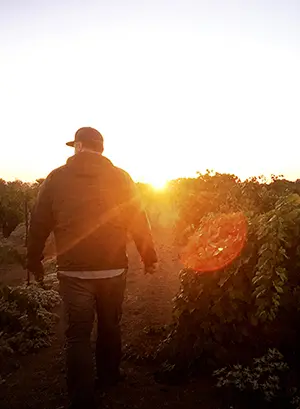
In the photo at the top is Raj. He is with our friend and colleague Katia, who made wine with me last year, and then worked closely to Raj, while she was a harvest intern at Stolpman Vineyards. Now is it is late winter 2021, and Raj is determined to prune the whole of the vineyards in his new venture, Phelan Farms, alone, with the help only of friends. Katia and I are here with him every day, pruning 11 acres, row by row. It is wonderful. But there is a lot more going on, and on a certain day, Raj announces that he must have bees. He puts Katia in charge of figuring out how to get them on the farm. Obviously, we are not going to buy bees.
Katia reaches out to a local whom she knows from Instagram, "@theslamdancekid". He works at some winery we have never heard of. He says, "yes, bees, you need to talk to Jordan at Tablas Creek." He connects them. On March 9, we have an appointment with Jordan, the director of farming at Tablas Creek. We spend half a day with him. We learn about how they manage their sheep. We learn about their cover-cropping strategies. We learn how and why they use bio-char. Our minds explode with everything we have learned, our spirits swell with the passion and energy shown by Jordan. We go from being indifferent to Tablas Creek, to buckling under our admiration for the comprehensiveness of their undertaking and the accomplishment of their farming. And I begin to take more seriously this kid from Instagram who steered us here. His name is Daniel.
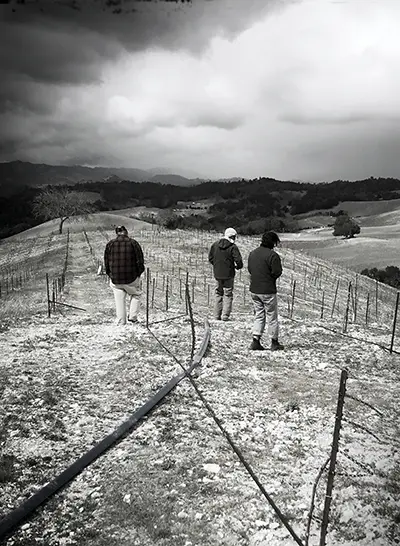
Jordan tells us how to get bees, and even gives us a special swarm harbor that he made himself. But the most important thing for me is not what we learned about sheep or bees or cover crops, but the opening of my eyes to what is taking place in Paso Robles, in San Luis Obispo county, a place I had never given a moment's thought to before. And it is all due to Raj, and his project of moving here and teaching himself how to farm, from the ground up. He has embraced the position of radical beginner not only fearlessly but with a quiet yet avid openness to the excellence of what is taking place around him— an excellence I might have been blind to without his lead.
This lead, day after day, sourcing hay, spraying kelp, learning from the neighbors, on the coast of Slo County, knits the disparate cultures of the state together, in a beautiful chain that no one could have foreseen.
2. THE CUCAMONGA TASTING
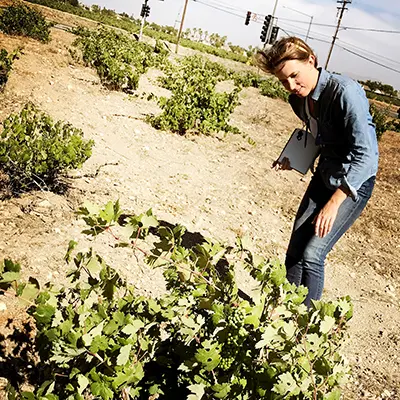
Now it is June 9. My dear friend Brenna Quigley has recently moved to Napa. She is one of the most accomplished geologists working in WineWorld. But even more than that, she is a great teacher, a great explicator. A Michael Faraday of the soil. She is the author, producer, and compelling voice, of a podcast ostensibly on the geology of winemaking regions— but it is really a beautiful anthropology of winemaking and winemakers, in relation to the very specific landforms that give them a physical world.
She has moved to Napa because she is very much in demand at the moment, and at the highest levels of winemaking in the world. Napa. Not Cucamonga. So I am surprised and delighted when she texts me and says, "I am in Los Angeles. When can I see these vineyards?" I feel the distance between Napa and the nether regions closing. Above, you can see Brenna explaining the soil in the Lopez vineyard, in Rancho Cucamonga. Later in the day, she discovers microscopic iron particles in Lone Wolf, by scooping up the sandy soil in her hand and pulling a little magnet out of some hidden pocket.
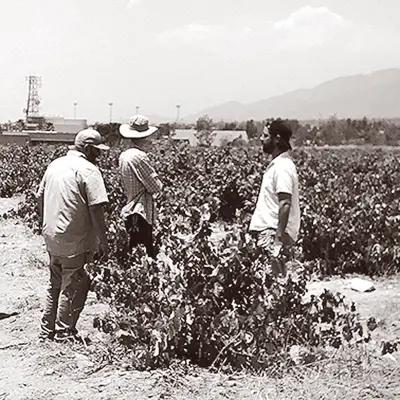
Now it is June 17. We are in Rancho Cucamonga, on the edge of the same vineyard that Brenna and I had visited the week before. It is a nearly incredible (and nearly unknown) historic vineyard: 30 acres of Palomino, planted around 1900, to make "California Sherry," on the periphery of the better known Lopez Zinfandel planting. Raj is down here, as are Jaime Arzate, my colleague from Los Angeles, and 5 other people who are passionate about our work. Three of them make wine themselves; they have just launched a joint project based on Southern California fruit, called Herrmann-York Wine. One of the trio, Patrick, reached out to me a year ago, and Patrick and his partners eventually became mainstays of our vineyard crew in Lone Wolf. On the last day of harvest, we had filled all of our bins and could not take any more fruit. But there was another 500 pounds or so left on the vine. We could not leave it behind. The Herrmann-York boys pick it and bring it home.
A few days after our June visit, they send Raj samples from their recent bottling, their first release. Night-time, Raj sends me a text: "These wines are really good. We have competition." I write back: "Rivals. Friends and rivals."
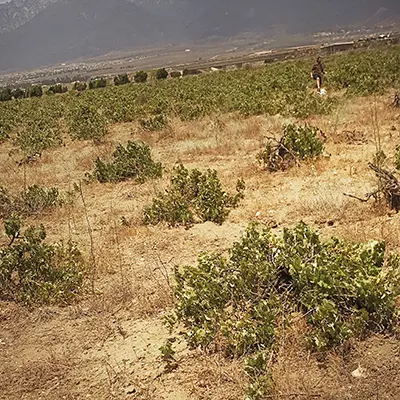
Now it is Saturday, five days ago. We all meet in the Palomino vineyard again, to carry out our first fruit sampling. Herrmann-York is going to get some of this amazing Palomino, and so will our friend Mikey, from Scar of the Sea. We want to make sure that this treasure is shared— soon, the world will see what wonders reside in the sandy Los Angeles basin.
I know that we are going to need lunch. We will go to our favorite pizza place, 5 minutes from the vineyard. I ask the Herrmann York boys to bring their wines; I want to try what Raj tried. We taste them together. They are really good, really remarkable. Wines of character, and of place. There is a beautiful Mission, from Lone Wolf, and an elegant Blanc de Noir, from Alicante (of all things!), from Lake Los Angeles (an area previously unknown to me).
This is the Cucamonga tasting, at the back table in a pizzeria. It emphasizes that we have colleagues everywhere. North and South and Center. I feel gaps closing, divisions melting away. We strive together, learn from each other, gain inspiration, and even confidence. It is a priceless treasure.
3. THE PASO TASTING
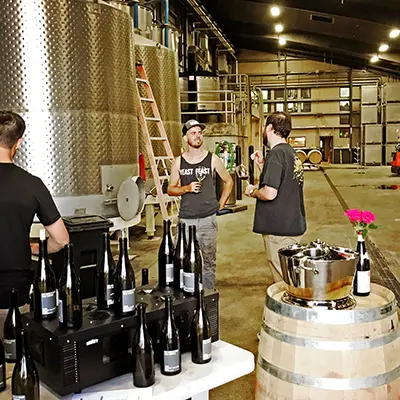
This is the tasting that spurred these reflections.
Do you remember Daniel, the Slam Dance Kid? After he connected us to Jordan at Tablas, we asked him to join us in pruning. He is a pruning machine: precise, careful, relentless, and quick. Then he comes to dinner, and we begin learning. He has worked in South Africa, with the best. He has a fondness, even a kind of protectiveness, for the New World wines of the Antipodes. Or to be more specific, he has a quiet but bristling loyalty to the wines that are dear to him, and severe discrimination before he lets anyone in the door of dearness.
We become friends. We were colleagues in name before, but now, as distances melt, I feel that we are really engaged in the same project. What is important to Daniel in Slo County is now important to me. The winery we did not know, where he works, now I need to know. What is it? He brings us a bottle. Cinsault. It is excellent. It is part of a small family; Tegan's wines, and Eben Sadie's, are the elders. It is good to meet the next generation. The winery is Thacher. Daniel is their Assistant Winemaker.
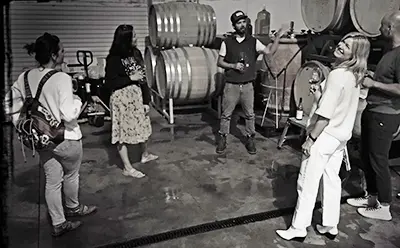
I have dear friends from Los Angeles who are coming North. They are ardent tasters. They know Napa and Sonoma well; they know my wines. But Paso is a blank spot on the map for them. I suggest that we taste at Thacher.
Daniel meets us. We begin tasting from barrel. It is one revelation after another. The 2020 Cinsault. A Valdiguié. A truly excellent excellent field blend of 11 varieties that does not ape some other wine but creates a new path for others to follow. Sclerotic preconceptions about the nature of Paso Robles wines are destroyed, in a crescendo accompanied by fireworks.
There is a community here in Slo County. It is strong and wide. Another member reaches out to me: "Hey. I just bought a bunch of your LA wines. We are going to do a tasting. What can you tell me?" Daniel gives me a headsup: "There is a guy who runs tastings here. A lot of the winemakers come. It is really good." I am in. The guy is Alex Kemp, @therootswine. We communicate only via Instagram. I ask him if he thinks it would be good if I came to the tasting. He was excited at the prospect; they have never had a winemaker present their own wines. I build my July schedule around this. The Los Angeles wines are very particular, as many of you know. I cannot say how excited I am to present these wines to winemaking professionals: people with precise, scientific knowledge; people with experience— who have had to make decisions about microbiology, aesthetics, the future of a winery.
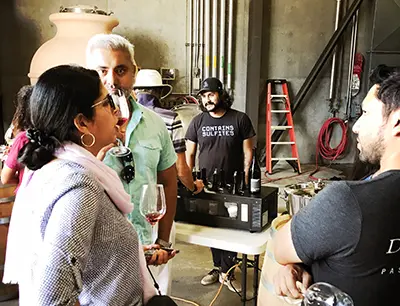
Now it is Tuesday. I have driven up from the city, and I am at a sprawling winery in Paso. There are 30, 35 guests. We offer 8 of our LA wines, and put them out freely for more than an hour before I begin speaking. Everyone has a chance to taste everything, to go back, taste again; if anything is delicious, there is the opportunity to drink, not just taste. I bring up 20, 30 bottles to supplement what the host has already purchased. We wait for Daniel to arrive; evidently, a wheel has fallen off his truck.
After 90 minutes, we tap on a glass. I launch in. "I am going to talk about the winemaking first, the 'technical' aspects, the decisions we made, the measurements we did or did not make." No romance. There were questions, really good ones: "That sounds like a lot of SO2; why would you begin that high?" Soon, I am making clear what you might call the aesthetic backbone; we all discuss, in wonderfully collegial tones, the ways in which the wines are fucked up, the role of microbes versus the vineyard, the effects of the stems. . . .
There is an anthropologist in the audience, the guest of one of the winemakers, who will return from Paso to work at Antica Terra in a few days. The anthropologist asks really good questions about Lone Wolf, about its history, what it means to work on a Native American reservation. Everyone hangs on her words; we are not limited by our fascination with SO2. We converse until a Summer's evening sunset.
It is such a special discussion, and such an extraordinary honor to have the focused attention of colleagues. There is also something deeply rewarding, within the danger of self-congratulation, of bringing something good in from outside. I remember a wonderful article from the Art of Eating about an anchovy merchant who brought anchovies by horseback from Genova to the Piemonte. It is warming to feel like we might be moving in his footsteps.
Napa, Paso, Cucamonga, become immeasurably closer. A community grows a little bit larger, a little bit stronger.
Sunday. I look forward to it so much. Very different wines. With more pizza, and a nod to a scholar of Beethoven.
Thanks, as always, for your support and attention.
Abe
Oh yes— Shipping! We have not shipped anything for a couple of weeks because of the heat. We expect to resume sometime next week.