The Lost Wines Of The Scholium Project Part 2
What I found in Napa
The Lost Wines Of The Scholium Project Part 2:
The Return to Napa
This is where I left you. It is the beginning of April 2021; I have kept two very serious questions not just unanswered, but unasked. They had been hiding in a dark corner of my mind and the shallow part of my heart. Something about the Spring in Los Angeles has finally given me the courage and backbone to address the questions. Both of them are about health, survival, persistence:
- John Guman, whom I have not heard from in a year, is he all right?
- The Scholium wines of 2018 and 2019, untouched and untasted for more than a year, is anything left of them?
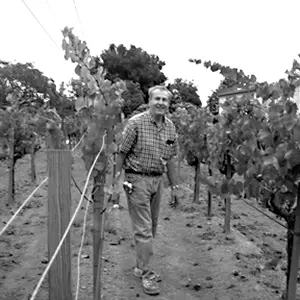
I drive to Napa on April 13. I waste a little time on some inconsequential errand and finally face the need to drive to Guman without further delay. The Gumans' home is on a street in Coombsville, on the east side of Napa, in a kind all-American suburban paradise. I turn into their neighborhood, make a left onto their street, and as I get about half-way up it, I see, maybe 100 yards away, a tall man in baggy jeans chatting with a child, by the Gumans' mailbox. My heart races with hope and anticipation.
I pull up. It's John. I get out. He looks great; not a day older, hale and healthy. "John, I am so glad to see you." My heart is full; not sure if my voice is normal. He's got the mail in his hands, ready to turn away and wrap things up with his young neighbor. "It's good to see you too, Abe. The vineyard is not doing too well. We have not pruned it yet. I will probably have to rip it out."
His wife's health is not great. John loves his vineyard and he has put his back and heart into it for 40 years, but here, on the edge of the pandemic, it is not the first thing on his mind. I tell him not to worry, that we can get a crew in here in days, but he is already on his way into the house. I take the alley on the side of the garage back into the vineyard and it feels like coming home.
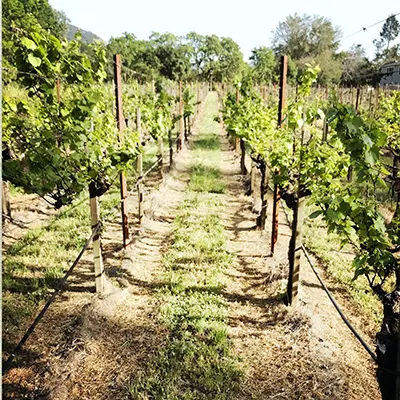
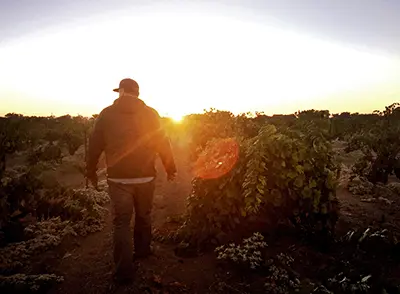
The vineyard looks great. The leaves are a rich green, and, here at the northern end where you enter, there are so many of them that they are reflecting green light into the sky. Then, when you go a little further in, you can see that a lot of weak vines have died in the last couple of years. Maybe half the vineyard is gone. And there are a lot of vines struggling to grow strong shoots from all the buds that remain. I know what this vineyard needs, and my pruning shears are ready in my pocket. I text a new friend who is devoted to our craft. "Can you meet me in a really interesting vineyard that needs our help? A couple of hours, then we can get some dinner."
Sam and I work till dinner time, prune back about a quarter of the vines, remove a lot of arms that will never support strong growth. To get the whole vineyard in good shape for this year's harvest, and make the permanent changes necessary to bring the remaining vines back to strength, will take about a day for good crew. This will get us about a half a ton of fruit, and extend the life of the vineyard for another decade or so. Nothing needs to be ripped out. The venerable vineyard still has a vibrant future.
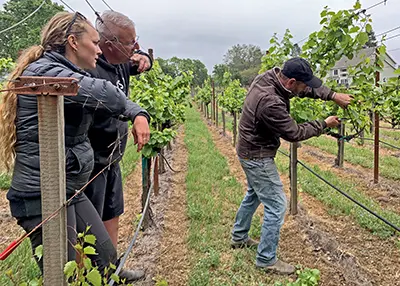
Nine days later, I return with a half dozen friends, some of them from as far away as Santa Ynez and Mendocino. Courtney and Alex and Graeme and I have been working in this vineyard together since 2009. I have pruned with Alice this year in Lone Wolf in Temecula, in her own vineyard in Santa Ynez, and now in Guman. All of us are vaccinated; we work in warm delight to be in each other's presence. I will return to this utterly new yoking of North and South— Temecula, Santa Ynez, Sonoma, and Napa— in a future email.
The day after seeing John, I go to Tim's winery, first thing. My heart is torn: I feel like seeing John and getting back into the vineyard is a good sign, a portent of more good things about to be revealed up in Napa. But then I feel like this is way too much to hope for: you can't have John healthy and the wines healthy too. I need to count my blessings and get ready for some painful discoveries.
Tim has taken all of the barrels down and laid them out, so that we can easily taste them all, assess them individually, tag them if necessary. We launch in, beginning with the oldest and most fragile. 2018 Rhododactylos. The first barrel is totally sound. No spoilage. Not even oxidation. The wine is good. There is a partner barrel of press wine. Not bad, not great.
And then it hits me: until this moment, I had developed a kind of theoretical relation to these wines. My relation to LA wines is visceral; it's almost like my blood is in them. These wines— Rhodo, for instance— I know what it is, what the wine can be, what it has been. But the knowledge feels abstract, not visceral. Tasting the first weak barrel— feeling the lack, the distance from the good barrel— brought me back, made me part of the wines again, and them part of me.
We taste every barrel, every wine. I am going to cut to the chase at this point; you have been very patient. The wines are stunning. They are pristine; each one demonstrates the sharp edge of effortless aging. No wine is blunted, much less spoiled. No wine is tired, no wine dull. Two press barrels don't make the cut. That is it. Everything else is superb. Tim has provided some kind of magic home for this inadvertent experiment, and I have learned a lot. I ascribe a lot of this to the perfect cool of Tim's cellar, and perhaps the rest to the perfect isolation the wines endured. No opening, tasting, testing, racking, stirring. The barrels were not even moved until that morning.
These are the wines that we tasted, in order:
- 2018 RHODODACTYLOS, BECHTOLD RANCH
- 2018 FTP-C, KIRSCHENMANN RANCH
- 2018 LA SEVERITA DI BRUTO, FARINA VINEYARD
- 2018 THE SYLPHS, GUMAN VINEYARD
- 2018 1MN, BECHTOLD RANCH
- 2018 THE PRINCE IN HIS CAVES, FARINA VINEYARD
- 2018 FTP_Z, KIRSCHENMANN RANCH
- 2019 RHODODACTYLOS, BECHTOLD RANCH
- 2019 LA SEVERITA DI BRUTO, FARINA VINEYARD
- 2019 THE PRINCE IN HIS CAVES, FARINA VINEYARD
- 2019 1MN, BECHTOLD RANCH
The wines are not only unspoiled, they are nearly shocking in quality. From the first, the 2018 FTP-C, with two plus years of aging, is one of the best white wines we have ever made, with the depth and power of a great wine. The 2018 Sylphs is beautiful, and it makes me so happy to think that we are going to keep making many more vintages of this wine. The 2018 Prince is great; beautiful, seductive, exotic.Two and a half years in barrel are so good for it.
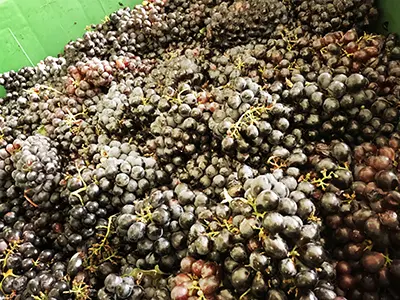
The 2019 wines are, except for FTP-C, even better than the 2018 wines. It was clearly a remarkable vintage in Northern California. All of the wines have a kind of depth that exceeds what we have achieved in any other year. In particular, the Prince is amazing. I feel like it is the best vintage ever. It is savage in the way that Graeme and I used to aim for in 2008, 2009, 2010— but also has the beautiful grace that we began achieving later, as we stopped punching down the fermentations. The 2019 1MN is deep and rich; a more darkly-colored and carnal red wine than this wine usually has been. It reminds me of the severe wines of Ribeira Sacra; earlier vintages were more like Beaujolais. Both vintages of LSB are beautiful and strong; all of the wines only seem to have intensified during their aging.
When Tim and I finished the tasting, I stepped back, silenced and flabbergasted. I have never tasted anything like this: so many wines, so strong. No problematic students; only stars.
The 2018 and 2019 are clearly the two best Scholium vintages in succession. What a strange and wonderful thing to find them both still in barrel, and to be able to taste them in this way, all together, and in contrast with each other.
We are going to bottle all of these wines in Napa in about a month. I am going to offer them to you now, overbrimming with excitement and enthusiasm for what we have in store.
I want to mention a couple of words with implications about scarcity. When we failed to make these wines in 2020, we lost the opportunity to continue working with two of the vineyards: Bechtold and Farina. We will never get back into Bechtold; the Phillips family has too great a need for the fruit to be selling it to anyone. So they will absorb my share.
Farina is in such demand that it is likely that the buyer who purchased the fruit in 2020 will want the fruit again in 2021— and they will have earned the right to buy all they can. This means that the 2019 vintage of 1MN is certainly the last ever for this wine. And that the 2019 vintages of the Prince and LSB are likely to be the last of these wines. I still have hope for Farina, but I won't know for sure till harvest approaches. For now, we must consider these the last vintages of all three of these wines.
It was inevitable that as I started the new winery in Los Angeles, the Scholium Project would mutate and develop in the North. This wonderful, brilliant year of survival and persistence is thus a natural inflection point for the Project. The vintages that we release now mark the end of one era, and herald the beginning of another. The Project will persist, rooted in Guman, Kirschenmann, and who knows where else?
You may go here to secure the last wines of the first era.
Thanks so much for for your attention.
Abe