The Pandemic and the Fetishization of Agriculture
a report on some current trends in California winemaking
THE PANDEMIC AND THE FETISHIZATION OF AGRICULTURE
Reflections on the socio-economics of pruning this year
Spring is here and it is wonderful almost beyond words. The warmer, longer, days make it easier to kindle hope in the heart. Plants yearn to begin a new year; trees are in bloom and the buds on grapevines swell and yearn to open. We, who husband the vines, must finish pruning before the buds break open: there is something dead wrong about putting sticks with open buds on the ground.
Since I last wrote you, 3 weeks ago, I have been pruning for 20 out of 22 days. More on this below, but—
Many of you are awaiting deliveries. The new Los Angeles wines. They will begin going out next week. I am so excited, and so grateful for your patience.
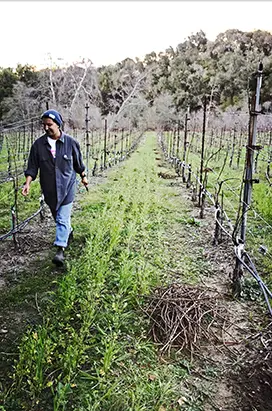
Raj and I are going to offer several virtual events to introduce the wines over the next few weeks: he and I will taste them together on Instagram on April 17, and I will do a couple of Zoom events to take your questions. I will let you know about all of these separately, over the next few days.
Now on to some thoughts on grape farming in the 21st century.
You might wonder why I spent so much time pruning in the last few weeks, and how common this is?
It is not common, but it is becoming more so every day. This presence of the winemakers in the vineyard in Winter and Spring is an expression of something novel, and marks a very interesting cultural (and socio-economic) change in California winemaking. You are witnessing the birth of a new regime. Here are some thoughts on its origin and meaning.
1. Labor and Locality in California Grape Growing
When I began learning about winemaking in Napa, in 1998 and in subsequent years, I did not know anyone who pruned. I knew vineyard managers, who knew lots about pruning. They would give instructions to and supervise the vineyard crews, who would then do the work. I knew winemakers, who also knew about pruning (and many aspects of farming), but none of them spent much, if any, time pruning. We would not prune, we would make "vineyard visits."
This is not a criticism— in fact, part of the aim of this essay is to reflect on the recent the valorization of farming.
In Napa at this time, there was a class of professionals who determined how to do the work and then supervised it; and a class of laborers who did the work. The professionals were largely non-Hispanic (though by 2000, not universally so by any means); the laborers were invariably from Mexico or Central America. The professionals lived in Napa or nearby, and were tied to the vineyards and responsible for them over years; the workers, except in some rare cases, were day-laborers from rather far away (like Fresno or Stockton), and sometimes even migrant workers (who might soon be in Oregon). Many of them never worked in the same vineyard twice. Some vineyards and wineries mitigated the transience of the workers by keeping on teams of workers year-round— but this was prima-facie difficult precisely because of the seasonal and cyclical, rather than constant, demands of grape-growing. The one farmer I knew who was devoted to creating a more permanent and sustainable community of workers tied to his vineyards was Lee Hudson. He was not alone in this respect, and was at the vanguard of a small but significant movement among other farms and wineries.
In spite of the efforts of people like Lee, there were many obstacles to this mode of farming becoming the preponderant model in Napa (and other similar places). The chief difficulty is the tension between the value of the land and its crop on the one hand, and the affordability of nearby housing on the other hand. Precisely because Napa wine is often a very precious luxury good, it is difficult for the people who make the goods to live anywhere near the locus of their labor. It looks like an economic necessity to bus them from somewhere they can afford to live. This is a serious conflict worthy of reflection.
But this does not yet explain why so few winemakers were in the vineyards in Napa in 1998. What about in Europe? Before we turn elsewhere, I want to tell you a little more about the mathematics of the pruning I have done in the last few weeks.
2. Pruning and Sheer Numbers
We pruned Lone Wolf before bottling, in late January, with a bunch of friends. We got the whole job done in two days, except for about a dozen vines. We returned a week ago to finish the job and then do a vine-by-vine census on the whole vineyard. We discovered that there were a total of 766 individual, living, vines in the vineyard. Every one of them is now pruned.
Now I should tell you that this "bunch of friends" numbered 28 people each day. So it took nearly 30 of us more than 2 days to prune these 766 vines. That is a lot of man-hours.
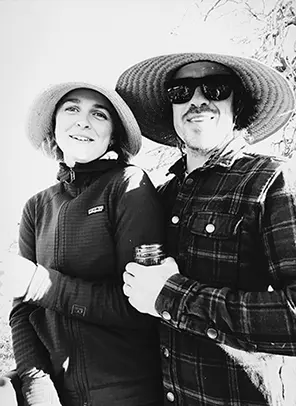
The week after this, we went to see our new friends Alice and Topher of Amevive wines in Santa Ynez. They have leased a wonderful old vineyard, planted by Bob Lindquist in the 70s, and have taken on all of the farming themselves. They have about 6000 vines to prune; nearly 10 times as many as we did at Lone Wolf. They put out a call on Instagram for helpers, and got about 30 people up over two weekends. I brought 5 from my Lone Wolf crew for one weekend. Alice and Topher pruned every day for nearly a month; some days with friends, some days alone.
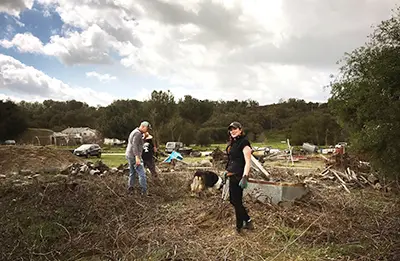
On either side of this two-day expedition for us was the grand pruning project of 2021: Raj Parr's new Phelan Farms. Raj decided this Winter, especially after the wonderful experience at Lone Wolf, that he wanted to prune all of Phelan Farms himself, with friends. Not a hired crew. I went to work on a pruning schedule and determined that if we could average 10 workers per day, it would take us only about two weeks.
Why?
Because Phelan Farms has 15,618 vines.
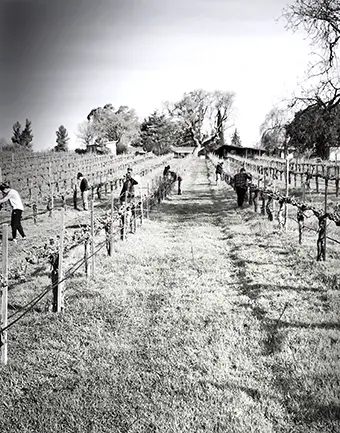
This helps demonstrate why pruning has fallen out of the hands of the people with the highest stake in the shape of the vineyards. The sheer numbers make it a daunting prospect. Even if you are really good, it is hard to prune one vine per minute. If you are relying on friends, and they are both inexperienced and careful, it might take 10 minutes per vine. At Lone Wolf, where the vines are wild, disordered, and each vine requires a new tactic, it took 26 minutes per vine. The sheer numbers suggest the necessity of bringing in help. If Raj were to try prune the vineyard himself, it would have taken him half of the year. And Phelan Farms is far from massive: it is very much on a human scale. 11 acres, less than 5 hectares. You can walk all of the land in a morning. You could come to know all of the hills, where the creek gets close, the low lands that silt— you could come to know every row in the vineyard pretty quickly. But it would take you half a year to prune it.
3. Pruning in the Roussillon
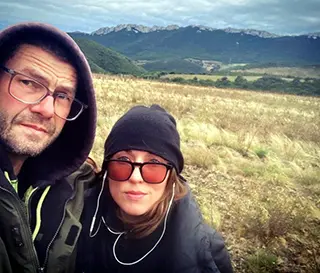
What do people do in the rest of the world? Far from Napa?
My dear friend Carrie and I made all of the Scholium wine together at Tenbrink in 2007. In 2008 she began helping us with a project in the Roussillon, in France. She now owns a small domaine there together with her husband Marcel. It is called Domaine des Enfants. They do nearly all of the work themselves, with a horse and a tractor in the vineyards. They farm 26 hectares, mostly of old vines. 66 acres. More than 115,000 vines.
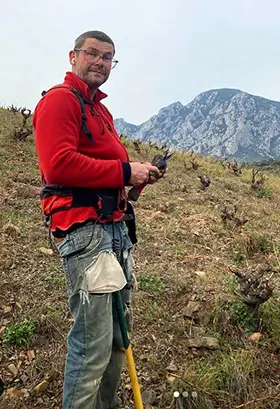
Marcel can prune faster than any human being I know. He averages about 33 seconds per vine. If he were to try to prune all of their vines, even at this rate, it would take him exactly half the year to prune everything. Instead, they have about 110 days of dormancy to get the job done, when the sap is not running and before the buds open.
So even if Marcel spends 6 days per week in the vineyards between December 1 and April 1, and even if Carries joins him whenever she can (she runs the cave, among other responsibilities), they must still hire pruning help. They have one full-time worker in the cellar and vineyards, and hire an additional 2-3 workers purely for seasonal work. Even with this team of 5 or 6, they are pressed every year to get the job done before budbreak— and, in fact, Marcel is still in the vineyard today.
Because the Domaine is in a small town in the country, not Napa, these workers can live nearby, and can work for Carrie and Marcel and other farms, depending on what is needed. There are many other small domaines nearby, and all of them work in a similar way: the principals are in the vineyards every day if possible, and they supplement their labor with seasonal workers who split their time between a few employers and a spectrum of different tasks. This means that a single seasonal worker will probably have a few different employers throughout the year, but only a few.
I know that in the old days, most of the domaines did not hire outside labor. Most domaines were family owned, and the size of domaine and the labor available within the family had to be proportionate. The rule of thumb was something like this: a typical family would put 3 family members into the field per day during pruning season, and that family could prune an hectare per week, or about 12 hectares per year, allowing for rain. You worked every day, day after day, and got Sundays and rainy days off. Unless there was a lot of rain, and then you had to suck it up. There were even little cabins in the fields in case you were too dog-tired to make it home. If you were short a kid, or Grandpa was infirm, you lost 4 hectares. This naturally limited the size of the domaines to about 12 hectares.
But for the last two or three generations in the Roussillon, there has been an exodus from the towns to the cities, leaving fewer people, and almost no young people, to prune. This in turn has led to the sale of domaines to "étrangers" like Carrie and Marcel (she is American and he is Swiss). Almost all of these newcomers work in the same way that Carrie and Marcel do (more on this below). It looks like if you really want to try to make it alone, without any seasonal labor, you are limited to about 5 hectares— a little bigger than Raj's farm. This is smaller than the 12 hectares that was traditional precisely because these new farms do not come with grandparents, and the owners are, at the moment, too young to have children who can prune.
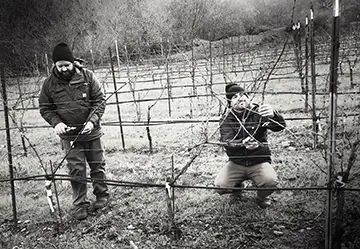
The history of California farming is radically different. European farming in California began on a series of gigantic land grants, with the result that most vineyards have always been huge, rather than small plots farmed by a single family. This means, in turn, that from the beginning, California vineyards have depended on hired help, and that there has always been a flourishing market for grapes as commodities— something nearly unknown in Europe. And lastly, this has made possible the advent of small producers like me, who own no land, but buy fruit. You can see how this whole economic model works to keep winemakers out of the vineyards, and to keep intimate activities like pruning in the hands of anonymous laborers. Unlike in the Roussillon, California winemaking has never depended on the domaine farmed by a single family.
4. The Pandemic and the Fetishization of Agriculture
Raj got all of Phelan Farms pruned in about two weeks, yet he did not bring in labor. What made this possible? The condition was the eagerness of friends, and even strangers, to help him— people who had never held pruning shears, who might never have set foot in a vineyard. And what made this possible? The opportunity to learn from and give help to Raj? These offer many enticements, but they are not sufficient explanations. Two factors were absolutely necessary: the pandemic, and the fetishization of agriculture. And both of these equally made possible the wonderful pruning of Lone Wolf earlier in the year. In fact, you could say that they are absolutely essential to our work in Los Angeles.
The pandemic has changed our daily lives in myriad ways. For many, nearly all of us, it disrupted our past work lives completely, and made us recreate them de novo, from the ruins of a bombed city. Many of us traveled incessantly before— we never stood still. Raj and I were among these. I am not sure that either of us could have, would have, spent two weeks pruning in a canyon in Cambria in the old world. The pandemic opened up this space for us.
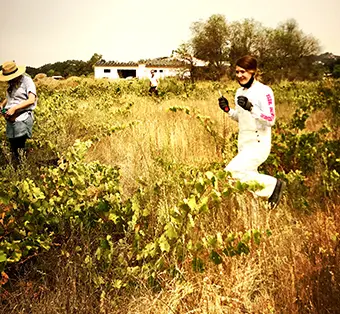
And the same is partly true of the friends that we turned to. The pandemic has given some of us more freedom, more flexibility. A year ago, when Lone Wolf desperately, and unexpectedly, needed shoot thinning, I had twenty friends who could be wherever they wanted to be for the next few weeks. Next year, perhaps even this year, thank goodness, it will not be so easy to get 20 people bending over vines hidden in Temecula.
And at the same time that the pandemic gave us the freedom to adopt new agricultural habits, waking up and going to bed early, migrating to vineyards all over the state to work silently in fields all day, phones tucked into backpacks— at the same time, the fields gave back and helped sustain us in the face of the pandemic. I don't think that I can properly put in words what it meant to my friends and me to make the trip to Lone Wolf every weekend in May last year, to escape the city, not just our city, but all cities, to escape the world of the city— and spend quiet hours in sunlight and fresh, moving, air, with no contact surfaces to fear, no distances to measure. As we helped the vines of Lone Wolf thrive, those vines helped keep us alive.
Given this pure and absolute blessing, what do I mean by "fetishization?"
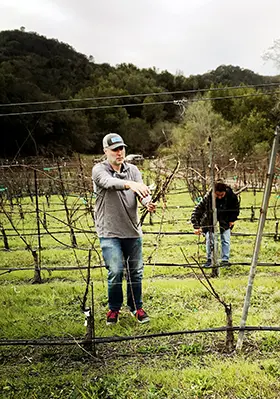
It is 2021. I have joined a dozen winemakers pruning this year, several architects, two librarians, two writers, two bankers, a nurse, a few programmers, a statistician, a professor, two photographers . . . The pandemic alone does not account for this. On both sides of the world of wine, on the side of wine-buyers and on the side of wine-makers, there is a new and dominating interest in farming. This has been fueling the gradual turnover of domaines in the Roussillon from old farming families to new étrangers who have never farmed before. And this, in turn, is preserving precious and irreplaceable old vines that otherwise would be ripped out. Something similar is happening here, heralded by wonderful wineries like Amevive and Phelan Farms. Small producers, who could not afford to buy a California vineyard, are not just buying grapes but leasing vineyards and taking over the farming themselves. And by taking it over, they are not just supervising traditional farming. They are doing the work themselves, but also doing a different kind of work.
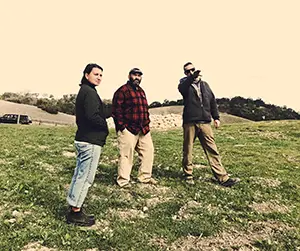
There is a new attitude sweeping the world of grape farmers around the world, and it is not just a new or deeper respect for the land, or for old vines, or for sustainable practices. It goes further than this. Perhaps the easiest way to see it is through the lens not of the farmers, but consumers:
Consumers now insist on a different mode of production in the luxury goods they consume. It is not unrelated to buying organic, but goes beyond this. They demand that the modes of production far transcend mere efficiency and utility and safety: they must be sustainable and ethical. They demand not just non-GMO wheat but conflict-free diamonds. The expectations in the world of wine are even more elevated and intense. A sign of this is that no one revels in photographs of the conflict-free mine. It is a mere requirement to be checked off.
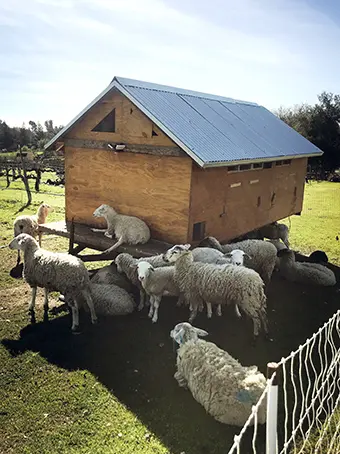
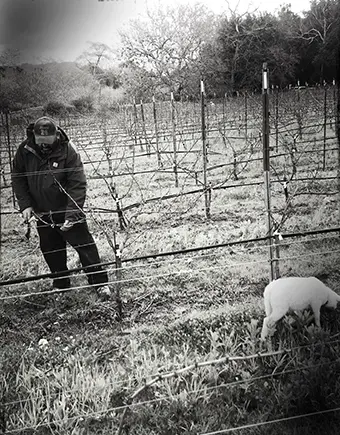
On the other hand, in grape-farming, it is not enough that the farmer avoids rightly-despised glyphosate, it is now essential that she keep sheep and employ a chicken tractor. The fans of the wines no longer want to see a photo of the "vintner" swirling a fancy glass, they want to see the farmer-winemaker in her cover-cropped fields with her happy flock.
And now we must return from the consumer to the mind and spirit of the farmer: she does not accede to this demand for the sake of commerce, she embraces it, seeks it out, and delights in it, for itself. What defines her as a cutting-edge winemaker in 2021 is not that she uses a chicken-tractor, but that she loves having one— and cannot imagine making wine without one.
Just as there is a new generation of consumers with new tastes, new demands, there is a new generation of winemakers with new aims, new goals, and a new way of working. This way of working is not a means to an end, but an end in itself. It is not enough to keep bees; you cannot wait to go out and trap a queen and her tribe who are swarming. It is not enough to avoid petroleum-based sprays to combat mildew, you pursue milk as an fungicide and commission a local dairy to sell you 900 gallons of raw milk during the growing season.
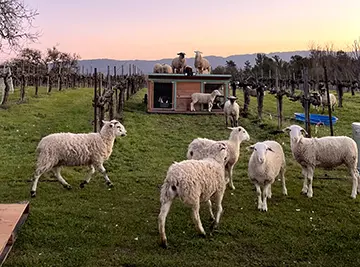
This is what I mean by fetishization: the shoe is not a tool to support the heel or curve the butt-- it is a source of pleasure in its own right. In this way, a certain kind of very beautiful and very virtuous farming is prized not because it leads to better wine or even a smaller carbon footprint, but because it is a source of delight and pleasure in itself. In the newest world of wine, in the new dance between the winemaker and the consumer, a chief responsibility of the farmer will be not to employ agriculture but to provide access to it.
Why were so many of us pruning day after day? Seriousness, dedication, for sure. But also because we are playing a key role in a new economy of pleasure.
I am, as always, so grateful for your interest and support.
Abe
PS: some of the 2020 wines are still available, though a few are already sold out. It is really wonderful to be playing a small role in this rebirth of grape-growing and winemaking in California. You can taste the results of this year's work in that movement here.