Our Wines of 2020: a Report on Racking and Blending
We begin bottling on Monday!
RACKING and BLENDING
A Report on
THEORY and PRACTICE
It's Saturday night, a little late. It's been a really big week. I am behind on correspondence— please pardon me!— and on a few shipments. We will catch up by Monday. I hope that you will understand.
A week ago, we were in Lone Wolf. We nearly finished pruning— only 10 vines to go. We called the game on account of darkness; but you can't deny, we were also eager for a reason to return. After bottling . . . .
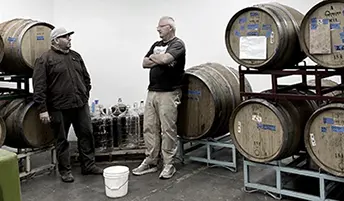
Monday morning, we were back at the winery, with some very important guests. Raj drove down from Cambria, leaving before first light, and he asked two colleagues to join him at the winery. He was driving down to taste all of the 2020 wines. I had decided in January to bottle all of the wines before the end of February, a couple of weeks ahead of last year. Raj and I wanted to taste through everything one last time before bottling: review possible blends, consider new possibilities, ponder and reflect on all the wines that we had made this year.
You know that study, education, reflection, are are crucial to what we do. We wanted to taste the wines and talk about them in the presence of the remarkable team that had picked most of the grapes, stomped all of them, filled every barrel by bucket. So, it was not just a blending session, as interesting as that would have been alone.
We taste, reflect, consider, take careful notes. We revisit a couple of blends, confirm the others. The wines seem very, very good— as if they are constantly improving. It is not shocking that they are so good, and getting better: and it is deeply desired. But you cannot count on it, and we are grateful.
The tasting is over. One of the guests is José Pastor. His knowledge is incomparable— I realize afterwards, especially of wines exactly like these. He loves wine with a fiery and generous spirit, but he is also a severe judge, and easily bored. My insides felt oddly soft at the thought of showing him the wines. But he loved them. And Raj was very happy. It is a little like an end of term exam with a visiting professor. We have passed, perhaps with honors. We are proud of our work and excited for what lies next. What lies next is slow, careful, physical work. We must get the wines out of the barrels where they have been aging, and prepare them for their next life: in bottle.
You can get a preview of the wines here, the wines we decided on Monday. But don't fail to read the rest.
The blends are set. We know our task. There is one word, a specialized word in winemaking, not really common in everyday speech, that is at the heart of the work we must now do: racking.
Racking is the moving of a liquid from one vessel to another in such a way that you leave something behind. But the word seems to have at least one more implication: racking is a drawing off, not a pouring. So when you decant a bottle of wine into a vessel and leave the sediment behind, this pouring is not exactly a racking.
"Racking" is a very old word in English, but of uncertain origin. The first usage that I can find is from John Russell's Boke of Nurture, from about 1450: " to rakke to the lees."
In contemporary winery English, we often speak of "racking off the lees." This distinction is important-- you can pour a wine off its lees, but not to the lees. I will come back to the lees in a minute, but for now, all you need to know is that the word is related to our word "leave"— the lees are precisely what you leave behind. A sign that pouring is never a kind of racking lies in the French expression for racking: soutirage. It is a little hard to define the word without treading exactly the same ground as "racking"-- but its etymology is revealing. "Rack" seems to come from an old Gascon term for lees or dregs; whereas "soutirage" means something like "what you draw from underneath." In other words, the verb is completely incompatible with the action of pouring, but consonant with Russell's racking to the lees.
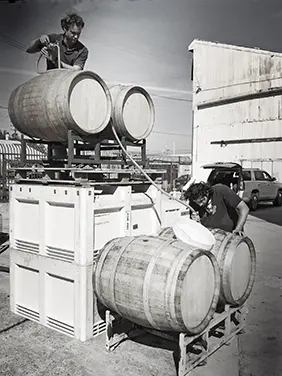
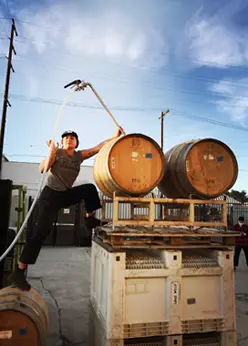
Let me illustrate this from the way that we worked. Above left, Katia is setting up racking: she has placed a long wand (or cane) in the bung hole of the barrel. Lowered into the barrel, the wand will reach all the way to the bottom of the barrel, and its elbow will project out of the top, allowing her to draw wine out of the barrel. The hose could be leading to a pump, which could supply the force necessary to raise the wine out of the barrel and move it to its destination.
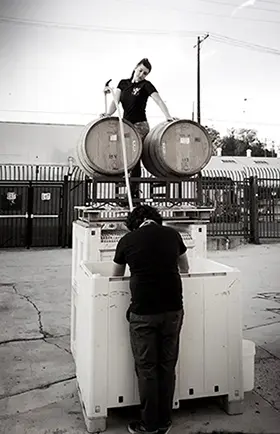
To the right are Dani and Jaime, racking Raisin City ("RC" on the blue tape) from barrel to our blending tank (a 240-gallon open plastic bin, supplied by our friends at VDC Wine.). The hose goes directly from the barrels to the tank. There is no pump in the line. The force necessary to move the wine is supplied by air pressure, and, I think, aided by gravity. As Katia put it, "Why do you need a pump if you have gravity and the Moon on your side?" This explains the tower that you see in these photos: we use a forklift to raise the source vessels onto the tower, above the receiving vessel, and then we initiate a siphon, and let the wine flow.
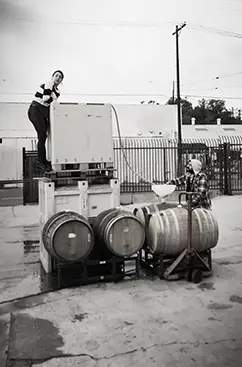
Racking by gravity is sometimes held up as an example of what you could call "Classical Racking." But gravity (as opposed to a pump or compressed gas for instance) is not essential to the nature of racking— but the structure of the wand is. The wand opens only to the bottom of the vessel, and so the wine, as it leaves the barrel, only enters from the bottom, until all the wine is gone. It is the opposite of a pouring out, and, in subtle ways, distinct from sucking out the wine from the top. There is something I cannot put my finger on, but that I suspect is significant, about the fact that this way of racking always draws from underneath, and always pulls the wine down on itself, rather than drawing it from the top. Thus, soutirage.
What are my winemaking colleagues doing up on the tower? They are not necessary for the siphon— the siphon is initiated from underneath. In the photo above and to the left, Jaime is about to start it by sucking on the end of the hose, and thus creating a low pressure zone for the wine in the tank to flow into.
Katia, Matthew (in the very first photo above), and Dani are all up there to make sure that the racking leaves the lees behind. And this is what is metaphysically interesting about racking. We rack the wine in preparation for bottling so that the lees do not end up in the bottles and cloud the wine or cause sediment. But racking is not just about cleaning— it is fundamentally about separation, divorce.
When we put the wine down to barrel, in August, or October, there were no lees. But as fermentations complete and the yeasts and bacteria subside, they fall out of the wine and sink to the bottoms of the barrels. This is what forms the lees, and it is tremendous: there can easily be 4 gallons, or 40 pounds, of lees in each barrel. As Aristotle knew, these 40 pounds of lees were not there in the beginning of the fermentation. They are the result of many generations, billions, of yeasts and bacteria multiplying in the fermentation, and transforming the fruit into wine. So they are not some annoying foreign matter external to the wine, to be extruded and discarded— they were, and perhaps are, absolutely essential elements of the wine. There is no wine without the mass of organisms now found in the lees, settled on the bottom of the barrel. And whatever we have been monitoring for months, whatever we tasted with Raj and José, all of this was wine that had never been separated from its lees. From this perspective, the separation of the wine from its lees is not something to be done lightly. It is not simply akin to tidying the house. It is perhaps more like the inevitable discarding of your high-school souvenirs. Carried out not by you, but by your parents.
Let me return to the practical: how do we leave the lees behind? As Russell says, we rack to them. The crucial work of the person up on the tower is to keep the mouth of the wand as low as possible, to take up as much wine as possible— but above the surface of the lees. This ensures that as the wine flows out of the barrel, and gets closer and closer to the lees in the bottom, that only wine flows out, and that the lees are left behind. It is all about heights, levels, care, attention. The level can be set automatically, and you could walk away— but that feels not just inattentive but somehow lacking.
In the adjacent photos, you can distinguish two kinds of activities from the position of the tank. When the tank is below and the barrels above, we are racking the wine from the barrels into the tank, leaving the lees behind, and creating, in the tank, a new blend.
When the tank is above and barrels below, we are now racking the blend down to the barrels, where the wine will rest for a few days, and from which we will bottle. The blending is very important since it makes possible bottling a multi-barrel blend from several distinct barrels, while ensuring that each barrel is the same as every other. In the case of blends that are only a single barrel (seven of the twelve wines we are bottling), we racked from barrel to barrel, without the intermediary of the tank. In the photo above and to the right, Dani and Jaime are putting a blend down to barrel; in the very first photo, you can see Matthew and Jaime racking two distinct wines, each one going from barrel to barrel. You know that they are two distinct wines from the fact that there is no tank in the picture.
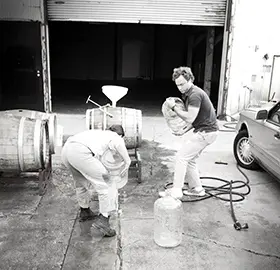
Lastly, we come to cleaning. Coming into our racking Tuesday, we had not a single extra barrel— nowhere to receive the blends that we were putting together. This meant that our first racking had to be one of the multi-barrel blends— and that we had to wash the racked barrels completely and carefully before we could put the blend back down to them. For us, cleaning was thus an absolutely essential task. And, it was, in some way, a metaphysically or morally interesting task, since it involved disposing of the lees. Let me just say that we now have some barrels full of lees; we can always compost them, and then, as one of us had suggested, put them in quart jars, and sell them at Erewhon.
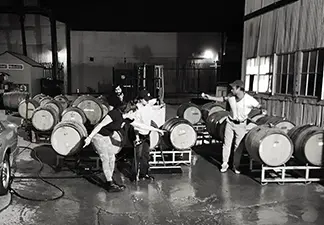
Now, I will finally tell you something about the wines. We completed the racking and blending and barreling down in the dark on Thursday. We racked and blended and put down 13 wines; each wine that we had tasted with Raj and José.
From the very beginning last year, we have been focused on making single wines that somehow captured and presented the single vineyards that we had discovered and were devoting ourselves to. For this reason, blending has never been our aim. On the other hand, care and attention sometimes requires subdivision, separation— as opposed to blending. And for this reason, we have known, since we showed up to harvest the fruit, that we would make several wines from Lone Wolf this year, with each one showing off a different aspect of the vineyard. In the end, we made 4: a Blanc de Noir, primarily from Grenache; a red wine exclusively from Pet Cemetery, and consequently mostly Grenache; a red wine from the pruned primarily Mission vines; and a red wine from the unpruned Mission (and Mission-crosses) in the Wildlands.
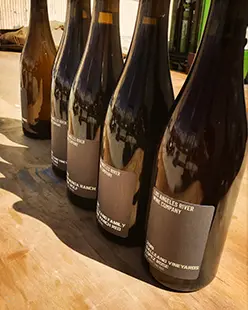
We made two wines from Gateway: a rosé from Zin and Rose of Peru, and a red from Zin; a Pecorino from young vines in Temecula; a strange and hauntingly beautiful Palomino from Fresno . . . .
But for me, the most remarkable wine, just for its sensory qualities, completely separate from any story or sentiment, is Maglite— a nearly 100% Grenache from a 100 year-old vineyard facing the Maglite corporate headquarters, surrounded by boxy buildings of cookie-cutter architecture. This wine is both emblematic of all of our reds, and also their highest expression. It is so light in body and color that you can barely call it red wine. Yes, it is ethereal, but that is trite, even if true. It has this a quiet intensity; a kind of insistence, and a creeping power. But nothing obvious. It defines the way that we see the possibility for making red wines from the deep sands of the South— and from the unrelenting sunshine. It is somehow right that these wines be brilliant and unblistered; an embracing of the sunshine, without giving up before its power. The wines are not rich, and dark, and intense; they are light, and deep, and intense. They are in no danger of overpowering food (or conversation); they are like string quartets without fortissimo sections.
Here is the full list of the wines that we racked and will bottle:
- LONE WOLF BLANC
- GATEWAY ROSE
- LONE WOLF CLASSIC
- LONE WOLF WILDLANDS
- LONE WOLF PET CEMETERY
- MEPPP
- DISCO ESSENCE
- RAISIN CITY
- MAGLITE RED
- PHULAX
- RIVERSIDE RED
- PECORINO FLOR
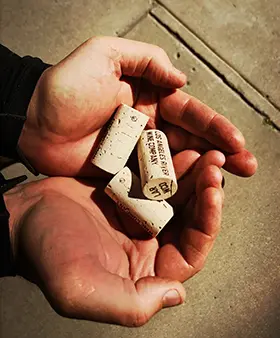
We have pre-sold much of this wine. For some of the 1-barrel wines, there are only a few bottles left. The Pecorino Flor suffered our only racking mistake: it is from a solera, and we did not take enough out to bottle before we added the fresh wine. There will be only 146 bottles of this wine, and we have sold all of them!
You may go here to purchase the wines. Some of them will eventually available in restaurants and in retail, but most will appear only here (and through a very special importer in London!).
Thank you so much for reading so far. There is something crazy about your interest and I am grateful for it.
And if you are waiting for wine, or for me to answer you, please pardon me. We really think that we can get everything out Monday— and then three days with our heads down, focused fiercely on bottling.
Thanks again.
Abe