What is pruning? Midway between a report and an inquiry
The surprising roles of Violence & Infinitude
WHAT IS PRUNING?
A metaphysical-practical inquiry
Yesterday, Tuesday, when I began writing this to you, it was sunny and cold on the California coast— but there was something new and different about the light. It was 49 Fahrenheit, cold for this Winter here, but everything reminded me of being fourteen, deep in the woods of Vermont, waiting for a ride to the school bus, in the middle of Winter.
The mornings were brilliant, with the temperature always near zero, and the sun shone so brightly on the snow that you were blinded everywhere you looked, and had to shield your eyes with gloved hands.
And it was not just the snow: it was as if the piercing cold transmitted light differently.
It's a sign from the beginning of the day that something magical is going on. Some weight was lifted from my soul by this out of place sun, and I feel ready for some thinking that was not possible only a day before. It is absolutely material that the new case count in Los Angeles is down 39% from 2 weeks ago. That kind of news makes it easier to see the sun at a new angle.
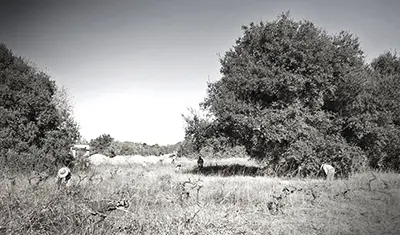
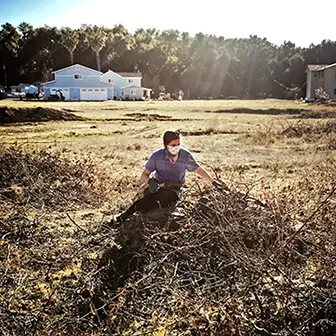
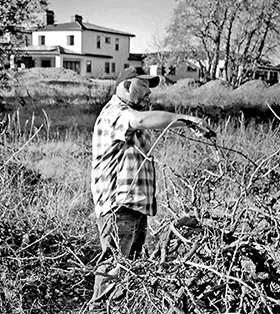
I had intended for this message to be a brief report on our pruning at Lone Wolf, ten days ago. But now I am moved in a different direction. Let's call it a preliminary inquiry into the metaphysics of pruning.
What is pruning?
Pruning is changing the permanent structure of the plant with a deliberate cut. You can prune with a chainsaw, and I think that breaking off a shoot with your bare hands can still count as pruning. In other words, "cut" does not depend so much on the tool, but on the action. You are shaping the plant and the only way to do that, in the case of the grapevine, is by removing something. Pruning always makes the plant less. You are taking something away.
The sharpness of the blade and the skill of the pruner can elide the full nature of the activity. We prune when the vines are dormant— what this means is that the sap is not flowing. Nonetheless, the cut tends to emit sap, at least here in the South. The vocabulary of pruning in English richly embraces the perspective of the plant: the cut is said to "weep," and the trace of the cut is called a "pruning wound."
Violence and The Shape of the Vine
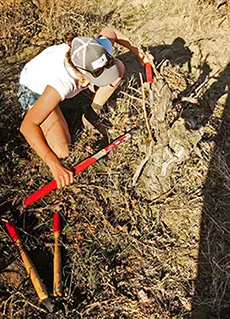
We prune to shape the plant to our own design. This is especially clear in Lone Wolf, where nearly half of the plants have not been cut for 60 or 70 years: they bear no pruning wounds and the shape they have is their shape— not the shape imposed by us.
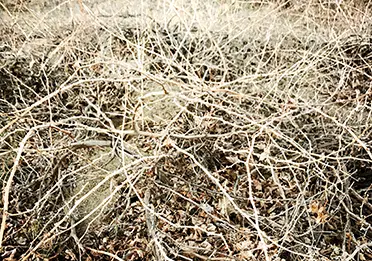
This is an example of a vine from the section of Lone Wolf we call "Wildlands." It looks like nothing in a well-cared for vineyard. It looks like part of a forest, the edge of a forest, growing on the border between field and tall trees. Even now, when the vine is dormant and has lost all of its leaves, it is hard to discern a center. The vine does not seem to have a trunk or a head. It does have a periphery-- which is both geometrically and physiologically interesting: an edge without a clear center. We can see the borders, the end of one plant and the beginning of another. But in the Summer, once there are leaves, this border is completely indiscernible. The vines seem to form a single organism, much more like a carpet of moss than a vineyard with its trunks proudly erect and distinct.
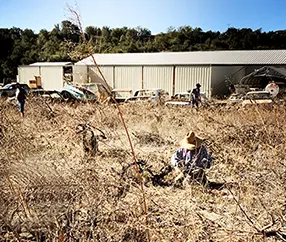
It is one thing to prune a plant that has already been shaped by human hands. You can step back from the plant and recognize the plan that we have for it, the shape and structure that we intend for it. You and the plant are already part of the same system before you make a single cut. But with the plants here, you step back and all you can do is somehow try to take in what the plant has been up to all these years. It has no easy-to-discern plan; no familiar shape. To make the first cut— it is undeniably an act of violence, an imposition. One really hesitates. I could see, looking all over the vineyard, people taking deep breaths before making that first cut. The crazy vines project something of the sublime; the care and humility with which we responded to the task was almost inevitable .
This moment's hesitation makes palpable the easy-to-ignore heart of pruning: There is no pruning without cutting or breaking, there is no shaping a vine without taking away. No pruning without tears and wounds.
The Bud and the Imagination
I have not been completely clear about what pruning removes: the cut removes something that we don't want to persist. In a certain sense, it is not so hard to make a cut, because you can see what you want to make go away. It is there. It might even be dead; that makes it really easy. Just cut away the dead stuff. But the other side of pruning is all about the invisible, or, at least, the not yet visible.
The aim of our pruning is to favor certain buds, and to do so by removing others. Cutting away the dead stuff is just cleaning up the kitchen; it might be essential, but it's still not really cooking. The cuts that count are not about taking away, they are about leaving behind.
And they are difficult, and interesting, because they depend not on sight and recognition ("this is dead, this in the way"), but on imagination, what Aristotle called phantasia: the ability to conjure up a complete picture of something that does not yet exist.
And all of this is focused on the bud. The vines are covered with buds; some visible, some latent. The visible ones occur for the most part on the shoots that grew in the present year. They grow at the nodes of the shoot; there are no nodes without buds. Every time a leaf or a tendril arises from a shoot, there is a bud opposite it— patiently waiting for the next spring to open.
These buds are the focus of our attention because they contain within them the next year's shoots. No growth occurs in a grapevine except from out of a bud. Once the buds open, tiny, furled up shoots pop out of them; and only these shoots grow, and only in the year that they emerge. Any further growth must occur from their buds, in the following year.
And this year's buds contain not just next year's shoots, but the next year's clusters, preformed within the bud! In other words, next year's fruit is already present in this year's buds-- right now! You can open a bud, and, with a basic microscope, see the tiny clusters. If you really want to know what next year's crop will be like, you just get an intern a few hundred shoots and ask her to do bud dissections and count the clusters within.
The depth of our work is to determine the future of the plant by saving the buds whose shoots we want to emerge, and removing the buds whose shoots we do not want.
This vineyard has somehow persisted for generations without pruning— without this selection and removal. But it was already suffering because of this: about half of the vineyard looked dead when we first saw it; two-thirds did not bear fruit in our first harvest. This was because, without pruning, the vines were trying to produce and sustain too many shoots. Those shoots were getting more and more spindly every year, and bearing fewer and fewer clusters. In this vineyard, at this time, our most important work is not shaping but limiting and concentrating, the plant.
Infintude
Pause for a moment to consider this:
The buds contain next year's shoots and clusters. But not only this— on each shoot are already, preformed, not just the clusters but the following year's buds. The grapevine bud is like some insane Borgesian Aleph of eternal regression, containing not just the future, but all infinity, within its tiny confines.
In pruning, our relation to the bud is less metaphysical, but no less remarkable. With each bud, we are called on to imagine what will happen when this bud opens and the next year's shoot emerges. We must imagine not just the shoot from any single bud, but we must somehow use our imagination to conjure up the whole system of shoots that would emerge from the whole mass of buds.
And then, in the theater of our minds, we must imagine what would happen if we cut here, and removed all of these buds, but retained these other buds. And then, we must consider other scenarios— what if we cut here instead?
And in order to make not just a reasonable cut, but a good cut, we must imagine the whole vine in a few months, heading into harvest. In order to make a really good cut, somehow worthy of these hundred year-old vines, we must be able to imagine this vine 5 years from now, 10 years from now, when we might long be gone.
This is the truly awesome task of the pruner.
I am going to stop here. It was night-time when I wrote this; I had not had dinner yet. A friend's wine awaited. While I was writing, another friend texted me, and thanked me for my kind words on his absolutely fucking amazing new release. We traded thoughts on my father and his renaissance through Instagram, at the age of 95. It was a day of many wonders and much beauty. I am grateful for my connection to both of them, and to you.
Don't forget the wines that we are making from this vineyard. We released them just two weeks ago and they await you still.
Abe