A second report on Lone Wolf: we prepare for pruning
the vineyard is ours to help and care for
PRUNING IS AN ACT OF DEVOTION.
A second report on Lone Wolf
It is such a hard, strange time.
The end of the year; the "New Year"— these expressions are just clerical devices. They signify nothing substantial.
In Los Angeles, now my city, nothing new is good. We can look to the sky: for us in the Northern Hemisphere, the days are getting palpably longer, and this is wonderful and natural at once. Yet it is still Winter, and that too is good. The short days and cool weather of Winter encourage dormancy, and there are plants and animals that require this pause. And who can say that we too do not need a dormant time?
I hope that you will remember some details from my report on the harvest at Lone Wolf this year— the wonderful, previously abandoned vineyard that is the object of our devotion.
THE SIGNIFCANCE OF THE BUDS
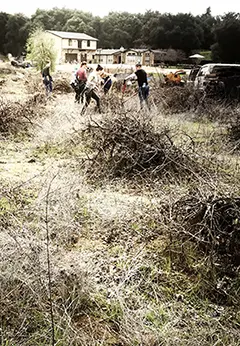
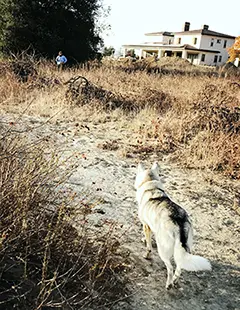
We visited Lone Wolf a few days before the December solstice. The vineyard looked wonderful. It is completely dormant, and, since it had not yet rained, the grasses were still brown. The photo above is from our pruning in February of last year— the first time these vines had been pruned in my lifetime; the photo to the right is from our last visit. There is a new lupine host, young and friendly.
We saw buds everywhere. The buds are both the signs and the embodiment of the future. They contain the future of the plant: nothing grows on a vine except from a bud. I exaggerate a little: the trunk will become thicker in a healthy year, but there is no such thing a a branch that gets longer or a trunk that gets taller. Every leaf is on a shoot, and every shoot emerges from a bud. Pruning is about culturing the buds and thereby shaping the future of the plant.
In a time of absolute despair, no one would prune. Pruning is thus an expression of faith in the flow of the natural world, and hope in our ability to participate in it. I can't think of a happier and more hopeful activity in this time than pruning a vineyard.
THE PRUNING STRATEGY
Lone Wolf, as you well know by now, is a very special case. We have only been working with the vineyard for two harvests; we hardly know it at all. In our infant understanding of it, we now divide the vineyard into three sections:
- The Center, consisting mostly of scraggly Mission vines
- Pet Cemetery and the Periphery; consisting mostly of large Grenache vines
- The Wildlands, consisting perhaps entirely of Mission, with lots of plants grown up from seed
In all three sections, there were lots of healthy, plump buds on last year's growth-- promising much more growth and fruit this year. Because of the simple care we gave the vineyard last year, we harvested nearly 3 times as much fruit in 2020 as we did in 2019. I was somewhat worried that this flush of production would leave the vines exhausted. But the profusion of plump buds suggests that the vines are still very strong, ready to flourish again.
Last year, not knowing anything about the vineyard, but fearing for its health, we pruned very restrictively and removed lots of wood and lots of buds. Raj and his school left more wood and more buds than I and my school did; on many plants, I brought us down to 10 buds or less. This meant that these vines would produce only 10 new shoots, and, at most, 20 clusters of fruit.
We also did not distinguish clearly between what we now call the different sections; but it is fair to say that Raj's instructions made intuitive sense in Pet Cemetery and the Periphery, because the vines there are very stout; and mine made a little more sense in center, where the vines are much scragglier.
The vines in the photo above are good examples of the more scraggly vines in the center. This year, they produced about 2 tons of fruit per acre; much more than we had expected, and produced many more shoots than the buds that we had left. In other words, they had much more power than we had realized— and we should have left more buds for them to express their power. We will not make that mistake this year.
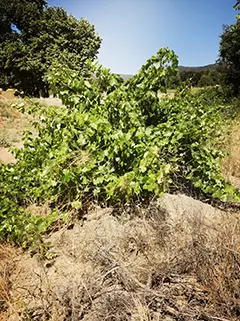
The vine to the left is an example of the very strong Grenache vines in Pet Cemetery and on the Periphery of the center (photo from June of last year). Raj had identified these as Grenache on his first visit based on their growth habit; now that we have harvested fruit, we are almost sure that he was right. (We are finally going to do genetic testing later this year.)
We thought that we had left about 30 buds on this plant at pruning last year, intending approximately the same number of shoots. It pushed about 60 shoots, all of them strong, and most of them bore two clusters. We harvested about 40 pounds of fruit from this vine alone; on the whole, Pet Cemetery yielded about 5 tons per acre.
This year we will prune the vine to the 60 buds that it pushed this year— maybe more.
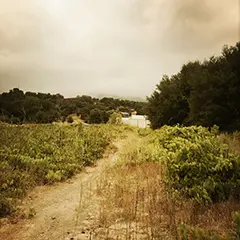
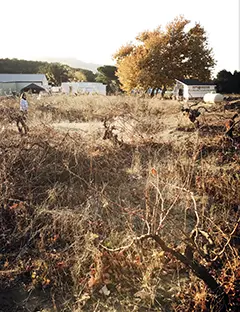
The photo to the right is of the Wildlands, with some big vines of the Periphery on the right side of the path between the vines.
The Wildlands are the vines that show no pruning cuts on them; they are a tangled and undifferentiated mass with no clear trunks or heads, just shoots heading in every direction.
Last year, we did not even try to prune them. I was completely befuddled, and could not even tell if the vines would survive or bear fruit. But come June, we saw an incredible amount of healthy, new growth, showing that the vines were very strong. By July, we could clearly see lots of clusters forming. The photo below right is a detail of vines as they were growing in June.
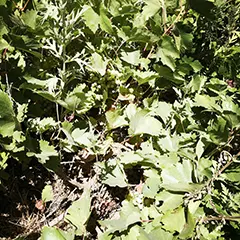
Tens of us drove down from LA, weekend after weekend, and spent days shoot-thinning the tangled vines, trying to open up space for the clusters and to get the riot under control. It was a wonderful time for us, but it is hard to imagine that this is the best way to manage the vines and benefit the crop. This year, we will penetrate into the jungle and prune them— for the first time in 60 years or more.
We will prune but not try to re-shape them: we will not try to create trunks or heads. But we will try to limit the number of buds somewhat, try to tame the riot before the buds break and the shoots push.
HOW FEWER BUDS CAN LEAD TO MORE FRUIT
The theory behind this is delicate but clear. If you leave an unlimited amount of buds, no matter how strong and healthy the vines, the shoots that push will eventually weaken because they are in competition with too many siblings. As a result, no shoot will be as strong as possible, and some will be so weak that they will not support fruit. By limiting the number of shoots, we can foster more healthy shoots, and that, in turn will actually lead to more fruit.
This will be the most difficult, and the most interesting, section to prune. Because there are no recognizable trunks or heads, you cannot simply say how many buds you will leave per plant. Instead, we will have to react woody cane by woody cane, but somehow keep the whole mass in mind. We will have to think systematically about a system that is far bigger and less regular than any we are used to. What a lovely challenge.
I so look forward to letting you know how it goes.
We will prune the vineyard on subsequent Saturdays in January and February, until the job is done. I will post regular updates on Instagram, and send you another report like this when we finish.
Until then, you can assure yourself a taste of last year's harvest. Tomorrow at this time, I will send out an offer for two wines: the 2019 FTP-C from Tegan Passalacqua's Chenin vines in Lodi, and the 2020 Lone Wolf Blanc— made from white and pale pink fruit from Pet Cemetery and the Periphery.
Thank you so much for your attention and your constant support.
Abe