A Report on Lone Wolf, from discovery through Harvest 2020
for your weekend reading
LONE WOLF
A Report in 11 parts
I am so excited to share this with you.
I have been composing this for weeks. I keep writing and writing, revising and revising. The store of wonder seems infinite. I am sending it this morning before I exhaust the patience of my friends and colleagues.
1. DISCOVERY
In the Spring of 2019, Raj Parr and I took a quick trip through Temecula to get a sense of what was possible there. We met with David Bradley at Vindemia Winery, toured his really well-farmed vineyards and tasted his excellent wine. The visit confirmed that Temecula was a viable fruit source for us. This was important because it is the closest substantial grape-growing region near LA-- we knew about Lopez in Cucamonga, but did not yet know about the other treasures nearby.
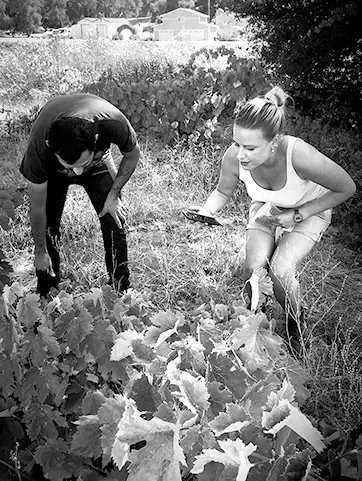
We knew so little then. But we were full of hope and curiosity. Raj asked David if he knew of any wild, old, vineyards nearby-- anything that might have been overlooked, ignored. David turned his head toward the ceiling and said, "I think that I know something." On May 7, he sent me an email and first mentioned a "real old Mission vineyard" on a Native American reservation near Temecula. I thanked him and filed the information away in my crowded head. I knew a little about Mission and was not very inspired to pursue it.
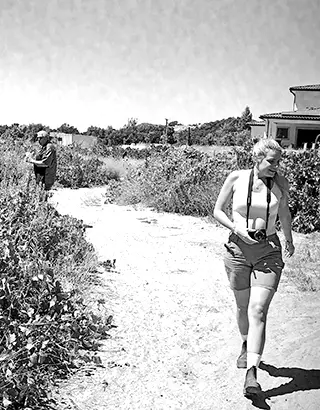
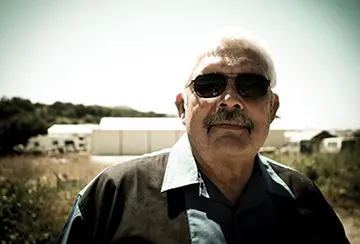
Now it is July 31, 2019: Christina Rasmussen is here. She is tireless and irrepressible. She has been in the country 3 days. She hears the story about the vineyard on the reservation, writes David, gets the owner's phone number. We visit on August 9 and meet Bob, the owner. He is a man of few words, and an elder in the band. The vineyard is abandoned. It has not been farmed since he was a child. He says that we can have the grapes: "it's you or the coyotes."
2. THE FIRST HARVEST: 2019
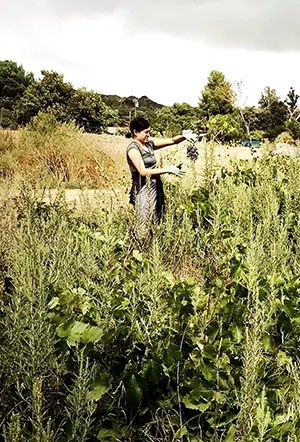
The vineyard is about an hour and half drive from Los Angeles, when traffic is tame; 3 hours when it is not. We visit several times to try to get a bead on harvest. What kind of grapes are there? How much? What shape is the vineyard in? It is all a mystery. We have never seen a vineyard remotely like this. The photo at the top is Xtina and our colleague, Jaime, photographing a typical vine so that we can get advice from our more knowledgeable friends.
We think that most of the vineyard is Mission, but we don't really know. Maybe 80%? There does not seem to be any "normal" white fruit, just a lot of different kinds of red and pink berries. Bob is clear that the vineyard has only been harvested a few times in his lifetime. This means that, absent what the coyotes have eaten, years of fertile fruit have fallen to the ground. This means, in turn, that many of the vines that we now see are "seedlings," the result of sexual reproduction in the vineyard. Some vines are the offspring of other, older vines. This is allowed to happen nowhere in the grape growing world. Vines have been propagated by cuttings since before Roman times. It is no surprise that we cannot identify all of the vines. Some of them are hybrids that are utterly specific to this vineyard.
We take measurements and estimate that the vineyard will be ready to harvest around October 1. Xtina has a ticket home to London on Monday, September 30. We plan to harvest the vineyard, with a crew of volunteers, on Saturday the 28th.
I estimate 3/4 of a ton, 1500 pounds.
Harvest is a story in itself, but I will pass by. Ten of us drive down to Temecula on what feels like the first day of Fall. We bring home 1600 pounds; some sections of the vineyard have no fruit at all. It takes us 6 hours of hard work to bring in what we do.
During harvest, there is a huge dog roaming the vineyard. It looks like half-wolf, half-husky. It is kind but vigilant. Xtina names the vineyard for the dog, in an act of nearly childish romance: "Lone Wolf."
3. PRUNING: FEBRUARY 2020
From the first time we set foot in the vineyard, we know that the most important thing we can do to recuperate it is to prune it.
You need to prune when the vines are dormant. I have never worked with vineyards down here, never worked with Mission at all, or whatever this is. We ask some locals: when do you prune? Is February good? It is. Xtina gets tickets from London; Raj clears his schedule; one of the investors flies in from NY; friends drive in from Napa, San Franciso, Oakland, Santa Barbara, Paso, Los Angeles, San Diego.
Raj and I put our heads together to come up with a plan for pruning. No one else on the team has ever pruned a vineyard. I have really important experience recuperating an ancient vineyard in France, of about the same age-- but it was not Mission, and it was in very different shape.
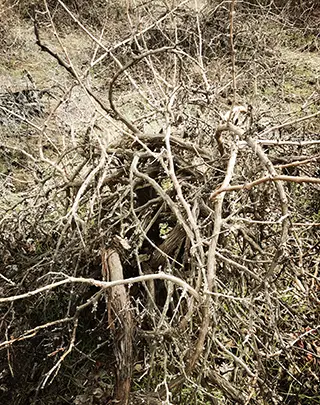
This vineyard was planted in about 1900, 1920 at the latest. It was abandoned about 60 years ago, when Bob, the owner, was about 5 or 6. From that time on, oak trees were allowed to grow up within it; most of the vines went unpruned, the fruit mostly unharvested. You could see traces all over the vineyard where people (like us? enthusiasts from outside?) had come in and pruned some of the vines, attempting to restore them to some kind of order.
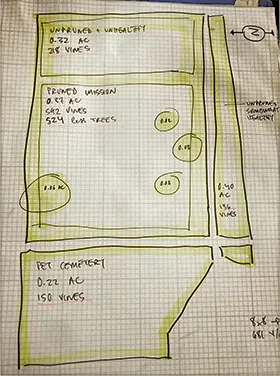
If you look at the map at left, only the center rectangle had been pruned recently, and perhaps only half of the 520 or so vines within in. On the perimeter of this rectangle, and within Pet Cemetery (that's right, there is one) below, there are some massive old vines that were trained carefully up to the 60s or perhaps even more recently. They have maintained their shape in spite of not having been pruned for a few years, and look pretty much like head-trained old vines anywhere in the world.
But the rest of the vineyard almost exceeds description. Most of the vines have no trunks. There are sprawling masses without discernible centers, or, they have ancient "heads," very close to the ground, emitting twenty or more arms, each of which has given rise, in turn, to tens of branching canes. There are seedlings everywhere. . . .
One whole section, the thin rectangle on the far right, seems like a single carpet of undifferentiated vines. I can not imagine any scheme for pruning them.
It is not insignificant that this vineyard has no fence surrounding it. Nowhere on the property do I see fence, a gate. The vineyard is not a Clos; it is in every way its opposite. Lone Wolf is what my friend Nate Ready and I would call a Hortus Apertus.
Now it's Friday night, February 22; we begin pruning the next day at dawn. Raj and I cannot agree on a single plan. He wants to preserve shoots and so allow for more clusters come harvest; I am terrified that the old vines cannot support all of this growth, and I want to prune them back severely to limit shoots and clusters. Raj points out my severe pruning could harm them too-- it will be like going into a town and cutting the arms off all of the residents. We are at an impasse. The only thing that we agree on is that we will focus our efforts on the vines that already have a shape. Unless we have an abundance of time, we will not even try to prune the undifferentiated mass.
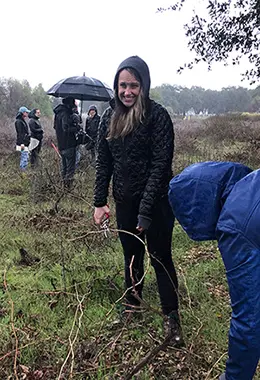
Now it's Saturday. The rain comes. One twelfth of the area's annual rainfall in a single day. We have all come from so far; there is no choice, we must persevere. We divide the team in two: half will prune according to Raj's instructions; half according to mine. Two schools of pruning. A crew from SommTV films us in the rain. It is wonderful, but terrifying. Every cut is a wound; what if every wound is a death blow?
We complete the center Saturday; Sunday we tackle the big vines in Pet Cemetery. Raj thinks that they are Grenache, or mostly Grenache. We start thinking of the vineyard as having sections: the central core, with small, orderly Mission vines; the periphery and Pet Cemetery, with large, vigorous Grenache; and the Wildands on the outside, vines without trunks, the carpet of vines.
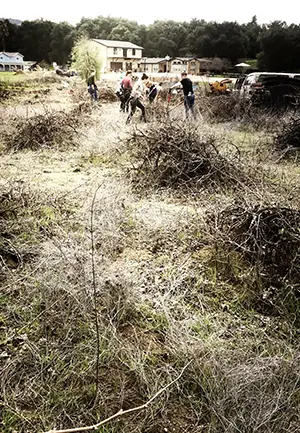
By the end of the day Sunday, we have pruned every vine in the center, periphery, and Pet Cemetery. We ignored the unhealthy vines at the top, and the tangled masses in the Wildlands. We are proud of our work, but still full of trepidation. What have we wrought? This vineyard brought us 1600 pounds of healthy, delicious fruit, after being undisturbed for years, without any human intervention. What will come of our imposing order?
There is this reassuring blessing: On Sunday, Bob gets into his golf cart and drives out to see us. He pulls up next to me, looks over the 11 friends bent over his grapevines, pruning away, slowly, carefully. He nods twice, meeting my eyes, and drives away. One of my proudest moments.
4. BUD BREAK AND SHOOT THINNING
I wait a month, five weeks. Still no budbreak. Bob goes out into the vineyard and checks for me. From what he describes, the buds are swelling, that is a good sign, but we won't know if the vines are healthy until we see the shoots.
April 7. I can't wait. I drive down. The vines look really good. There are buds everywhere, even on the vines that I had thought were unhealthy, that we did not prune. There are adventitious buds that we did not leave, buds springing up right on the bark. This is a sign that the vines have untapped strength, that they have more to give than the room that we left them. I am so excited, so happy. And I have no idea what is still to come.
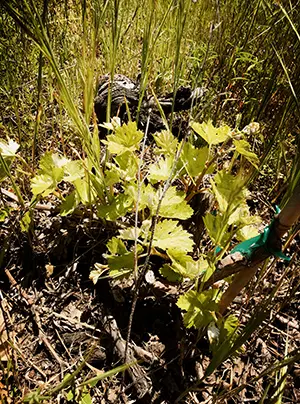
April 19. I return, with a few friends, hoping that there will be a little work to do, tidying up the vines, removing some extra shoots. We are met with a riot of growth. Yes, budbreak: shoots everywhere, strong shoots, not long yet, but thick, promising lots of healthy growth. We begin to thin the vines that we pruned and try to get them to the number of shoots that we had intended at pruning. We find we are removing more than half the shoots. This seems like too many. Clearly, we had underestimated the vines. We leave a few more shoots. We feel confident that the vines can suport all this growth.
(This means, by the way, that Raj was right.)
It is a beautiful Spring day. The city is locked down and far away. We are so happy to be outside. We work swiftly, efficiently. Our work is quickly done. We survey the rest of the vineyard, beginning with the vines that I had thought too unhealthy even to merit pruning.
I was so wrong: these, more than any other vines, need our care: they are pushing shoots, lots of them— too many. The shoots are spindly; many look like they will soon wither. Here we must thin. I marshal the troops. Ten shoots per vine, maximum. We go back to work.
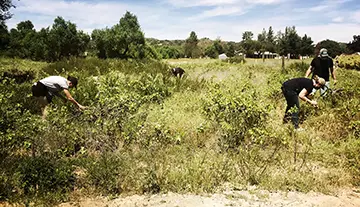
I know that we have many days of work ahead of us. Not just a little shoot thinning where we had pruned— but radical, and remedial, work where we had not pruned at all. Here, there are too many shoots; and the excess shoots are sapping each other of strength and nutrition. The situation will become only worse once there is fruit: too many clusters for the plant to bring them all to happy ripeness. This is where we can really help the plants: remove shoots, make it more likely that come ripening, the plants will have the power to sustain what is left.
We returned five weekends in a row, one day at a time, for a day, for a few hours. The growth was so furious, sometimes we could not tell where we had thinned and where we had not yet touched. But subtle attention revealed all: here, untouched, was a riot; there, thinned, was merely a party.
5. WONDER: A SPECULATIVE EXCURSUS
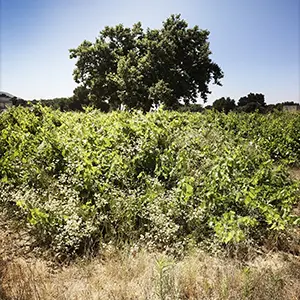
Soon, it was clear that the most interesting part of the vineyard was the very part that we had walked away from: the Wildlands, on the Southern margin of the vineyard, on the right side of the map. Here there were no discernible trunks, not even heads of vines. No centers. Only a sprawling network, not only without center but perhaps without nodes. And the most remarkable aspect of this section, from the perspective of human culture, was that the vines had no scars, no cuts. There were no traces of any prior pruning. It had been so long since the vines had been pruned that their former shape and structure, determined by human decisions and human actions, had been completely superseded by the spontaneous growth of the plants themselves.
It is hard to describe the growth here properly; hard even to provide good photographic images. Let me tell you one thing about what one might call the "habit of growth" of the plants here, and then two things about the density of growth.
- HABIT OF GROWTH: The vines are supine. They do not stretch into the sky, as you might expect vines to do (but nearby, vines scale the four oak trees, interlopers in the vineyard). They stretch out horizontally and intertwine. Some shoots from just last year are 5 meters long. They course over and under each other, and also form new root zones when they touch the earth. A single shoot will emanate from older wood, close to the ground, rise up a few inches, grow laterally a few feet, touch the earth, put down roots, rise up again and keep growing outward. (For a long time, farmers in various parts of the world have taken advantage of this metamorphic ability of vines to change from shoots to roots in order to propagate them without cutting or sexual reproduction. This is called "layering," or "provignage" in French.)
Because of this, it is hard even to say what counts as an individual plant in this section of the vineyard. On the other hand, it is important to note that if you look at a recent aerial photograph of the vineyard, you can still clearly see from the sky the ancient centers of the vine sprawl, where the individual vines used to be. - DENSITY OF GROWTH 1: in the central section of the vineyard, where the vines look like individual vines, with trunks, heads, and space in between them— there is not much vegetative mass. One relatively small vine every 8 or 9 feet, and rather thin grass and some other weeds in between. Not lush growth. There are not that many shoots, even on the strongest vines-- even the ones pruned by Raj's method! Because of the relatively small number of shoots per surface area, there cannot be much fruit here. If you were to put it quantitatively, the Wildlands have a vegetative density and biomass 5 or ten times that of the center section.
- DENSITY OF GROWTH 2: the Wildlands have not only more vine vegetative mass than the center, but much higher total biomass: There is a lush rye grass that grows there, more lush than anything growing in the untilled spaces between the central vines. But this grass grows only within the tangle of the vines— as soon as you step outside them, onto truly open ground, the lush rye disappears and is replaced by dry, sandy, ground— sometimes completely bare. The vines, rather than suffering "competition" from "weeds", provide a home for them. In this way, the vines do not try to "out-compete" other plants nearby; just the opposite, they provide a better, more fecund home for these plants than bare ground does.
(I am visiting Nate Ready at Hiyu right now, as I edit this. He spoke about the same thing last night, in a dusk vineyard visit: the false myth of competition in the vineyard.)
6. THE MICROBIOME OF THE VINES: A SECOND EXCURSUS
There is a very strange phenomenon in this vineyard: there is no sign of damage from any fungal diseases. The growing conditions all over the Los Angeles basin and the Temecula highlands are wonderfully healthy for vines (it is a separate question to ask why this is not better recognized). There is very little rainfall (one third of Napa's) and very little ambient humidity during the growing season, and very good air flow all of the time. This means that fungal diseases, like mildew and botrytis, pose a much smaller threat to grape vines in this whole area than they do in Napa and Sonoma, and many other grape growing regions all over the world. Yet, they still pose a threat; and commercial grape growers in this area still combat fungal diseases with efforts similar to those used all over the world. This typically means several tractor passes throughout the growing season, spraying one of several substances (even organic standards allow for the spraying of certain chemicals) to inhibit fungal growth. The downside of these treatments is that even highly specific organic agents will diminish the whole fungal biome of the vineyard as they attempt to control pathogenic fungi. It is impossible to treat for harmful agents without affecting the whole system. Of the six vineyards that we worked with this year, 4 did not receive a spray all year (one, only biodynamic sprays. The other four were feral). Lone Wolf has probably never received an antifungal treatment in its whole life-- certainly not in my lifetime. Yet there was no damage from mildew, botrytis, or any other form of microbial pathology. Perhaps the most remarkable expression of this is that we never saw a single trace of common rot on any cluster or any even any berry. Clusters that lay on top of each other in the Wildlands were pristine; huge clusters of Grenache lying on the ground presented only intact, unspoiled fruit.
Lone Wolf is magical; but there is still an explanation for this:
- There is a lot of excellent recent research on the nature of the whole microbial world that surrounds and interpenetrates the grape vine— its "microbiome." Some of this research has demonstrated that under certain growing conditions, there is a complex and diverse system of yeasts and bacteria that can inhibit vine pathogens-- including, especially, fungal pathogens.
- The microbes are described as "epiphytic," living on the surface of the plant; and "endophytic," living within the plant— dwelling within its tissues. Some are both; and some, whether endo- or epi-, contribute to a systemic resistance within the whole plant to the pathogens— not just a local inhibition. This means that, under the right conditions, the joint system of the plant and its microflora can successfully resist the usual fungal pathogens that drive farmers to spray all over the world.
- Lastly, there is a whole fungal world underground that knits the vine into its soil environment and provides a network that interconnects the vines. The importance of this world is well known, even if farming practices around the world do not yet attend to its culture. The fungi are called "mycorrhizae," and the world they share with the plant roots is called the "rhizosphere." The mycorrhizal fungi stretch between and connect the plants to each other, but even more remarkably, they interpenetrate the tissue of the plants themselves and slide in between the cells in the root. The health of the rhizosphere directly influences the health of the whole plant above ground, and affects every aspect of its growth. The interconnected mycorrhizae can be thought of as a single organism, making the many physically separated plants of the vineyard into a single system in a more than analogical sense. Many conventional farming practices, especially tilling and spraying, harm the mycorrhizae; even organic antifungal agents will compromise them.
The point of these lengthy excurses is to raise the following possibility: that the remarkable vigor and fertility of the whole vineyard, but especially the Wildlands, is not a miracle that erupted in spite of its being abandoned for 60 years, but that it is precisely and perfectly the result of 60 years of spontaneous self-regulation. Let me point to three specific farming practices whose omission might have had a positive effect on the vineyard:
- the omission of tilling
- the omission of spraying
- the omission of irrigation
The omission of the first two practices could have led to a much stronger, more complex, more diverse, microbiome, including especially the strengthening of the rhizosphere. The omission of the third would have had some effect on the microbiome of the rhizosphere simply by changing the soil moisture, and especially would have changed the macroscopic structure and physiology of the grape vines in ways that are already well recognized.
The deepest magic in Lone Wolf lies in the longstanding community between the visible plants that are our focus, and the invisible microbes, above and below ground.
7. THE HOLES AND BURROWS: A SHORT AND FINAL EXCURSUS
Most of the vines in the vineyard have some kind of animal burrow beneath them. In the more orderly center section, there are fewer burrows and they are small-- perhaps the work of voles or field mice. You sense that there are tunnels beneath the surface of the vineyard, but the ground is still hard and does not collapse beneath your weight.
In the rest of the vineyard, there are burrows that an adult could fall into. There are openings beneath the vines that are two feet wide. Not many, but some. You collapse small tunnels underneath the vines all the time. I cannot even imagine what lives in them. Many of the vines, especially in Pet Cemetery, are mounded up, with fine, loose sand forming a cone that descends a foot or two from the central trunk to the level of ground, then with some kind of hole in the mound. I really do not understand the macrobiome of this vineyard, but it is clearly complex and dense. We saw a few snakes, but the only mammals we saw were the pet dogs that live around the vineyard.
I have no idea what kind of interaction there is between the vertebrate residents of Lone Wolf and the vines, but I can tell you that in a "normal" vineyard, no one would greet hundreds of burrows with enthusiasm.
8. HARVEST
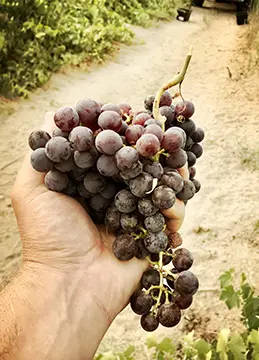
Once we begin working within the Wildlands, we are thinning there every week. The work seems infinite-- appropriately. Perhaps the best thing is that by returning every week, we see the changes-- not just the continuous, apparently unbounded, growth of shoots and leaves— but also the emergence of clusters! And there are so many. And they grow too; they elongate, you can see them making room for lots of flowers, and then, after bloom and fertilization, we see lots of grape berries. It is truly wonderful.
Early in the year, I composed a spreadsheet to help me estimate the crop that we could expect in 2020. We did a rough vine count during pruning, and I used Google Earth to get an approximation of the surface area of the vineyard. I assumed that the Wildlands had the same vine density (but a much higher shoot density) as the rest of the vineyard. I figured that pruning might bring down our pounds per vine in the main section slightly this year, on the assumption that the average vine would have fewer shoots post-pruning than in its more wild state the year before. But I anticipated that we would harvest fruit from much more of the vineyard this year. In 2019, the sections outside of the main rectangle had almost no fruit; I don't think that we harvested anything at all from what I now call the Wildlands.
Next I plugged in my estimate of how many pounds per vine we harvested last year, and guessed at the average cluster weight at harvest this year. This gave me all the variables that I needed to make a mathematical projection, and, on this basis, I projected that we would bring in much more fruit this year than the year before: 3400 pounds, nearly twice the 1600 from the year before! So exciting.
As harvest approached, I returned as often as I could. Each time, I saw more clusters and saw that they were going to be much bigger than last year. I plugged new numbers for total clusters into the spreadsheet, and upped the cluster weight. 4300 pounds. More than two tons! What a reward for our hard work; what a blessing that we had helped and not hurt the vines.
September 8. Visit. The clusters have achieved their final size. Much bigger than last year. Raised cluster weight again. 6300 pounds.
And the fruit is ripening very well. We will begin harvesting the next weekend. I hope to get 10 people each day; I think that it will take us four days to pick the whole vineyard. About 1600 pounds per day-- the same each day as our total harvest last year.
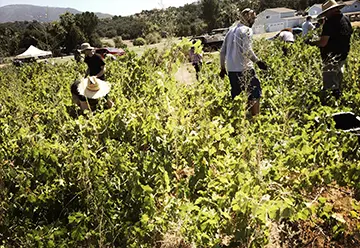
September 12. Harvest day. We meet at the vineyard at 7 AM. We begin picking in Pet Cemetery. We have no idea how much fruit there is there. Jason harvests more than 100 pounds from a single Grenache vine (pruned Raj-style, of course).
It is 100 degrees. In spite of the heat, we are picking much faster than last year. It is in part because we are better organized, but also because there is so much more fruit, so much easier to find. We pick from 7 AM till 1 PM. We put 5300 of the projected 6300 pounds on the truck. In one day! And we have not yet touched the Wildlands. I revise my projections again. An additional 3600 pounds from the Wildlands alone. It is more fruit than we can use. We don't have the fermenters, we don't have the barrels. Colleagues from the Hermann York winery have been helping us all season, from shoot thinning throug harvest. I offer them the balance: I think that there will be 500-800 pounds for them. They are very grateful.
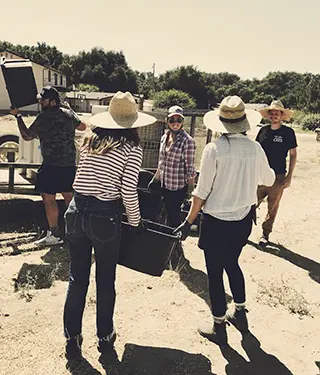
September 20. The weather is no longer in the 100s. We are old hands at this. We finished all of the vineyard except for the Wildlands in 6 hours the previous week. Today our only task is the Wildlands. We know that we have a short day and attack the vines with gusto and joy. It is remarkable to think that we harvested no fruit from this section last year, and now it is the work of a single day. We harvest about 2400 pounds for ourselves and turn the rest over to the Hermann York boys. They bring in another 1000 pounds before they call it a day. Wildlands produces 2.2 tons alone— more than 5 tons per acre. From an undifferentiated mass of vines.
The total harvest for 2020 is about 8700 pounds, five and a half times as much as we harevested in 2019. We are so happy. We pack up and head back to Los Angeles to turn the fruit into wine.
9. MAKING WINE
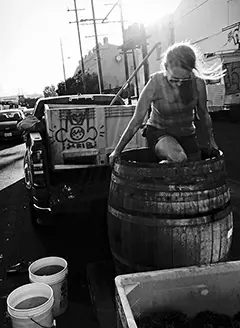
We drive back to the winery. As a consequence of the pandemic, we have what you might call a less formal relationship with our landlord and share the space that had previously been ours. This is another story, which I will tell you another time. For now, you need to know that a production company has taken over much of the neighborhood to shoot the first season of a new show— a kind of Top Chef™ for ace welders. We made all of our wine this year out of doors; our crush pad is what others might consider the building's parking lot. It is dear to us and we feel at home there. But on this day, the production company needs the whole lot, and, what is more, we have tried to give them their own space in relation to Covid, and intend to stay out of parking lot. In anticipation of this, the night before, I staged everything that we would need today on the edge of the lot, just inside the fence. We return from Lone Wolf, I mount the forklift and begin moving puncheons, barrels, and the presses outside. Into the street.
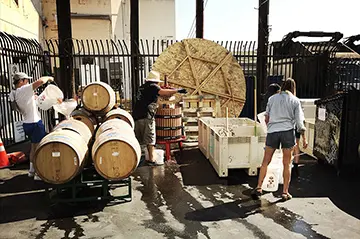
I know that we want to make at least two wines from Lone Wolf. The first is a white wine, from the huge yellow clusters found on the plants that we think are Grenache, and from the less ripe or yellow clusters found on the Mission vines. All of this fruit will come from Pet Cemetery and the periphery. For the white wine, we foot-tread the fruit directly in the half-ton bins, and then immediately bucket it into the presses. The juice that flows out is pink, not white. It goes into two barrels to ferment and then age until Spring.
I am fascinated and excited by the prospect of a white wine from Lone Wolf, but in a certain sense, our most serious work is to make a red wine— a wine that depends on and captures not just the juice but also the skins and seeds and stems. For this, we pitch fork the fruit from the truck into the puncheons, stomp in the puncheons as we fill, and then allow everything to stay together during fermentation. The first harvest, from the center and Pet Cemetery, spends 3 weeks in contact with skins and seeds and stems; the second harvest, from the Wildlands, two weeks. It is not that Wildlands needs or wants less time; it is just that it tastes perfect on the same day that we drain and press the earlier fermentations.
10. TASTING THE NASCENT WINE
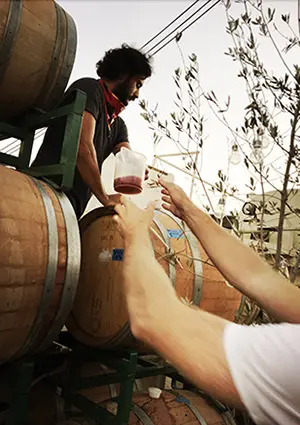
We walk away from the wines for a week, maybe two. Let them settle; start turning into themselves. There are the two barrels of white wine, and then several barrels of reds: a single barrel of Pet Cemetery, two barrels of Wildlands, and a single barrel from the center section.
The whites are excellent: rich, powerful; some of the power clearly comes from tannin. Raj points out that the wine has the color of a wine that the French would call "gris—" not a rosé— but not a white wine either. It is quietly aromatic: very slightly floral and herbal, not as savory as some of our wines, not as marked by oxygen and richness . . . . The acidity is very good; the wines already have length and complexity.
The reds: We taste Pet Cemetery first. It is light in color, nearly pink— but not the pink of rosé. It is clearly a very light-bodied red wine. The nose is pungent: fresh fruit, but also savory elements, herbs, woody things. So not all fruit, but somehow forestral. So different from the wine we made from the vineyard last year. This fits with what we think about the vines in this section: they are mostly, if not all, Grenache, with fewer rampant seedlings— unlike the Mission and its offspring in the rest of the vineyard. A new wine.
Next we taste the two barrels of Wildlands, separately. Each represents a different fermentation, and they differ slightly. Both are tannic, highly structured wines. They have none of the fruit of Pet Cemetery, or perhaps one could say that the fruit is secondary to structure. These wines are forestral too; more so than Pet Cemetery. This will be a red wine much like last year's; reminiscent of alpine Nebbiolo.
Lastly, we taste the barrel from the center section; the same section that gave rise to most of the wine last year. This wine is a darker red, but still very light in body. It is so perfumed that it surges out of the glass. Again, fruit plays a minor role; forestral, herbal, savory. Highly structured, like the Wildlands, but already more complex, longer. A very serious wine; noble, impressive. The essential Lone Wolf.
Our intention is to bottle four wines from Lone Wolf this year: the white, and the three reds from the different sections. This is not necessarily the future for our work with the vineyard, but it seems like a necessary first step, of exploration and learning.
11. THE PEOPLE OF LONE WOLF
The vineyard is a wonder, a wonder of nature, on the edge of some kind of magic. And as much as the vegetative magic of the vineyard itself may depends on the mycorrhizae, the actuality of putting wine into your hands has depended completely on the goodwill, enthusiasm, and tireless energy of some 40 friends. Only volunteers work in this vineyard. Only friends of mine, of this endeavor, of the vineyard, its history, of its future. I cannot thank everyone in the way that they deserve, but we must, after all this cogitation, honor the human side of Lone Wolf.
My father, I am delighted to say, is an ardent supporter of my work in Los Angeles. It is so rewarding to create something that wins his interest and admiration. He has has made this point several times:
The opportunity to work in Lone Wolf is a wonder in itself. Our project makes that wonder possible too. The opportunity to leave the city, to set foot on land with its own inimitable nature, to see the plants, touch them, shape them, see them grow, flower, fruit. This opportunity too is something to honor and give thanks for.
All of this coalesces and becomes concrete in the wine. The wine that we made is the offspring and palpable proof not just of our work, but of our love and devotion. The wine, this wine that already exists, aging in barrels on the edge of Chinatown, wine, makes all of this concrete and shareable.
Lastly, I am so happy to know that we can share this work and its fruit with your— and not just through my words. The wine will go into bottle, and once in bottle, we can put it in your hands. You can have a share of this, and help support this endeavor, by purchasing future cases of our wines here. These future cases will contain at least one bottle of every wine that we make this year (for a total of 12 bottles), including one bottle of every distinct Lone Wolf wine. The participation in the futures will also entitle you to purchase additional bottles of the Lone Wolf wines. Many of you have purchased these futures already, and I can say, with great amazement and gratitude, that your support this far is simply what has allowed us to get Lone Wolf from the vineyard and into barrel. Thank you.
Thank you so much for your attention and interest.
Abe