A Season of Hope and Terror: a report on the 2020 harvest
only Lone Wolf remains
A SEASON OF HOPE AND TERROR
Harvest 2020: we near completion in the Los Angeles Basin
I had wanted to give you an interim report a couple of weeks ago, but the work of harvest has been too furious. And now we are nearly done. It is wonderful, but strange beyond words in so many ways. I hope you will pardon me if I now report somewhat fully to you.
In Napa, it feels like a true Apocalypse. Have you seen photos of the sky? I am not being facile: it looks like the end of the world. And the same particles that color and cloud the sky impede breathing and settle on the precious fruit. The vineyards there are horticultural jewels and are farmed exquisitely. The downside of this is that the careful and precise tuning of the fruit does not prepare the berries to withstand days of air temperatures above 100 degrees: the fruit is collapsing when it should be ripening— and, perhaps worse, it is irretrievably threatened by the aroma of smoke. My friends and colleagues are courageous and resourceful like Odysseus— all of them learning right now how to make the best wines in this terrible time. No one regards it as the end of the world— but the fiercest know that it is the harrowing beginning of a new era.
Months ago, I felt the pandemic impressing a new localism on me, and I embraced it. I am rooted in the sandlands of the South now. I decided that in this year of novel uncertainty, I should concentrate all of my efforts here, and so made no plans ot harvest fruit from the North. All of my thinking this year, and perhaps in the future, will be on the wines of the Los Angeles River Wine Company. And I feel so lucky to be able to say: none of our vineyards have been affected by smoke or even heat. The South holds its own terrors, as you know well— but so far we escape.
It has been such a blessing to work with these unforeseen vineyards— not just a comfort but something much more, much more powerful. Let me now tell you about these vineyards, harvest by harvest, and wine by wine. We begin with Gateway, pictured immediately above.
Gateway
Gateway is one of two abandoned vineyards we worked with this year. We owe our connection with it to a friend who is a Professor of Public Health and loves old vines. He introduced me to it this Winter, and, after months, we met its caretaker and got permission to harvest from it. The owners want to put a hotel on the land and are just waiting for the city council to give them permission. The vineyard was planted around 1905, mostly to Zinfandel and Rose of Peru; part of the original plantings in the Cucamonga Valley, as grape-growing migrated out of a rapidly urbanizing Los Angeles. The vines will vanish when hotel construction can begin. This is most likely the more than hundred year old vineyard's last vintage.
When we got permission to harvest from the vineyard, we sampled it and decided that it was in perfect shape to make a Rosé; I got a crew of volunteers together and we harvested nearly a ton of fruit (mixed Zin and Rose of Peru together) into two pickup trucks in blazing heat and brought it back to the winery for pressing. We worked into the night and made nearly two barrels of superb wine. It is already dry; we will bottle it in December.
Pirate Vineyard
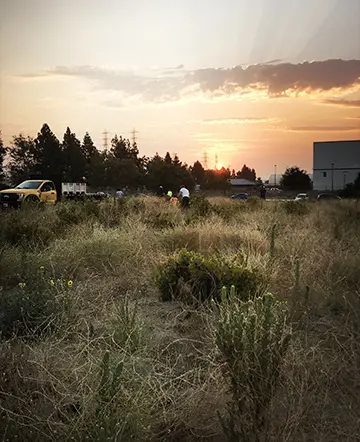
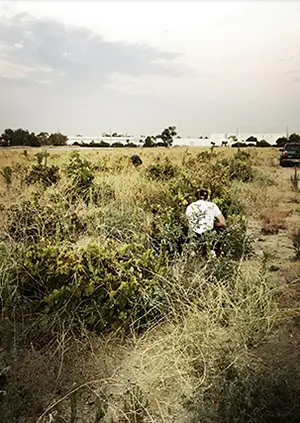
Our second harvest was from another abandoned vineyard; we call it "The Pirate Vineyard." It is pictured to the right and at the top of the email, at dawn on harvest day. This vineyard, planted in the Cucamonga Valley about 1920, was purchased to be ripped out and replaced with a corrugated steel warehouse. The developers are waiting for their permits before they raze the land. The vineyard looks like it had been carefully farmed until a couple of years ago; even without pruning, shoot thinning, mowing, tilling— it was still productive and fruitful this year. I saw it for the first time around the 20th of August, right before the first round of 100 degree days. Our guide told me it was "mostly Zinfandel;" I did not see anything to contradict this, and quickly noticed a lot of ripe and perhaps over-ripe fruit. We made plans to pick it immediately. When we got back in the vineyard a few days later, I realized that it was not predominantly Zinfandel at all, and that the vines harbored lots of unripe fruit down low and inside. Whatever it was, I realized that we had to pick it very carefully. The wine that we made is beautifully aromatic, high in acid, light in color and body. It is like Rossese or Grignolino— red in color, but otherwise a white wine by nature. It was a lesson about charging into these mysterious vineyards.
Maglite
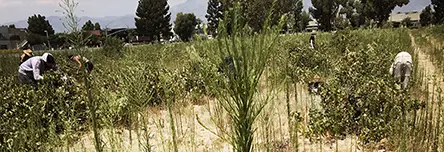
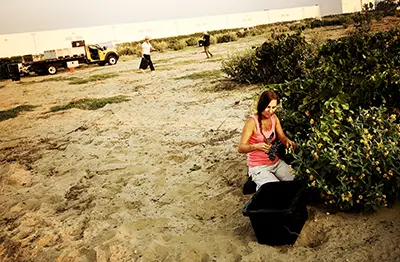
A week of more than 100 degree weather threatened, so we immediately began harvesting our next vineyard. We call this one "Maglite," because it faces this crucial winery tool's corporate headquarters. It is another survivor; surrounded by on all sides by faceless buildings— it is hard to imagine that it was once at the center of thousands of acres of vines. We owe our knowledge of this treasure to a friend from Instagram who had driven past it for years. It took months to make a connection to the owner; we only did so a few days before harvesting it. He has taken good care of the vineyard for years; it is carefully pruned, and its dry, sandy soil is tilled once each Spring to keep the weeds down. You can see in the photo above how different it is from the other two vineyards, and even bears some resemblance to bush vine vineyards all over the world.
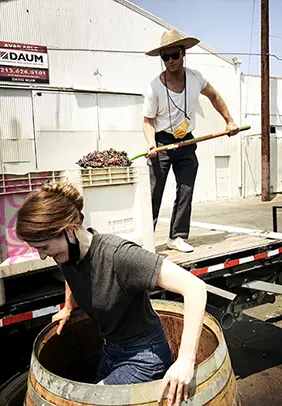
We never knew what fruit Maglite was-- we first saw it in the winter and guessed that it was Mission. Then, this Summer, when you could tell from the leaves and clusters that it was not Mission, we thought: Zinfandel. Even if it did not really look like it-- it was turning red, and it was in Cucamonga. What else could it be? We learned from the owner that it was Grenache and suddenly everything made sense. It immediately put into perspective the Pirate vineyard. The leaves and clusters of Grenache and Zinfandel bear almost no relation to each other: Grenache is round-berried, plump, with rounder, fuller clusters; the leaves are more pie-shaped and less indented. Zin, especially down here, is very small-berried and loose-clustered. Picking the fruit in Maglite made us realize that Pirate was Grenache too, and no doubt part of a large, and not-well recognized, Grenache planting in Cucamonga.
For years, a wine of great inspiration and admiration for me has been Angela Osborne's Grenache made from the nearby Hofer Ranch. It is a revelation in lightness and intensity at once and offers the strongest sign that one can make wines of great subtlety and seriousness from Los Angeles fruit. I now realize that Maglite and Hofer are both expressions of a singular local devotion to Grenache on the Southwestern edge of the Cucamonga Valley. I never expected when we first visited Maglite that it would be a kind of doorway to the excellence of Hofer.
We are making two or three wines this year from Maglite and all of them are excellent. Most exciting is the red: beautiful yet intense. It reminds me very much of Angela's Hofer, but also of the other greatest, and lightest, Grenaches in the world. Who would have guessed that the hot sands east of Los Angeles would make such subtle, graceful, wines?
Very intriguing are the other Maglite wines: we have a Blanc de Noir of Grenache that is pale yellow, high in acid, and fragrant in a way completely different from the red; and a very lightly extracted red, like a Rosé in color, with perhaps the highest acidity of any of the wines.
Gateway Red
We finished Maglite on a Friday morning and raced back to Gateway to sample it-- full of the hope that, in spite of the 100 degree weather, we would be able to find some sound, high-acid fruit to make a red from the vineyard, companion to the Rosé. The Rosé seemed so good, we could not help but see what kind of proper red wine the vineyard would make.
And so we returned on Sunday with the hardiest of crews on the hottest day yet-- it would be well over 100 degrees. There was less fruit than before; the heat was taking its toll. At this point, we were averaging about 5 pounds per vine. I accidentally buried the truck in the vineyard's deep and loose sand, and a splendidly tattooed man (Scythian?) helped us get it out. We worked hard and as fast as we could: 900 pounds by the time the truck was out and prudence decreed that we should flee the sun.
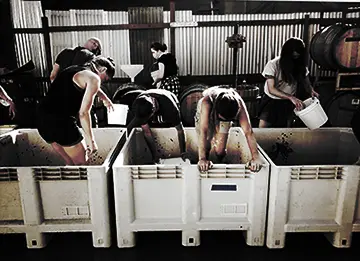
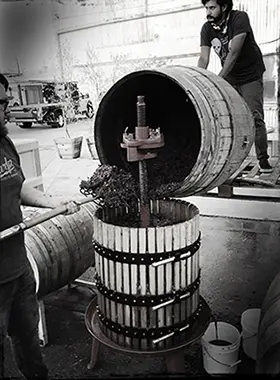
We returned to the winery, filled a puncheon, stomped. The wine fermented quickly in furious heat— but fermented well, cleanly, aromatically. The wine is dry and we have already removed it from the skins and seeds and stems. We have nearly 50 gallons of a very special red wine. Gateway will be gone next year, a hotel. It was important to make this wine.
M.E.P.P.P.
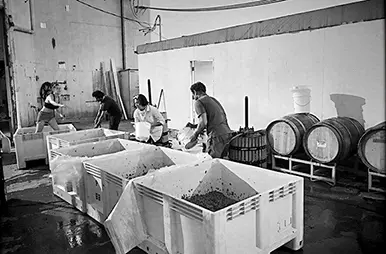
On Monday morning, we rise early, and for the first day in more than a week, do not harvest. We drive our truck down to Temecula to pick up 3.5 tons of Pecorino grown and harvested by our colleagues at the Ponte Winery, in the high desert south of Los Angeles. With this fruit, we will make the 2020 version of our immensely successful 2019 M.E.P.P.P.
Thus, we begin our white harvest.
The drive back from Temecula is long and beset by traffic. We must also stop to pick up some supplies. We reach the winery late, at 5 PM, with only a couple of hours of light left.
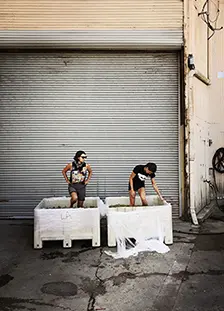
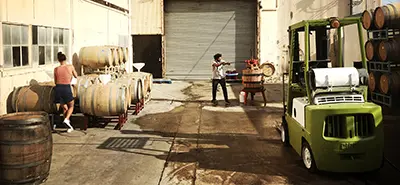
Our equipment at the winery is interesting. As I mentioned in a previous report, the pandemic created a certain disruption in our capital inflow. We are not set up like a regular winery. But we too are endlessly resourceful, and my friends are tireless. We have made all of our wine once again without a pump— we move everything with pitchforks or little buckets. But this time, we have two presses! With the help of your futures purchases (see below), we bought a second, larger press, and picked it up (just in time!) on the way back from Ponte. Both presses are unchanged in design from the Middle Ages, both of them driven by hand.
The Pecorino was quite a task-- using our new team of presses, we pressed 1.5 tons the first night, stomped on 1.0 tons for a quick skin-maceration, and then, the next morning, stomped and pressed the remaining final ton. All of it is now fermenting in barrel, and it all seems really good. Really good. Especially the skin-macerated version.
Raisin City
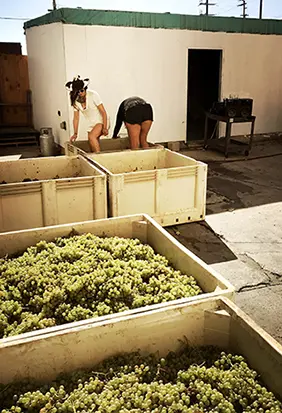
Our second white is Palomino from a very special vineyard in Fresno, in the town of Raisin City. The land is not famous for wine making— its fruit usually has a different destiny. We call the wine "Raisin City" after its surprising place of origin. Like the Pecorino, this is fruit from a vineyard that we worked with last year. The vineyard is Marian Farms, owned and farmed by Gena Nonini. Her grandfather brought cuttings of Palomino over from Europe more than 60 years ago and planted them on their own roots in Fresno. Her father took hundreds of cuttings from his father's vineyard, and planted them on their own roots in a second vineyard in Fresno. This vineyard succumbed to phylloxera, but Gena was determined to keep the heritage of her grandfather's vineyard alive, and so sought out more sandy land (less hospitable to phylloxera) and once again made cuttings and planted them on their own roots. She has one of the oldest biodynamic farms anywhere in the country. Her work is a living lesson to farmers of all kinds around the world, and her fruit is utterly distinctive.
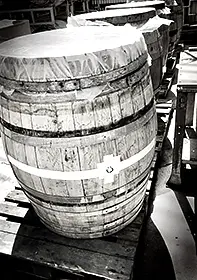
We always skin-ferment part of the wine, and make the rest from juice alone. The puncheon at right holds the skin-fermentation. All of the wine is already dry, and is already showing the quiet nobility of last year's Raisin City. We will drain and press the skins soon and combine both portions into the final blend.
Gena makes wine from the vineyard that she distills into a remarkable biodynamic brandy. Other than that, only one other winery has access to this fruit: our friend and partner Raj Parr bought 10 tens this year to form one of the foundations of his Raj Parr Wines.
Lone Wolf
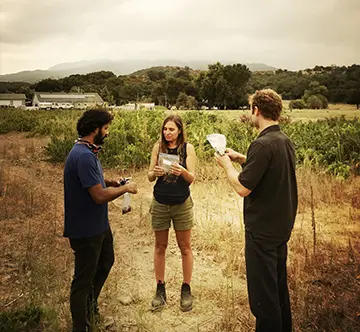
These are the vineyards of the Los Angeles River Wine Company.
All of this year's wines are made. Save one. Lone Wolf remains.
We sampled it yesterday, and it is truly magnificent. The week of 100 degree days burned some leaves and has left some (but only some!) of the plants weakened. But the fruit is unscathed. There are many reasons for this, and I will go into them in a separate report— perhaps as early as tomorrow if I have time. But for now, let me only say that this utterly wild vineyard has resources available to it unknown to a manicured vineyard. It has the invulnerability of the truly feral.
We will begin picking the vineyard Saturday. If you are nearby and want to help, let me know. I am hoping to bring 10 friends each day, and pick the whole vineyard over 2 or 3 days, stretching into the following weekend if necessary. It is easy to pick and maintain social distance, and there is always vigorous air flow in this special precinct. There is a lot of fruit— perhaps 3 times as much as last year. The harvest will be glorious indeed.
Lone Wolf is truly the heart and center of what we are doing.
Winemaking and Hope
Winemaking is always a gesture of deep (nearly supernatural) hope. Making dinner is about tonight-- an act focused on the next few hours. It involves expectation, but not Hope.
Making wine (to say nothing of tending a vineyard) is an act that will only reach fulfillment in the next year or even in the next two decades. It has nothing to do with tonight. It involves expectation and excitement, but, especially in a time as deeply uncertain as this one, it depends utterly on hope.
Our showing up at Lone Wolf on Saturday is an act of reverence to the vineyard and its history; our bringing the fruit home and carefully fermenting it is an expression of our hope for the future.
You can join us in this hope in a material and concrete way. We still need to sell a few more cases of wine to pay for our harvest expenses. We are nearly done and, with your help, have paid for nearly everything-- but there are still a few more barrels to buy, a forklift to repair, and, eventually, Pecorino to pay for. Join us by buying a case of this year's wine now, or by urging a friend to so, and then reading these reports with a deeper sense of intimacy and involvement.
We are so excited for Saturday. I am glad catch you up, let you know what we have been doing. It is all prelude.
Abe