The 2020 Harvest Report. Part 2
Here is a plan to support our mission ⚡⚡⚡
WE HAVE A MISSION
Part 2 of the Harvest 2020 Report
I want to leap into this account. I will skip history for now, how we got here, what we did last year. Know that the point of this email is not just to brief you, but to engender your support. But to understand what this means, you must read on.
It is Friday morning. Harvest began Sunday and we have been up every morning at 5 AM since then. We have already picked two tons of Grenache today, and now we are back at the winery. I had hoped to send this to you Sunday, then Tuesday. Fermentations have begun, and the yeasts will have their demands. But for now, our first focus is the vineyards. They order our lives.
The exigencies of ripeness.
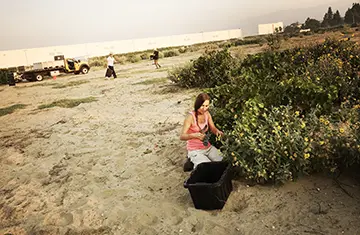
We have immersed ourselves in the last two weeks in the old vine vineyards of the Cucamonga Valley, planted between 1900 and 1920. Almost none survive. Some have been abandoned-- not as real estate, but as vineyards. They will support the construction of anonymous edifices soon; for now, there are still vines rooted in the soil.
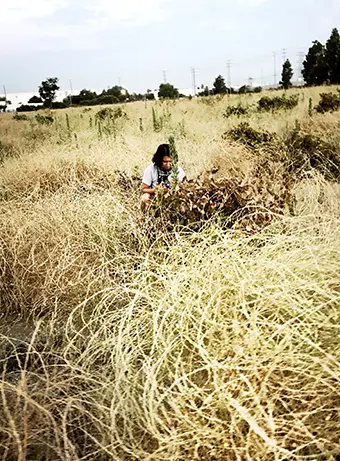
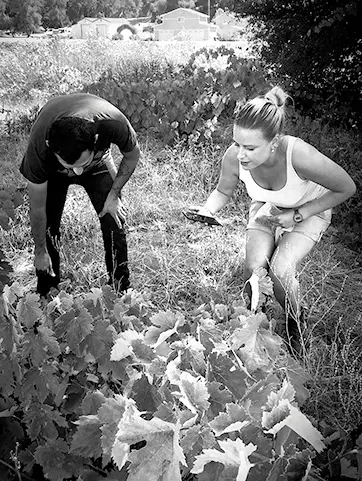
In the photo, Katia, surrounded by tumbleweeds, is searching for clusters in a vineyard traditionally identified as Zinfandel. It is, in fact, about 80% Grenache. We call this the Pirate Vineyard. But it is we who are picking under the Jolly Roger in this vineyard. The vines, at least 100 years old, have new owners, who care nothing about the vines and fruit; they will rip out and destroy the vineyard this Fall.
It is, after all, a time of widespread devastation and destruction.
When I step back just a little in my mind, the world feels Medieval and poised on the edge not of a Modern future, but of a dark tar pit; sometimes, I feel like I play a supporting role in a Technicolor remake of Bergman's "Seventh Seal."
Friends' vineyards are burning in Napa. Other friends have left their homes in the path of conflagration, under evacuation orders.
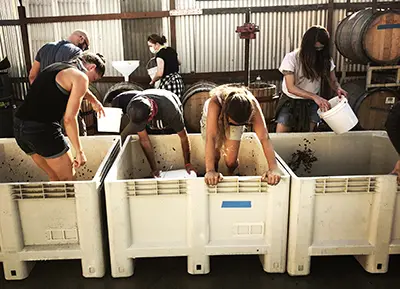
Yet we toil down here assiduously, and joyfully celebrate the fruit of our labor: in a land of earthquakes and hillside infernos, things are somehow calm for us. We can can count vines and bins, estimate fruit yields, worry about where we are going to put that extra Grenache. This limit to our worry is a gift to treasure.
All is not easy here. The winery, the winery that I had imagined and had begun to build, was in many ways also a restaurant, a club, an "events space." I had fallen in love with a place on the east side of the city with magical light inside and out, and had committed triumphantly to a lease that only made sense if we had a couple of hundred guests per week. A winery-- dedicated to very special vineyards, but a winery whose urban location was funded by not simply or directly by its wine, but by its visitors.
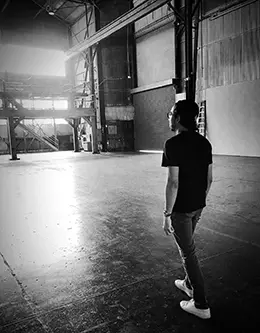
It was late February; we had hoped to open the winery on May 31, and I could not wait finally to receive guests in a formal and public way. We had made wine, but that was only half our work. The other half was a promising Sun about to rise above the horizon.
And then in early March, the toll of the pandemic started to become clear. I have 50 or 100 friends who own or work in bars and restaurants. It used to be my world. I do not need to explain to you the dread that we all felt. We began to realize that any guest experience that we had imagined was banished for years-- and that any business plan that depended on easy and open hospitality, on eager visitors lined up to get in, on carefully curated private spaces-- all such business plans were null and void, vacant-- historical documents merely memorializing the innocent thinking of another era.
Like shipwrecked fishermen suddenly awash in a huge and unknowable sea, we all focused our minds on simply staying afloat. Heads above water.
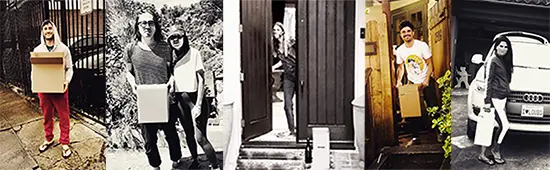
Bars have become retailers; a dear friend, who, for 20 years ran some of the best, most inventive, restaurants in Los Angeles, is managing a food truck. Takeout is everything, but even that is not the deep truth. The axis of our world is now delivery; delivery is the key to everything. Not just convenience for the buyer, but connection. Even at a distance. I now know 100 of my customers who previously were names at best. I know where Kurt lives, and where he used to go to the office. Don't deliver there; bring the wine to his home. I have had a hard time getting Justin his 6 bottles promptly, but at least I know what he would like to drink. I have seen a magical alley in Venice; I have brought dumplings home from San Diego County and a bottle of Antica Terra from Palos Verdes. Gifts from people grateful for our visit. The winery could have gone out of business without the possibility of hospitality, without the opportunity to bring in guests, but it has hung on, fueled by a wine club that sends bottles to peoples' homes every month.
But I am not writing you to promote this wine club. I have something much more serious and daring to discuss.
The winery as I had imagined it was expensive. It required investors. I was about to begin another round of capital raising, the final one envisioned, when the pandemic hit. It did not feel like the right time to seek investors. In a winery.
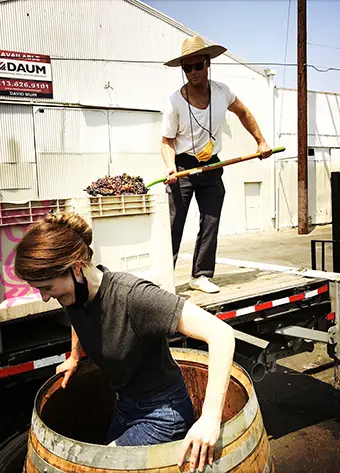
But our lease was monumental (one could use other words to give a sense of its burden). I am delighted and grateful to report that our landlord understood everything: in this new world, without guests, we would not be able to afford this space. So we have renegotiated the lease, with the utmost collegiality, and have moved our winemaking outside. We have surrendered, for now, the glorious indoor space. Our winemaking could not now be more simple, ingenuous, and most importantly: it could not be more more immediate. We could not be closer to the wine.
Just like last year, we don't even have a pump.
The wine club is enough to keep the business alive-- we are selling library wines, as some of you know. But making new wine, even without a fancy location, even without a pump, is very expensive. The subscriptions to the wine club will not cover it. (It's kind of like discovering that you can keep your restaurant open by doing takeout, but then discovering that you need to pay for a year's worth of food and labor up front!)
So, this is how we are going to fund this year's harvest: we are going to sell wine.
This year's wine.
The wine that we are making right now. Think of it like a Tock payment, where you pay for the special dinner when you make the reservation. Think of it as futures if you must, but futures are an investment, and this is something else. . . . It is patronage-- you are supporting something that is clearly now an arts project, an archeological endeavor dedicated to uncovering lost treasures-- but one that will produce not just a report or an exhibit, but something you can literally ingest. It is an investment-- but in future pleasure.
You may go here to buy the wine of the 2020 vintage right now, and thereby fund our harvest.
If you purchase the wine now, you will receive it in the first week of April 2021. We will bottle, as we did last year, toward the end of March, and begin shipping immediately. If you live within driving distance, or want meet us part way, we will put the wine (metaphorically) in your hands ourselves.
12 bottles. Eleven wines. We have not even mentioned Lone Wolf. You will get two bottles.
This is a wild plan. But it feels perfect to me for these terrible times. Meet terror with boldness and the lovely hope that is necessary for all winemaking: in a few months, we will have something precious to drink, whose mere presence can bring joy.
Thanks so much, as always.
Abe
PS: I am going to give a zoom harvest report this evening at 6 PDT. Register here; I will be delighted to discuss this program. It is, after all, essential to harvest.