The 2020 Pre-Harvest Report. Part 1.
We begin picking 100 year old Zin on Sunday! ⚡⚡⚡
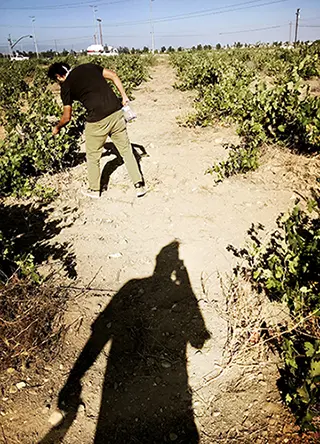
IT IS BEGINNING!
Harvest 2020 Report— Part 1
I cannot believe it. We will begin harvesting on Sunday.
I feel so incredibly lucky to be here, to be able to say this. It is such a terrible and terrifying time. So much is uncertain for all of us. The path of the vines has been a comfort all Spring, all Summer. They continue on their own, especially in the magnificent and utterly autonomous Lone Wolf— buds bursting, shoots growing, fruit forming, and now ripening— all on their own, blissfully independent of human care— and cares.
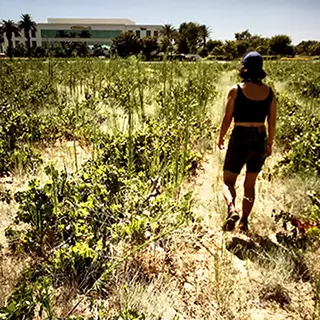
I will have more to say about this in the next few days, in my second pre-harvest report— the impact of the pandemic on our winemaking and the winery itself. For now, today, I am going to concentrate only on the vineyards that we began visiting a week ago, and what we saw and tasted there. I had to take a break in composing this to return to Cucamonga and see new vineyards today. For now— let's return to a week ago:
We began the day just East of the LA River and got amazing quesadillas for breakfast. Our focus this day was the Cucamonga valley, home of the incomparable Lopez vineyard. But first, we were finally going to make authorized visits to two other Cucamonga vineyards. Both were survivors of the original Secondo Guasti plantings, from around 1900. One was abandoned, the other carefully but anonymously farmed; both pointed out to us by followers on Instagram. We had visited both vineyards for the first time in the dead of winter, before bud-break. One had not been pruned probably since 2017 or 2018; the other was well-pruned and the fine, sandy, soil looked like it had been cross-cultivated regularly. The abandoned vineyard was known to local home winemakers and was called "Gateway." This was our first stop.
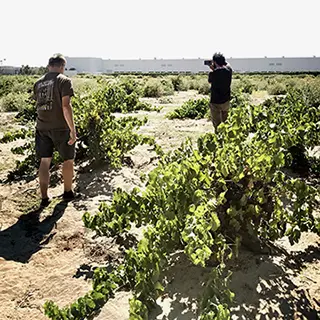
Our guide is George Walker, both a historian and custodian of the vines. He has written a careful book on the history of winemaking in Cucamonga. It tells a remarkable and almost unbelievable story of thousands of acres of vines and millions of gallons of wine— less than an hour east of Los Angeles. Except for Lopez, there is almost nothing left; small survivors surrounded by recent developments that could be found in any American city, anywhere . . . .
We walk the vineyard; wading through tall, thorny weeds once we get close to the plants (I will come back to this phenomenon later). We see stretches of more or less vigor, but all of the plants are at least pretty healthy. George points out that there is Zinfandel— pretty easy to recognize, and with the appearance of Zin common to this area: small berries of uneven size, small, loose clusters; and Rose of Peru, a heritage cultivar we are fascinated with: also small berried and but even looser, but with longer, more conical clusters.
Both types of vines display fruit that is nearly fully ripened. The Zinfandel, especially: purple, sweet. No traces of woodiness or vegetal characteristics; instead, freshness, good acidity, deep flavors. So exciting. We could pick it the next day and make good rosé.
George says we can come in whenever we want. We tell him that we would like a ton, maybe two. I begin making plans . . . .
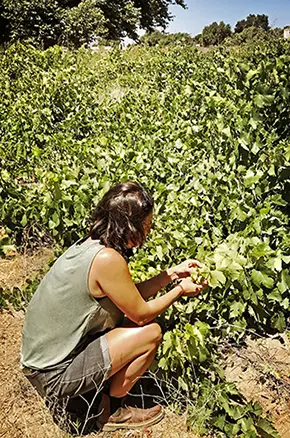
We go next to the carefully farmed vineyard; we call it "Maglite," (pictured above with George) because that company's corporate headquarters borders the north side of the vineyard. All of these noble survivors are surrounded by the unlasting architecture of big box stores, nameless warehouses, and indistinguishable office complexes.
George tells us that Mario di Carlo owns and farms the vineyard; his family planted it before Prohibition. The clusters are rounder, more tight; the berries bigger. We had thought that the vineyard was Mission, but clearly not. It is Grenache noir. It is still ripening. George gives me Mario's phone number. We are very excited.
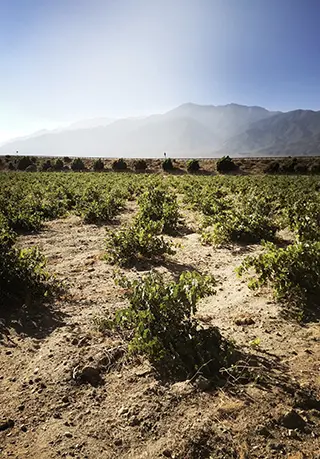
Next we part from George and our friend Stephen and go further east to Lopez. Lopez was planted in 1918 as a "packing vineyard"— to supply grapes, packed in 30 pound boxes, to home winemakers on the East Coast during Prohibition. The vineyard is preserved by the Galleano family, who have farmed it organically for years, and for whom it forms the foundation of their winemaking. The vines are nearly bonsais, never irrigated, thriving in perfect balance. They look like they could live another hundred years— if somehow they could survive the insatiable maw of subdivision. (The photo at the top of the email is Lopez too, looking East. You can see the difference between a vineyard that is tended somewhat and a wild one by the ground cover.)
We made a great, nearly meaty Rosé from it last year, and a beautiful, dark Zin, with the lightness of Old School Chianti. This fruit is ready too; we will pick it as soon as we can.
Let me emphasize that this beautiful landscape, with the San Gabriels on the horizon, is less than an hour's drive from our starting point in Los Angeles this morning.
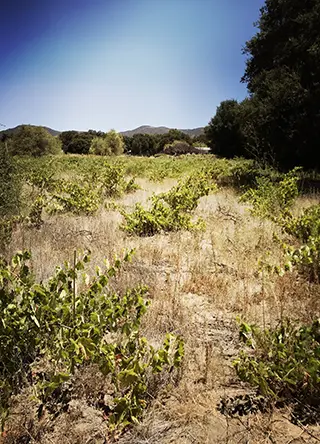
We stop for a late lunch of 14" pizza slices and cold beer in a parking lot. Then south and east, deep into Riveride county, to the edge of the Temecula growing region. Lone Wolf. A vineyard planted sometime around 1900 on a Native American reservation, and abandoned, about 65 years ago. Three oaks interrupt the vineyard; the owner remembers when they were saplings. The vineyard has never been tilled in his memory; there are vines that have been pruned on and off for the last few years and don't look so different from 100 year-old vines all over the world— and then there are vines that are nothing like anything anyone I know has ever seen. Vines that have been allowed to grow wild for 3 human generations.
They form sprawling, tangled, masses, without trunks, without centers, and sometimes even without definite peripheries. They are incredibly healthy and vigorous; most of them are bearing a fair amount of fruit: small, loose clusters, with small berries, intense in flavor and aroma, tannic, but not harsh. They give the lie to the whole syndrome of cultivation-- but this is a complicated and difficult topic. Let me add only this now: late this Spring, we notice the following phenomenon first in Lone Wolf, and then later in other vineyards:
The conditions in Lone Wolf are so dry and inhospitable that on one side of the vineyard, there is no wild growth of anything. No grasses, no weeds. Just bare, sandy, ground. On the other hand, growing up right around the vines, there is beautiful rye grass and at least two or three other vigorous cohabitants. But as soon as you get outside of the circumference of any vine or cluster of vines, the wild growth stops and the empty sand resumes. In the moister, central, section of the vineyard, we see the same phenomenon in a less stark, more attenuated form. The roots of the vines, rather than requiring the solitude of monoculture, enhance, support, engender biodiversity and vegetative growth. My guess is that it begins at the fungal and bacterial level in the soil: that the sphere of the roots (the "rhizosphere") has a richer and more diverse microbial ecology than than the surrounding bare ground does, and that this richness and complexity leads to more and more life-- no doubt in symbiosis rather than in competition. I will return to this topic in a zoom session with my dear colleagues Nate Ready and Pascaline Lepeltier. (Thus in Maglite, the annoying weeds are at their worst closest to the vines; not in the perimeter cleared a few years ago for construction.)
Back to the immediate concerns of winemaking. We learned a lot about the vineyard on this trip. The experience of Grenache in Maglite confirmed an insight of Raj Parr's during pruning at Lone Wolf: there is Grenache in the vineyard; some of it interplanted with Mission, some grouped together on its own. The clusters are completely different in size and shape, and in general even the trunks and arms are different. There might even be a lot of Grenache. We are very excited. There is some kind perfect synergy imaginable between these two varieties: both light in color and in body, but Mission, fiercely tannic and Grenache almost slack in its softness. We made a truly beautiful and bewitching wine last year— and for all of our expectations of making some kind of light whitish wine from Mission, the wine that we made was more like Alpine Nebbiolo than anything else in the world: perfumed, light in color and body, but intense and nearly cutting in its delineation. A very precise wine. A revelation from this wild vineyard.
These are the vineyards of the Los Angeles River Wine Company. I have several more to tell you about, including a biodynamic Palomino vineyard in Fresno, and one completely abandoned Pirate vineyard in Cucamonga, visited for the first time today and destined to be ripped out before we finish harvest elsewhere. This is clearly a kind of archaeological project we are engaged in, but also a very serious exploration of the present of certain places and possibilities, esoteric and ingenuous at once. Just knowing and telling you about these vineyards is doing some kind of good work; but making wine from them feels truly substantial and worthwhile.
I will let you know in the next couple of days what more you can do to be part of this project. Please stay on the lookout for the next installment.
Abe
PS: I am going to take advantage of our new habits in this strange time. A week from today, in the middle of harvest, I am going to offer you a live zoom harvest report! Friday 8/21 at 6 PM PDT/9 PM EDT (Sorry #teamlondon!). Please go here to register. I really look forward to this.